






Harvard Admissions Reality Checker
Select your four A-Level grades below to see how they compare with typical Harvard applicants and discover your best next steps.
Profile Comparison
| Metric | Typical Harvard Profile | Your Profile |
|---|---|---|
| A-Levels | A*A*A*A / A*A*AA | A*A*A*A |
| Estimated GPA | 3.9 - 4.0 | 4.0 |
| Class Rank Expectation | Top 1% | Top 1% |
| Academic Competitiveness | Exceptional | Exceptional |
You Are in the Competitive Range
Your grades meet the typical academic baseline for Harvard consideration. However, remember that admitted students also have extraordinary extracurricular achievements, compelling essays, and strong recommendations.
The "Hook" Factor
Even with strong grades, exceptional achievements can significantly boost your application. Do you have any of these?
National or international competition experience, recruited by a coach
Published research, international olympiad medals, significant patents
Founded organization with national impact, significant community transformation
Recommended Next Steps
- Apply to a balanced list including reach, match, and safety schools
- Invest time in crafting authentic, compelling personal essays
- Secure strong letters of recommendation from teachers who know you well
- Consider taking SAT/ACT if scores would strengthen your profile (1500+ SAT)
You’ve just opened your A-level results. You were aiming for four A*s, but reality hit hard: you have four solid B’s. Your heart sinks. You think of Harvard University, a prestigious Ivy League institution in Cambridge, Massachusetts. Is it over? Can you still get into Harvard with 4 B’s?
The short answer is no. Not based on grades alone. In fact, if your application relied solely on those B’s, you wouldn’t even pass the initial screening at most top-tier US universities. But here is the twist that catches many students off guard: US admissions are not like UK UCAS applications. It’s not just about hitting a grade threshold. It’s a holistic puzzle.
While four B’s make acceptance statistically near-impossible, understanding *why* helps you decide your next move. Maybe you pivot to a different strategy, or maybe you realize that a "safe" school could offer a better experience than chasing a dream that isn't there. Let’s break down how American admissions actually work and what your options really are.
How Harvard Actually Reviews Applications
To understand why four B’s are a dealbreaker, you need to see inside the black box of Holistic Admissions, an evaluation method considering grades, essays, recommendations, and extracurriculars together. Unlike the UK system, where an offer is conditional on specific grades (e.g., AAA), US schools look at the whole person.
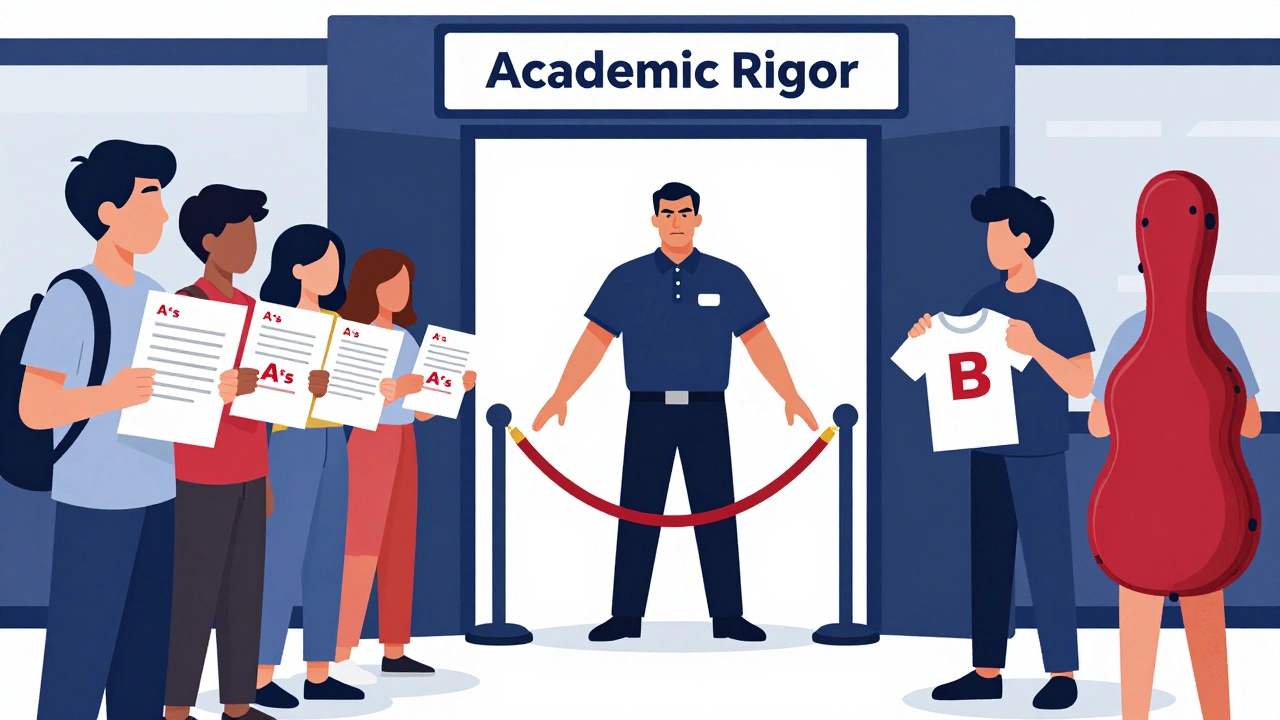
However, "holistic" doesn’t mean "grades don’t matter." On the contrary, academic rigor is the baseline filter. If you don’t meet the academic standard, they stop reading. They don’t care about your essay, your violin skills, or your charity work if they doubt you can handle the coursework.
For international students, especially those from the UK, Harvard expects top marks. We aren’t talking about "good" marks. We are talking about exceptional ones. Here is the data:
- Accepted Students' GPA: The average GPA for admitted students is around 3.9 to 4.0 on a 4.0 scale.
- A-Level Expectations: While Harvard doesn’t publish a strict minimum, the typical profile includes A*A*A*A or A*A*AA.
- Class Rank: Most admitted students are in the top 1% of their class.
If you have four B’s, you are likely ranking significantly below this benchmark. In the eyes of an admissions officer, B’s suggest you struggled with the material or didn’t prioritize these subjects enough. Since Harvard’s curriculum is notoriously demanding, they assume you will struggle there too.
| Metric | Typical Range for Top Ivies | Your Profile (4 B's) |
|---|---|---|
| A-Levels | A*A*A*A / A*A*AA | BBBB |
| SAT/ACT (Optional but helpful) | 1500+ SAT / 34+ ACT | Unknown/Lower |
| Class Rank | Top 1-5% | Varies (Likely lower) |
| Rigor of Coursework | Most challenging available | Standard |
This table shows the gap clearly. You are competing against students who have perfect grades *and* world-class achievements. Without the grades, you don’t enter the arena.
The "Hook" Factor: Exceptions to the Rule
Is there any scenario where someone with B’s gets in? Technically, yes. But it requires what admissions officers call a "hook." A hook is something so rare and compelling that it overrides academic weaknesses. These include:
- Olympic-Level Athletics: Are you a recruit for the rowing team? Did you win gold at the Junior Olympics? If the coach wants you, the academics might bend slightly-but only slightly. Even then, B’s are usually too low unless you’re a generational talent.
- Legally Binding Legacy Status: This applies primarily to children of donors or alumni, and even then, the bar is high. For international students, this is virtually non-existent.
- Extraordinary Talent: Have you published groundbreaking research at 17? Won an international science olympiad? Created a startup that made millions? Again, these are outliers.
If you are a regular student with good extracurriculars-like being captain of the debate team or volunteering at a shelter-you do not have a hook. Good extracurriculars are expected at Harvard. They are not exceptions. So, unless you are an elite athlete or prodigy, four B’s remain a hard stop.
Why US Universities Think Differently Than UK Ones
Many students coming from the Irish or UK education systems misunderstand the US approach. In the UK, UCAS, the Universities and Colleges Admissions Service for England, Wales, and Northern Ireland operates on a points-based system. You get points for grades. You meet the requirement, you get the offer. It’s transactional.
In the US, it’s relational. They want to know who you are. But remember: they only want to know who you are *if* you can prove you are academically capable. Think of it like a club. The bouncer checks your ID first (grades). If you’re underage, he doesn’t care if you’re funny, kind, or talented. You don’t get in. Only after you pass the ID check does he ask about your personality.
This is crucial because it means you cannot "make up" for low grades with a great personal statement. Essays can enhance a strong application; they rarely save a weak one. At Harvard, essays help them choose between two candidates with A*A*A*A. They won’t help you jump from BBBB to A*A*A*A.
What Should You Do Instead?
So, Harvard is effectively off the table. Does that mean your future is ruined? Absolutely not. In fact, pivoting now saves you time, money, and emotional stress. Here is a strategic plan for students with four B’s who want a top-quality education.
1. Target "Match" Schools in the US
There are hundreds of excellent US universities that value B grades much more highly. Look for schools where your GPA puts you in the middle 50% of accepted students. These are your "match" schools. Examples might include:
- State Universities: Many state schools have strong programs in engineering, business, and sciences. They are less selective than Ivies but offer great ROI.
- Liberal Arts Colleges: Some smaller colleges focus on community and teaching quality rather than prestige rankings. They often have higher acceptance rates for students with solid B’s.
- International-Friendly Programs: Some universities have specific tracks for international students with support services tailored to cultural transitions.
2. Consider a Gap Year or Foundation Year
If you are determined to improve your academic profile, consider taking a year off. Use this time to retake exams, take online courses (like Coursera or edX) to demonstrate current knowledge, or gain significant work experience. A strong foundation year result can sometimes override previous A-levels, though this is more common in the UK system.
3. Excel in Your Chosen Major
Once you are in university, your past grades matter less. Graduate schools and employers care about your recent performance. If you go to a reputable mid-tier university and graduate with honors, your undergraduate brand becomes irrelevant. Focus on building a network, getting internships, and maintaining a high GPA in college.

Common Misconceptions About Admissions
Let’s clear up some myths that circulate on social media.
Myth 1: "If I write a brilliant essay, they’ll overlook my grades."
False. Essays are tie-breakers, not lifelines. They show voice and character, not intellectual capacity to handle calculus or macroeconomics.
Myth 2: "Harvard has a secret quota for international students."
False. International acceptance rates are often lower than domestic ones because resources are limited. Competition is fiercer, not easier.
Myth 3: "B’s are fine if I took easy subjects."
Dangerous. Taking "easy" A-levels (like Art or Music) without excelling in them signals a lack of challenge-seeking behavior. Harvard wants to see rigor. If you took STEM subjects and got B’s, it’s viewed as harder work but still insufficient. If you took humanities and got B’s, it’s seen as a lack of depth.
Next Steps for Your Application Strategy
Now that we’ve addressed the Harvard question, let’s look at actionable steps. Don’t waste another month dreaming about Cambridge, MA. Start building a realistic list.
- Research Financial Aid: US education is expensive. Look for schools with generous need-based aid for internationals. Harvard needs-blind for all applicants, but since you’re unlikely to be admitted, look elsewhere. Schools like Amherst, Williams, and MIT also offer strong aid packages.
- Talk to Counselors: Speak to your school counselor. Ask them which US schools have historically accepted students with similar profiles to yours. They have data you don’t.
- Prepare for Standardized Tests: Even if tests are optional, a high SAT score (1500+) can help validate your academic ability despite the B’s. It shows you can perform under pressure.
- Focus on Fit: Find schools where you will thrive, not just where the name sounds impressive. A happy student at a #20 school beats a stressed-out dropout at a #1 school.
Your worth is not defined by a logo on a hoodie. Four B’s are a setback, not a sentence. By adjusting your expectations and targeting the right institutions, you can build a successful career and life. The goal is education, not just a brand name.
Is it impossible to get into Harvard with any B's?
It is extremely difficult. While Harvard occasionally admits students with one or two B's if they have extraordinary hooks (like Olympic sports or genius-level talent), having four B's places you far below the competitive range. The typical admitted student has A*A*A*A or similar.
Do US universities care about A-level subjects?
Yes, they do. They look for rigor. Taking challenging subjects like Math, Physics, or History is preferred over easier options. However, the grade matters more than the subject. An A in Art is better than a B in Physics for admission purposes, though the latter might help if you apply for Engineering.
Can I appeal if I'm rejected due to grades?
No. US universities, including Harvard, do not accept appeals for admissions decisions based on new information or requests for re-review. The decision is final. It is better to focus on other options immediately.
What is a realistic target university for someone with 4 B's?
Realistic targets depend on your location and budget. In the US, consider state universities like University of Texas at Austin (for certain majors), University of Washington, or liberal arts colleges like Colby College. In the UK/Ireland, you might look at mid-tier Russell Group universities or strong regional institutions like University of Limerick or Trinity College Dublin (though TCD is very competitive).
Does Harvard accept transfer students?
Yes, but it is even harder than freshman admission. Harvard accepts fewer than 1% of transfer applicants. You would need to have excelled in your current college program, demonstrating that your earlier B's were an anomaly. This is a long-term strategy, not a quick fix.