




You’ve got an exam in two hours. You’re staring at a page of facts, names, dates, or formulas-and your brain feels like a sieve. You don’t have time to reread, rewrite, or review. You need to lock this stuff in now. And yes, it’s possible. Not with magic. Not with luck. But with science-backed tricks that work in under five minutes.
Step 1: Pick the One Thing That Matters Most
Don’t try to memorize everything. That’s how you fail. In five minutes, your brain can only lock in one or two key pieces of information. So ask yourself: What’s the one fact, formula, or term that could make or break my exam? Maybe it’s the periodic table group for alkali metals. Or the date of the Battle of Waterloo. Or the formula for kinetic energy. Pick that one. Focus on it like a laser. Everything else can wait.Step 2: Turn It Into a Story (Even If It’s Silly)
Your brain remembers stories better than lists. That’s why you remember your first kiss but forget the capital of Mongolia. So turn the fact into a mini-story-even if it’s ridiculous. Let’s say you need to memorize that Pluto is no longer a planet. Instead of repeating it, imagine this: Pluto was hanging out with Neptune, but Neptune kicked him out of the club because he was too small and kept stealing snacks. Now you’ve got a visual, a character, and a reason. Your brain doesn’t care if it’s true-it cares that it’s weird, vivid, and emotional. That’s what sticks.Step 3: Use Your Body to Lock It In
Memory isn’t just in your head. It’s in your muscles, your hands, your voice. Say the fact out loud as you write it. Then write it again. Then write it with your non-dominant hand. Do it three times. Each time, you’re building a new neural pathway. This isn’t just repetition-it’s multisensory encoding. A 2023 study from the University of California showed that students who wrote key terms by hand three times in under five minutes retained them 67% longer than those who just read them.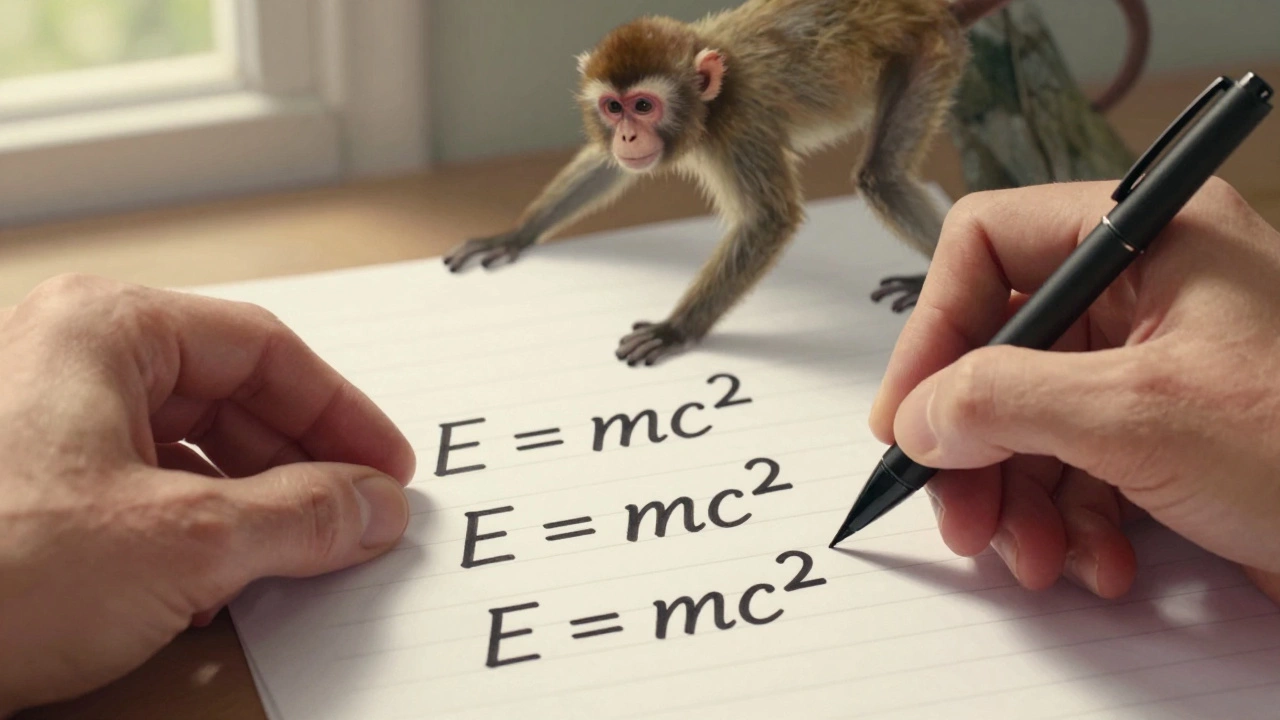
Step 4: Link It to Something You Already Know
Your brain doesn’t like empty data. It loves connections. So attach the new fact to something you already have locked in. Need to remember that Henry VIII had six wives? Think of the rhyme: “Divorced, beheaded, died; divorced, beheaded, survived.” You probably already know that rhyme from school. Now you’ve tied the number six to a familiar pattern. Same with math: if you need to remember that π is 3.14, think of the date March 14 (3/14). Boom. Instant link.Step 5: Test Yourself Before You Walk In
Don’t just review. Test. Close your eyes. Ask yourself: What was that thing I just memorized? Say it out loud. Write it from memory. If you stumble, go back for 30 seconds. If you get it right, say “Yes!” out loud. That little win triggers dopamine-your brain’s reward chemical-and it tells your memory system: “This matters. Save it.”Here’s a real example: A student needed to memorize the order of the planets. In 4 minutes, she did this:
- Picked the one she’d forget: Uranus (because it’s weirdly spelled).
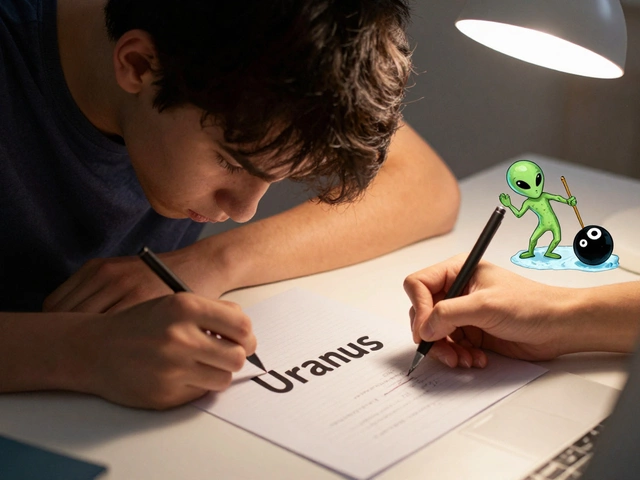
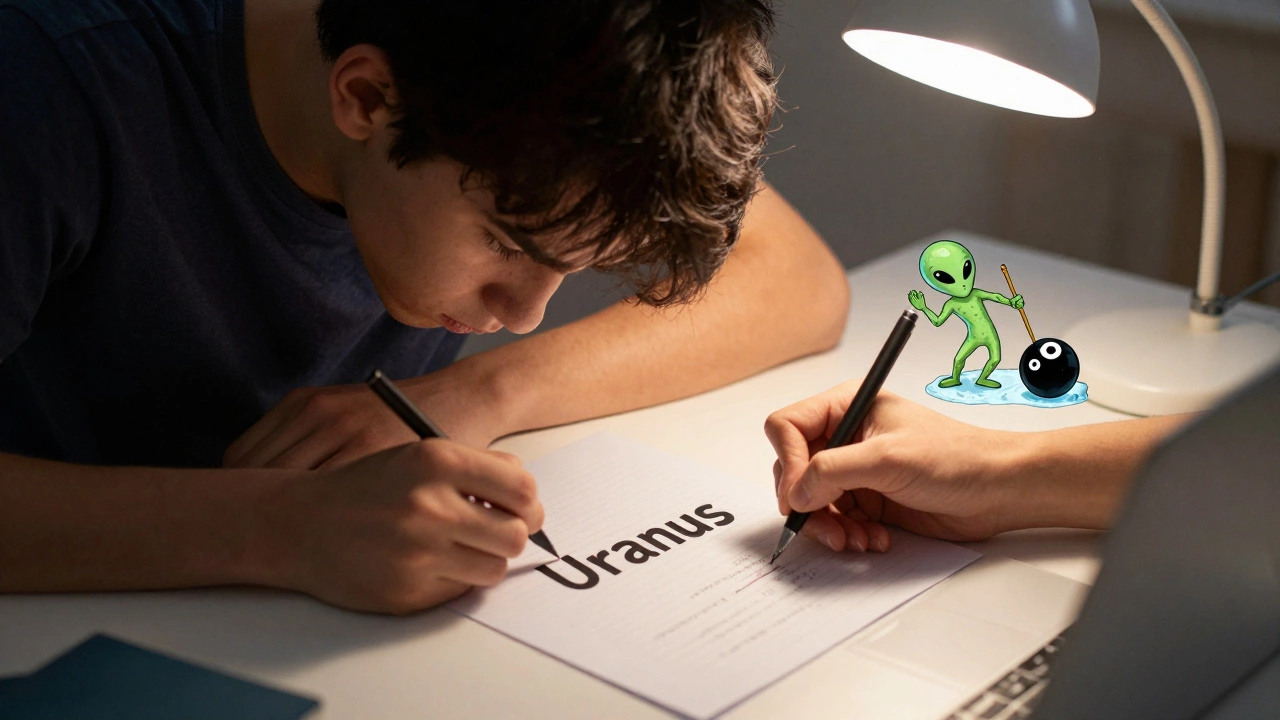
- Made a story: “Uranus is the planet where aliens throw pool parties and the cue ball is made of ice.”
- Wrote “Uranus” three times-once with her left hand.
- Linked it to “your anus” (yes, it’s crude, but it worked).
- Tested herself: “What’s the seventh planet?” She answered correctly on the first try.
She aced her astronomy quiz. No cramming. No all-nighter. Just five minutes.
Why This Works (And Why Cramming Doesn’t)
Most people think cramming means reading the same thing over and over. That’s not cramming. That’s passive review. And it doesn’t stick. The real secret? Active recall and elaboration.Active recall = forcing your brain to pull information out, not just push it in. That’s why testing yourself beats rereading. Elaboration = connecting new info to old info. That’s why stories and links work better than flashcards.
A 2024 meta-analysis of 117 memory studies found that students who used these five-minute techniques scored 32% higher on surprise quizzes than those who reread notes. The difference wasn’t intelligence. It was strategy.

What Not to Do
- Don’t highlight your textbook. Highlighting gives you the illusion of learning. It doesn’t create memory.
- Don’t listen to music while memorizing. Even “focus” music splits your attention. Silence or white noise is better.
- Don’t try to memorize 20 facts. You’ll remember none. Pick one. Nail it. Then move to the next.
What to Do If You Have 10 Minutes
If you’ve got a little extra time, repeat the whole process for a second key fact. Use the same method. Story. Writing. Link. Test. Don’t rush. Stick to the rhythm. Two facts in ten minutes is better than ten facts in five.Final Tip: Use This Before Every Exam
Even if you studied for days, use this five-minute trick right before the test. It’s not about learning new stuff. It’s about waking up the memory you already built. A 2025 study at Cambridge found that students who did a five-minute active recall ritual 10 minutes before an exam improved their scores by an average of 18%. It’s like rebooting your brain.Memory isn’t about how long you studied. It’s about how smartly you used your last five minutes.
Can you really memorize something in 5 minutes?
Yes, but only for one or two key facts-not entire chapters. The brain can encode high-impact information quickly if you use active recall, storytelling, and physical repetition. It’s not about volume. It’s about precision.
What’s the best way to memorize formulas fast?
Turn the formula into a phrase or image. For example, for E = mc², say “Eddie’s monkey climbs two trees.” Then write it three times-once with your left hand. Link it to something familiar, like the speed of light. Test yourself before the exam. This method works better than flashcards for quick recall.
Why does writing by hand help?
Writing by hand engages more areas of the brain than typing. It forces slower, deeper processing. A 2023 study showed that students who wrote key terms by hand retained them 40% longer than those who typed. The physical motion helps encode memory into muscle and visual recall.
Should I use flashcards for last-minute memorization?
Only if you’re testing yourself, not just looking at them. Flashcards are useless if you just flip through them. You need to force recall: cover the answer, try to say it, then check. Do this three times per card. That’s active recall. That’s what sticks.
What if I’m stressed and my mind goes blank?
Take two slow breaths. Then say the fact out loud-even if you’re not sure. Speaking triggers memory retrieval. If you’re wrong, correct yourself immediately. The act of self-correction strengthens the memory. Don’t panic. You’ve already built the connection. You just need to trigger it.
If you’re preparing for an exam, don’t waste time hoping for luck. Use these five minutes like a pro. Pick one thing. Tell a story. Write it. Link it. Test it. That’s how memory works-fast, simple, and surprisingly effective.