





GCSE Revision Effectiveness Calculator
Calculate how much of your revision time is actually effective. The article shows that 4 hours of passive revision is less effective than 2 hours of active recall.
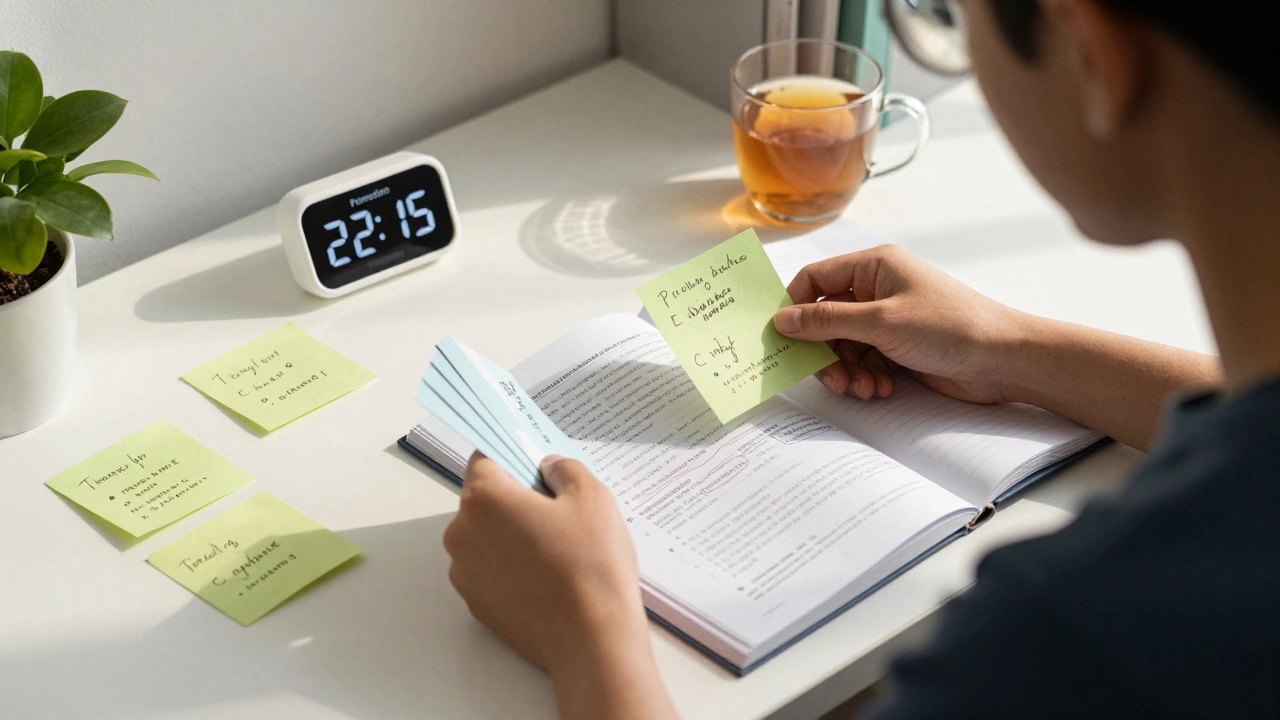
Four hours of revision a day sounds like a lot. You’re sitting at your desk, flashcards spread out, past papers stacked up, maybe even a cup of tea going cold beside you. But is it enough? Or are you just burning out without making real progress? The truth isn’t in the clock-it’s in what you do during those hours.
It’s not about the hours, it’s about the focus
Two students can both do four hours a day. One walks away feeling clear-headed and confident. The other feels drained, confused, and like they’ve done nothing. Why? Because revision isn’t about time spent-it’s about attention given.
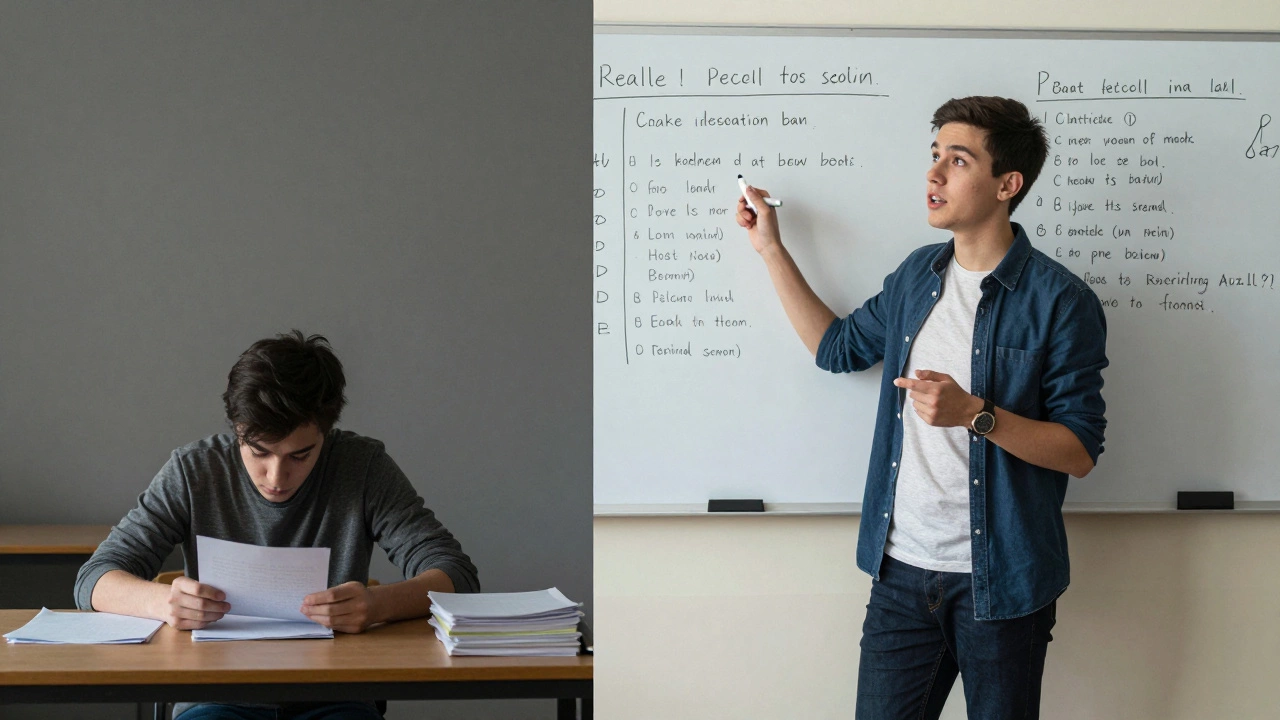
GCSEs test your understanding, not your stamina. If you’re reading the same page for an hour while your mind wanders, you’re wasting time. If you’re actively testing yourself-quizzing on keywords, explaining concepts out loud, correcting mistakes-you’re building real memory. A 2024 study from the Education Endowment Foundation found that students who used active recall (testing themselves) improved exam scores by 30% compared to those who just re-read notes.
Four hours of passive revision? That’s not enough. Four hours of focused, active revision? That’s powerful.
What does effective revision actually look like?
Forget the idea of sitting for four straight hours. Your brain doesn’t work that way. Most people lose focus after 45-60 minutes. The best revision schedules break time into chunks.
Here’s what works for top GCSE scorers:
- 25-minute focused sessions (Pomodoro technique)
- 5-minute breaks to walk, stretch, or grab water
- Every fourth session: 20-minute review of what you learned that day
- End each day with one self-test question per subject
That’s still four hours-but spread out, with rest built in. You’re not just clocking time. You’re training your brain to remember.
And here’s the kicker: active recall and spaced repetition are the two most powerful tools you have. Use them.
For example, don’t just write down the formula for photosynthesis. Ask yourself: What happens if a plant doesn’t get enough light? How does that affect oxygen production? Then wait two days and ask again. That’s spaced repetition. That’s how memories stick.
How many subjects are you revising?
GCSE students typically take 8-10 subjects. If you’re doing four hours a day across ten subjects, that’s 24 minutes per subject. That’s barely enough to cover one topic properly.
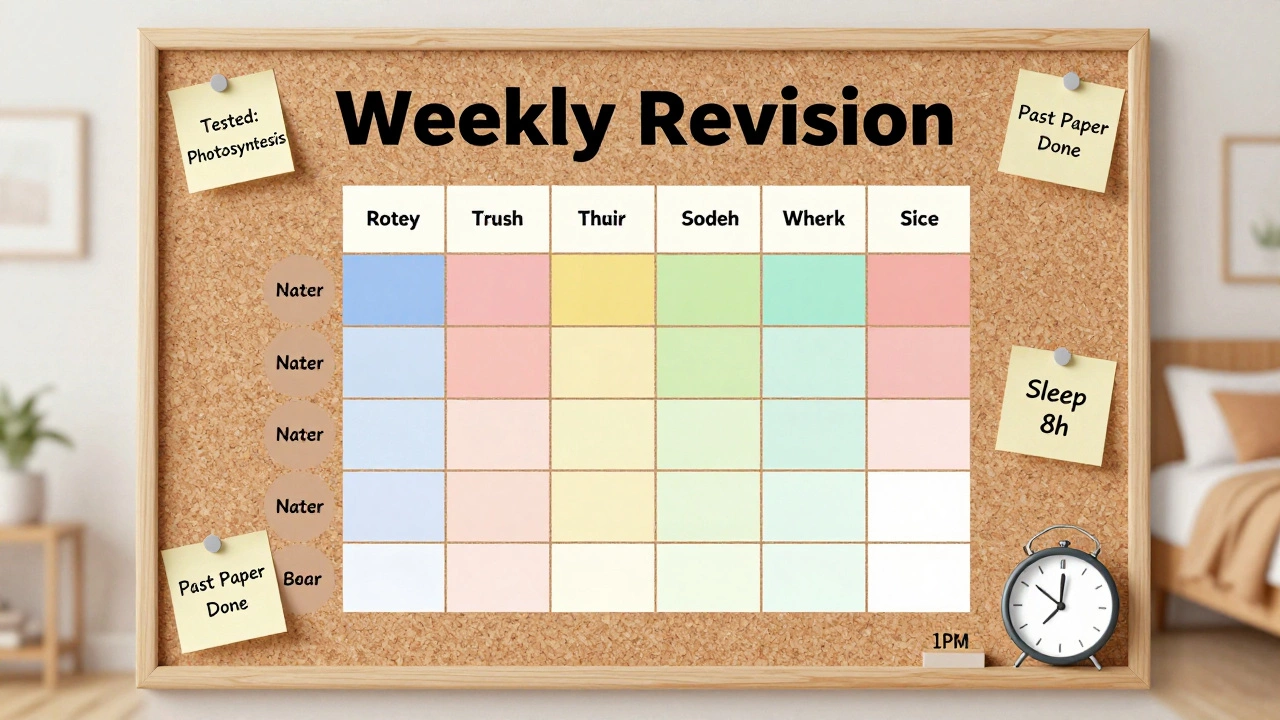
Most students don’t revise everything every day. They rotate. A smart schedule might look like this:
| Day | Subjects | Time per Subject |
|---|---|---|
| Monday | Maths, English Lit | 90 mins each |
| Tuesday | Science (Bio + Chem) | 60 mins each |
| Wednesday | History, Geography | 75 mins each |
| Thursday | Maths, Spanish | 90 mins each |
| Friday | Science (Phys), English Lang | 60 mins each |
| Saturday | Weak areas only | 2 hours total |
| Sunday | Review + past paper | 1 hour |
This gives you 3-4 hours of focused revision daily, with one lighter day and one review day. It’s not about doing everything every day. It’s about hitting everything regularly.
What if you’re behind?
If you’ve left things too late and you’ve got six weeks until exams, four hours a day might be the minimum you need-but only if you’re ruthless about what you study.
Focus on high-yield topics. For example:
- In Maths: algebra, graphs, probability, and ratio questions make up 60% of the exam
- In Biology: cell biology, homeostasis, and inheritance are tested in 7 out of 10 papers
- In English: essay structure and language analysis appear in every paper
Don’t waste time on low-frequency topics. Use exam board past papers to find patterns. If a topic hasn’t come up in the last three years, it’s probably not worth 45 minutes of your day.
What’s the minimum you need to pass?
You don’t need to be perfect. You just need to be consistent.
Students who score a Grade 4 (standard pass) often revise 2-3 hours a day, five days a week. That’s 10-15 hours a week. Four hours a day is 28 hours a week. That’s more than enough if you’re using your time well.
But if you’re doing four hours a day and still feeling lost? You’re probably studying the wrong way. It’s not the quantity-it’s the quality.
Signs you’re revising too little-or too badly
Here are red flags:
- You can’t explain a topic without looking at your notes
- You feel like you’ve read everything but remember nothing
- You avoid past papers because you’re scared of failing them
- You revise the same subject every day and never switch
If any of these sound familiar, you’re not being inefficient-you’re being ineffective.
Try this: At the end of each day, write down one thing you learned. Not one thing you read. One thing you now understand. If you can’t write one, your revision didn’t work.
What about rest and mental health?
Four hours of revision a day leaves room for sleep, meals, family, and downtime. That’s good. But don’t confuse rest with distraction.
Scrolling TikTok for an hour isn’t rest. It’s mental clutter. True rest means moving your body, getting sunlight, talking to someone who isn’t talking about exams.
Students who take proper breaks-walks, music, cooking, even naps-remember more. Their brains consolidate information while they’re not trying to learn. Sleep, especially, is non-negotiable. If you’re pulling all-nighters, you’re hurting your performance.
One student from a school in Birmingham improved her grade from a 5 to an 8 in Chemistry after she started sleeping 8 hours a night and cutting her revision to 3.5 hours. She didn’t study more. She studied smarter.
Final verdict: Is 4 hours enough?
Yes-if you’re focused. No-if you’re distracted.
Four hours a day is more than enough for most GCSE students to get top grades. But only if you’re using active recall, spaced repetition, past papers, and smart scheduling. If you’re just reading and highlighting, you’re wasting your time.
The best revision isn’t the longest. It’s the most intentional.
Start tomorrow by asking yourself: What did I actually learn today? If you can answer that, you’re on track. If you can’t, change your method-not your schedule.
Is 4 hours of revision a day too much for GCSE students?
No, 4 hours isn’t too much if it’s broken into focused sessions with breaks. But if you’re sitting for 4 hours straight without testing yourself, it’s too much wasted time. Quality matters more than quantity. Most top scorers revise 3-4 hours daily, but they use active recall and past papers to make every minute count.
Can I pass GCSEs with only 2 hours of revision a day?
Yes, if you’re studying smart. Many students who score a Grade 4 or 5 revise 2 hours a day, five days a week. The key is consistency and active learning. Don’t just re-read notes-quiz yourself, explain concepts out loud, and use past papers. Two focused hours beat four passive ones.
What’s the best time of day to revise for GCSEs?
There’s no single best time, but most students retain more in the morning or early afternoon when their brain is fresh. Avoid revising right before bed-your brain needs time to process information while you sleep. Try scheduling your hardest subject right after school or breakfast, and save lighter tasks like flashcards for the evening.
Should I revise every subject every day?
No. Trying to cover all 8-10 subjects daily leads to shallow learning. Instead, rotate subjects. Focus on 2-3 per day, and revisit others every 2-3 days using spaced repetition. This keeps your brain engaged and helps long-term memory stick.
How do I know if my revision is working?
Test yourself. If you can answer past paper questions without notes, explain a topic to someone else, or recall key facts after a 3-day gap, your revision is working. If you’re relying on highlighting or rereading, it’s not. Progress isn’t measured by how much you read-it’s measured by how much you remember.
Do I need to revise on weekends?
Not every weekend, but one focused session every 7-10 days helps. Use Saturday or Sunday to review weak areas or do a full past paper under timed conditions. Rest is just as important as revision-burnout lowers your scores more than skipping a day.
Next steps: What to do tomorrow
Don’t wait until tomorrow to change your revision. Start now.
- Take out your next past paper. Don’t read it-try to answer one question without looking at your notes.
- Write down the one thing you struggled with.
- Look up the answer, then explain it out loud to yourself.
- Set a 25-minute timer and repeat with a different topic.
That’s 30 minutes. That’s all you need to start doing revision that actually works. You don’t need more time. You need better methods.