





Adult Learning Principle Calculator
Assess Your Learning Scenario
Relevance Assessment
Your goal shows strong connection to immediate needs. Apply the 'Need to Know' principle by ensuring content directly addresses your specific situation.
Experience Integration
Your background as a [SITUATION] means your experience is a major asset. Leverage your life experience by connecting new information to your existing knowledge.
Problem-Solving Focus
Your format choice of [FORMAT] suggests you need practical application. Implement problem-based learning with real-world scenarios you face daily.
Autonomy Support
As a [SITUATION], you need flexibility. Prioritize self-directed learning with customizable pacing and content selection.
Collaboration Needs
Your learning style indicates [FORMAT] is most effective when combined with peer interaction. Include collaborative elements like group projects or peer feedback.
Feedback Requirements
Your learning goal requires immediate, specific feedback. Build in quick assessment cycles where you get actionable insights within 24 hours.
Self-Directed Learning
Your approach shows strong self-direction potential. Design your learning pathway with clear milestones and resources for independent exploration.
Key Implementation Tip
Combine these principles: Start with your immediate need (e.g., 'land a job in 6 months'), build on your experience, solve real problems, and get timely feedback. This approach increases completion rates by up to 78%.
Adults don’t learn the same way kids do. That’s not just common sense-it’s backed by decades of research. If you’ve ever tried to teach an adult something new, whether it’s how to use a new app, change careers, or pass a certification exam, you’ve probably noticed they need something different from a classroom lecture or flashcards. They want relevance. They want control. They want to know why it matters now.
Adults Need to Know Why They’re Learning
Children often learn because they’re told to. Adults learn because they choose to. If they don’t see the immediate value, they tune out. This is the first and most powerful principle of adult learning theory: need to know.
Think about someone going back to school at 35 to become a nurse. They’re not doing it because it’s ‘good for them’ in some vague future sense. They’re doing it because they want to earn more, help people, or switch from a job that’s burning them out. If a course doesn’t connect to that real-life motivation, it’s just noise. Successful adult education programs start by answering: ‘What’s in it for you?’ before they even mention the syllabus.
Adults Learn Through Experience
Adults come to learning with a full tank of life experience. They’ve worked jobs, raised kids, solved problems, made mistakes. That’s not baggage-it’s their biggest resource.
Traditional education often treats learners as empty vessels. Adult learning flips that. It assumes you already know a lot. The job of the teacher isn’t to fill you up, but to help you connect new information to what you already understand. For example, if you’re teaching a group of warehouse workers how to use a new inventory system, don’t start with software tutorials. Start by asking: ‘What’s the hardest part of tracking stock right now?’ Then show them how the new tool fixes that exact problem. That’s experiential learning in action.
Adults Learn Best When They Can Solve Real Problems
Adults aren’t motivated by abstract theories. They’re motivated by results. They want to walk away from a lesson able to do something they couldn’t do before.
That’s why problem-based learning works so well. Instead of memorizing tax codes, an adult learner in a financial literacy course might be given a real-life scenario: ‘You’ve just gotten a raise. Your rent went up. You have $200 left after bills. How do you budget?’ The learning happens through doing, not listening. Studies from the Center for Adult Learning show that adults retain 75% more when they apply knowledge to practical challenges than when they’re just told facts.
Adults Need to Be in Control of Their Learning
Adults don’t like being told what to do-especially when it comes to learning. They want to choose what they learn, how they learn it, and when.
That’s why flexible pacing matters. A 40-year-old parent studying for a business certificate can’t drop everything to attend a 9 a.m. class. They need asynchronous options, mobile access, self-paced modules. It’s not about convenience-it’s about respect. When learners feel they have agency, engagement spikes. Programs that let adults set their own goals, pick their projects, and choose their pace see completion rates up to 40% higher than rigid, one-size-fits-all formats.

Adults Learn Better When They’re Collaborating
Isolation kills adult motivation. Learning alone feels pointless. Learning with others feels real.
Group discussions, peer feedback, shared projects-these aren’t nice-to-haves. They’re essential. Adults learn from each other’s stories. A veteran teacher sharing how they adapted lessons for remote students helps a new educator more than any textbook. Online forums, cohort-based courses, and peer mentoring aren’t just social features-they’re learning tools. Research from the University of Toronto found that adult learners in collaborative environments were 50% more likely to persist through difficult material than those studying alone.
Adults Need Immediate Feedback and Recognition
Waiting months to find out if you got a question right doesn’t help an adult learner. They need to know they’re on track, right now.
Feedback should be timely, specific, and constructive. It’s not about grades. It’s about progress. Did you fix that spreadsheet error? Great. Here’s how you can do it even faster next time. Did you nail that client presentation? Tell them why it worked. Recognition-whether it’s a simple ‘well done’ or a digital badge-triggers motivation. It tells the learner: ‘You’re not wasting your time. You’re growing.’
Adult Learning Is Self-Directed
Andragogy-the term coined by Malcolm Knowles in the 1970s-is the formal name for adult learning theory. One of its core ideas is self-direction. Adults don’t wait for someone to hand them a curriculum. They look for resources, ask questions, test things out.
Good adult education doesn’t just deliver content. It builds learners’ ability to find, evaluate, and use information on their own. That means teaching them how to spot reliable sources, how to break down complex topics, how to set learning goals. The goal isn’t to make them dependent on a teacher. It’s to make them independent learners for life.
What Doesn’t Work With Adult Learners
Some habits from school just don’t translate. Here’s what fails:
- Memorizing lists without context
- One-size-fits-all deadlines
- Passive lectures with no interaction
- Punishing mistakes instead of using them as learning moments
- Ignoring cultural or life experience differences
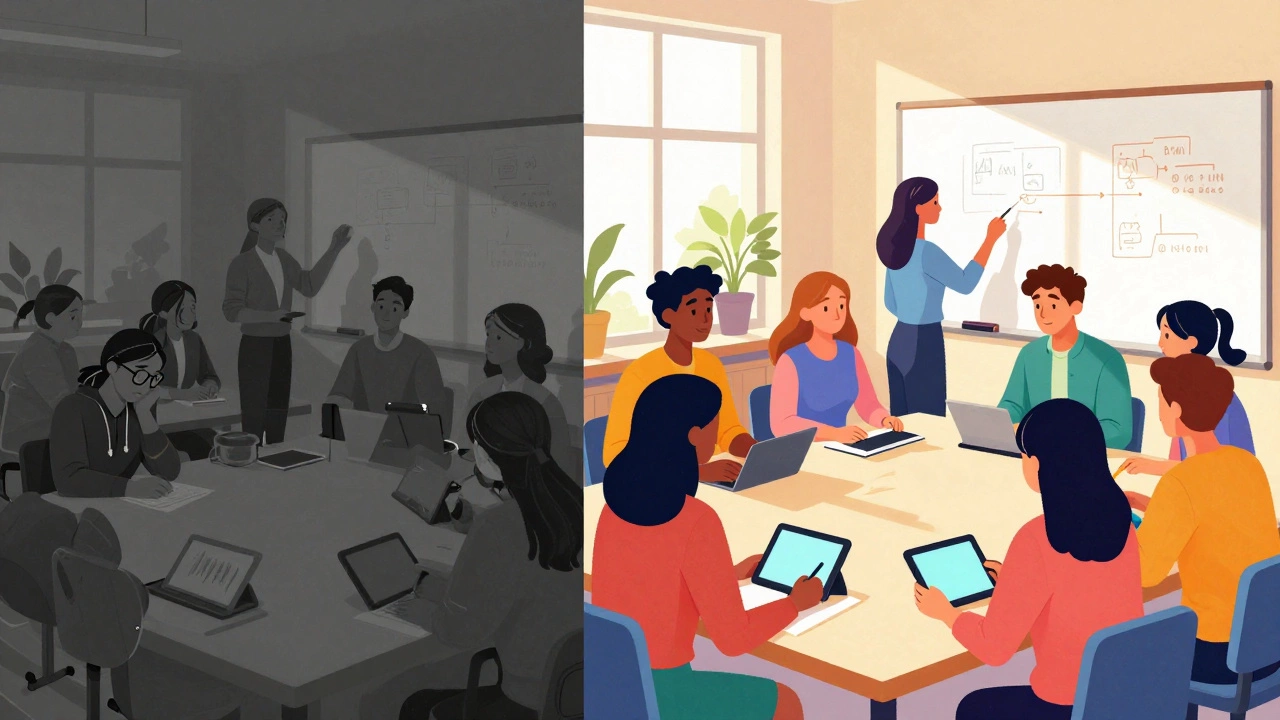
Adults aren’t ‘hard to teach.’ They’re just not wired for outdated methods. When you treat them like children, they disengage. When you treat them like capable, experienced people, they rise to the challenge.
Putting It All Together: A Real-World Example
Imagine a community college offering a free course on digital marketing to unemployed workers. Here’s how they apply the principles:
- Need to know: The first session starts with: ‘Here’s how learning this can help you land a job in 6 months.’
- Experience: Learners share what marketing they’ve already done-posting on Facebook, managing a small business page.
- Problem-solving: They’re given a real local business with low online sales and asked to create a 30-day plan.
- Control: Learners choose which platform to focus on: Instagram, Google Ads, or email.
- Collaboration: Weekly peer reviews of each other’s plans.
- Feedback: Instructors give feedback within 24 hours on submissions.
- Self-direction: Learners build their own portfolio of work to show employers.
That course has a 78% completion rate. Last year, 62% of graduates got jobs in marketing or related fields.
Why This Matters Now
In 2025, the average person changes careers 3 to 4 times in their working life. Skills become outdated faster than ever. Learning isn’t something you do until you’re 22-it’s something you do for life.
Organizations that understand adult learning theory don’t just train employees. They build resilient, adaptable teams. Educators who use these principles don’t just teach-they empower. And learners? They don’t just complete courses. They transform their lives.
What is the difference between pedagogy and andragogy?
Pedagogy is the method of teaching children. It’s teacher-led, content-focused, and often based on external motivation like grades. Andragogy is the method of teaching adults. It’s learner-centered, experience-based, and driven by internal motivation like personal growth or career change. The key difference? Children learn because they have to. Adults learn because they want to.
Can adult learning principles be applied in online courses?
Absolutely-and they should be. Online learning fails when it just dumps videos and PDFs. But when it’s designed around adult principles-like self-paced modules, real-world projects, peer discussions, and timely feedback-it becomes powerful. Platforms like Coursera and LinkedIn Learning succeed because they use these principles, not because of fancy tech.
Why do adults drop out of courses?
The biggest reason? Lack of relevance. If learners don’t see how the material connects to their goals, they lose motivation. Other top reasons: no flexibility in timing, no feedback, no support, and feeling like they’re just ticking boxes. It’s not laziness-it’s poor design.
Do adults learn slower than younger people?
No. Adults may take longer to memorize facts, but they learn deeper and faster when the content is meaningful. Their brain isn’t slower-it’s smarter. They filter out what doesn’t matter. That’s why a 50-year-old can master a new software tool faster than a teenager if it solves a real problem they face every day.
How can managers use adult learning theory in workplace training?
Start by asking employees what skills they need to do their jobs better. Let them choose how they learn-video, workshop, or hands-on practice. Give them real tasks to solve, not quizzes. Offer feedback quickly. Celebrate progress. When training feels like support, not compliance, participation and retention go up dramatically.
Next Steps for Learners and Educators
If you’re an adult learner: Ask yourself before starting any course-‘Does this connect to something I actually care about?’ If the answer is no, walk away. Find something that does.
If you’re designing learning for adults: Stop talking. Start listening. Ask your learners what they need. Build around their lives, not your syllabus. Let them lead. You’ll be surprised how much more they achieve when you treat them like the capable, experienced people they are.