






Support Needs Estimator
Select all scenarios that apply to the individual's current abilities.
Communication & Social Interaction
Daily Living Skills
Safety & Independence
Estimated Support Level
Based on selected criteria--
Please select scenarios from the list to see an estimated support classification.
You might hear the term "learning disability" thrown around in schools, hospitals, or even casual conversation. But when we talk about a severe learning disability, we are entering a very specific area of support that looks nothing like struggling with math homework or dyslexia. It is a life-defining condition that affects how a person understands the world, communicates their needs, and interacts with daily tasks.
If you are a parent, a teacher, or a caregiver trying to navigate this space, the labels can feel overwhelming. What exactly qualifies as "severe"? How does it differ from other conditions? And most importantly, what kind of support should be available?
This guide cuts through the jargon. We will look at the clinical definitions, the real-world signs, and the practical steps for getting the right help in place.
The Clinical Definition: Beyond IQ Scores
To understand what constitutes a severe learning disability, we first need to look at how professionals classify these conditions. In many countries, including the UK and Ireland, the classification relies heavily on Intellectual Disability (also known as Intellectual Developmental Disorder), which is characterized by significant limitations in both intellectual functioning and adaptive behavior.
Clinically, a severe learning disability is typically associated with an IQ score between 20-35 (or 25-40). However, relying solely on a number is misleading. A child with an IQ of 30 might have different strengths than another with the same score. The more critical factor is Adaptive Behavior, which refers to conceptual, social, and practical skills needed for everyday life.
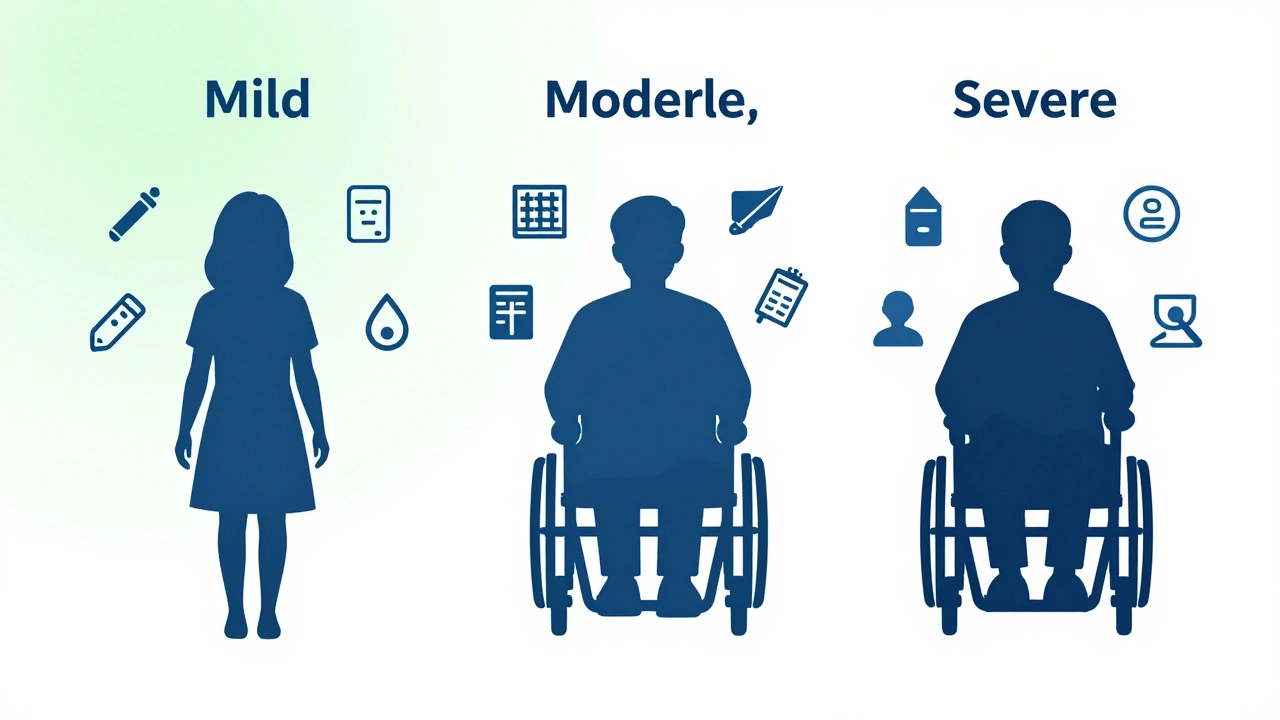
Here is how the severity levels generally break down:
- Mild: IQ 50-70. Individuals can often live independently with some support.
- Moderate: IQ 35-50. Requires substantial support for daily living but can learn basic self-care.
- Severe: IQ 20-35. Requires extensive, ongoing support for all aspects of daily life.
- Profound: IQ below 20. Requires constant, round-the-clock care and supervision.
A severe learning disability means the individual has significant delays in reaching developmental milestones. They may not speak in full sentences, may have limited understanding of cause and effect, and require physical assistance with eating, dressing, and toileting.
Signs and Symptoms in Daily Life
Diagnosis isn't just about a test result; it's about observing how a person functions in the real world. If you are wondering whether someone has a severe learning disability, look for these concrete indicators across different age groups.
In Young Children
Early signs often appear before age three. You might notice that the child:
- Does not crawl, walk, or sit up at expected times.
- Has difficulty making eye contact or responding to their name.
- Shows little interest in toys or interactive play.
- Struggles to feed themselves even with simplified utensils.
In School-Age Children
In an educational setting, the gap between the student and their peers becomes stark. A child with a severe learning disability:
- Cannot read standard text or write legibly.
- Relies on visual aids, gestures, or single words to communicate.
- Needs one-on-one assistance for simple tasks like packing a bag.
- May exhibit behavioral challenges due to frustration or inability to express needs.
In Adults
For adults, the focus shifts to independence and safety. Key characteristics include:
- Inability to manage personal finances without direct oversight.
- Dependence on caregivers for transportation and meal preparation.
- Limited ability to engage in unstructured social interactions.
- Vulnerability to exploitation or abuse due to lack of understanding of social norms.
Common Causes and Associated Conditions
Understanding the root cause can sometimes help in managing associated health issues. Severe learning disabilities are rarely caused by a single factor. Often, they stem from genetic conditions, prenatal complications, or environmental factors.
| Cause Category | Specific Examples | Impact Level |
|---|---|---|
| Genetic Conditions | Down Syndrome, Fragile X Syndrome, Tuberous Sclerosis | High - Often accompanied by physical health issues |
| Prenatal Complications | Maternal alcohol use (Fetal Alcohol Spectrum Disorders), infections (Rubella, CMV), drug exposure | Variable - Can range from moderate to profound |
| Birth Complications | Severe oxygen deprivation (Hypoxic-Ischemic Encephalopathy), extreme prematurity | High - Often linked to cerebral palsy |
| Postnatal Factors | Severe head trauma, meningitis, lead poisoning, prolonged malnutrition | Variable - Depends on extent of brain damage |
It is crucial to note that many individuals with severe learning disabilities also have Co-occurring Conditions. These might include epilepsy, autism spectrum disorder, sensory impairments (blindness or deafness), or mobility issues. This combination is often referred to as Profound and Multiple Learning Disabilities (PMLD) when the support needs are extremely high.
Difference Between Learning Disabilities and Difficulties
One of the biggest sources of confusion is the terminology. In the US, "learning disability" often refers to conditions like dyslexia or ADHD, where intelligence is average or above average. In the UK and Ireland, "learning disability" is the standard term for what Americans call "intellectual disability."
To clarify:
- Learning Difficulty: Affects specific academic skills (reading, writing, math) but does not impact overall intelligence or daily living skills. Example: Dyslexia.
- Learning Disability (Severe): Impacts global cognitive development, communication, and independent living. It is lifelong and requires comprehensive support.
If your child struggles with reading but can tie their shoes, make friends, and understand jokes, they likely have a learning difficulty, not a severe learning disability. If they struggle with all of these areas, the diagnosis is likely more complex.
Support Strategies and Interventions
Living with a severe learning disability doesn't mean a lack of potential. It means the path to growth looks different. The goal is not to "cure" the condition but to maximize quality of life, independence, and happiness.
Communication Methods
Since speech may be limited or absent, alternative communication is vital. Augmentative and Alternative Communication (AAC) systems are widely used. This includes:
- Picture Exchange Communication Systems (PECS).
- Sign language or Makaton.
- Technology-based devices that generate speech from button presses.
Educational Approaches
Inclusive education is a right, but it must be tailored. For students with severe learning disabilities, the curriculum focuses on functional life skills rather than abstract academics. This might involve:
- Learning to recognize danger signs.
- Practicing hygiene routines.
- Developing social cues through role-play.
Small class sizes with specialized teachers and teaching assistants are essential. One-to-one support allows for personalized pacing and immediate feedback.
Therapeutic Support
Many individuals benefit from a multidisciplinary team approach:
- Occupational Therapy: Helps with fine motor skills and daily living tasks.
- Physical Therapy: Addresses mobility and muscle tone issues.
- Speech and Language Therapy: Focuses on communication and swallowing difficulties.

Legal Rights and Advocacy
Knowing your rights is half the battle. In many jurisdictions, laws protect individuals with severe learning disabilities from discrimination and ensure access to services.
In the UK, the Equality Act 2010 protects people from discrimination in education, employment, and healthcare. In Ireland, the Assistive Technology Act and various special education circulars mandate support for students with additional needs.
Parents and caregivers should advocate for:
- An Individualized Education Program (IEP) or Statement of Special Educational Needs.
- Access to respite care to prevent caregiver burnout.
- Community-based adult services for housing and social activities.
Do not accept generic solutions. If a school says they cannot accommodate a student, ask for a formal review. Document everything. Keep records of appointments, emails, and assessments.
Looking Ahead: Future Trends
The field of special needs education is evolving. There is a growing emphasis on neurodiversity, which views learning disabilities not as deficits to be fixed, but as differences to be accommodated. Research into early intervention shows that starting support in infancy can significantly improve outcomes.
Technology is also playing a bigger role. Apps designed for cognitive training and AI-driven communication tools are becoming more accessible. While these won't replace human connection, they offer new ways for individuals to express themselves and engage with the world.
If you are navigating this journey, remember that you are not alone. Connect with local support groups, seek out specialists who understand severe learning disabilities, and focus on small victories. Every step forward, no matter how small, is progress.
Is a severe learning disability the same as autism?
No, they are distinct conditions, though they can co-occur. Autism Spectrum Disorder (ASD) is a developmental disorder affecting social interaction and communication patterns. A severe learning disability affects cognitive functioning and adaptive skills. A person can have autism without a learning disability, and vice versa. However, many individuals with severe learning disabilities also meet the criteria for autism.
Can a severe learning disability be cured?
Currently, there is no cure for severe learning disabilities. They are lifelong conditions. However, with appropriate support, therapy, and education, individuals can learn new skills, improve their quality of life, and achieve greater independence. Early intervention is key to maximizing potential.
What is the difference between PMLD and SLD?
SLD stands for Severe Learning Disability. PMLD stands for Profound and Multiple Learning Disabilities. PMLD indicates a higher level of need, where the individual has a profound intellectual impairment combined with multiple physical, sensory, or health conditions. PMLD individuals require constant, intensive support for all aspects of daily life.
How do I get a diagnosis for my child?
Start by speaking with your pediatrician or GP. They can refer you to a specialist team, which may include developmental pediatricians, psychologists, and speech therapists. The process involves comprehensive assessments of cognitive abilities, adaptive behavior, medical history, and developmental milestones. In some regions, you may need to apply through local education authorities for a formal statement of needs.
What support is available for adults with severe learning disabilities?
Support varies by location but often includes supported living arrangements, day centers for social and recreational activities, vocational training for sheltered workshops, and community nursing care. Families should explore options like respite care, financial benefits (such as disability allowances), and advocacy services to ensure their loved one's rights are protected.