





GCSE Revision Planner
Build Your Revision Schedule
Create a practical, personalized plan to maximize your exam success.
GCSE revision isn’t just about reading notes or highlighting textbooks. It’s the process of actively preparing for your GCSE exams - the big qualifications most students in England, Wales, and Northern Ireland take around age 16. If you’re wondering what GCSE revision really means, you’re not alone. Many students think it’s just repeating what they learned in class. But that’s not enough. Real revision means changing how your brain stores information so you can recall it under pressure.
What Exactly Is GCSE Revision?
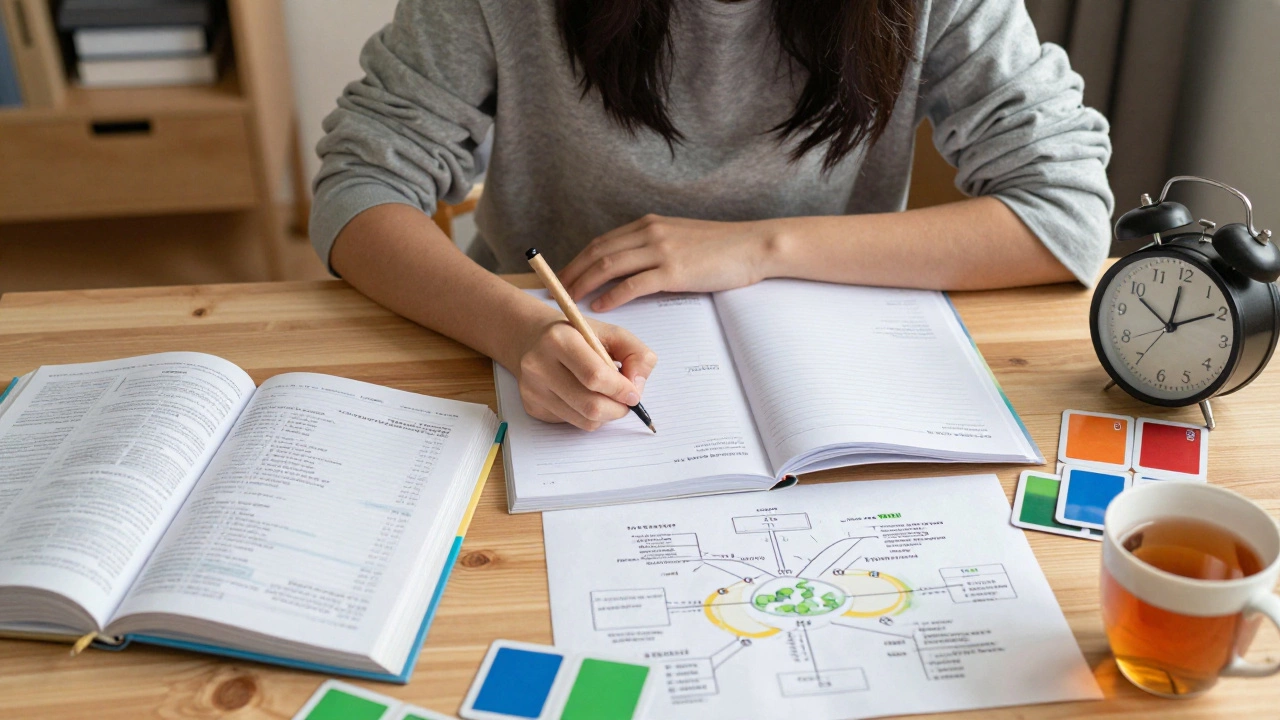
GCSE revision is the structured practice of reviewing, testing, and reinforcing everything you’ve learned across your subjects. It’s not cramming the night before. It’s not rereading your class notes once. It’s building habits that help your brain hold onto facts, formulas, dates, and concepts for the long term. Think of it like training for a sport. You don’t win a race by just thinking about running. You run every day, adjust your form, and test your speed. Revision works the same way.
Each GCSE subject has its own demands. For example, revising History is a subject that requires memorizing events, causes, and consequences, plus the ability to write structured essays. Revising Maths is a subject that demands constant practice with problem-solving, where mistakes reveal gaps in understanding. And Biology is a subject where terminology and processes - like photosynthesis or cell division - must be learned precisely. There’s no one-size-fits-all method.
Why Revision Matters More Than You Think
Teachers don’t just say "revise" because they want you to be busy. They say it because the exam board tests your memory, not your last-minute guesses. The AQA and one of the main exam boards in England, known for its detailed specification documents and Edexcel are two major exam boards that design papers to separate students who’ve truly learned from those who’ve just memorized. If you don’t revise properly, you won’t be able to answer questions that twist the material in new ways.
Studies show that students who revise consistently over weeks, not days, score up to 20% higher on average. That’s not magic. It’s how memory works. Your brain needs repeated exposure to information to move it from short-term to long-term storage. This is called spaced repetition and it’s a learning technique where you review material at increasing intervals to strengthen memory retention.
Common Revision Mistakes (And How to Avoid Them)
Most students make the same mistakes. Here are the top three:
- Just rereading notes. Your brain tricks you into thinking you know something because it looks familiar. But that’s not the same as recalling it from memory. Try closing your notebook and writing down everything you remember.
- Waiting until the last minute. Cramming doesn’t work for GCSEs. The exams cover too much material. Trying to learn everything in two weeks leads to burnout and confusion.
- Only revising what you like. Everyone avoids their weakest subject. But that’s where you gain the most points. If you struggle with Chemistry is a subject where revision must focus on understanding reactions, equations, and practical applications, spend more time on it - not less.
How to Revise Effectively: 5 Proven Methods
Here’s what actually works, based on how students who get top grades study:
- Use past papers. These aren’t practice tests - they’re your blueprint. The exam board repeats question styles. Do at least three full papers for each subject. Time yourself. Mark them honestly.
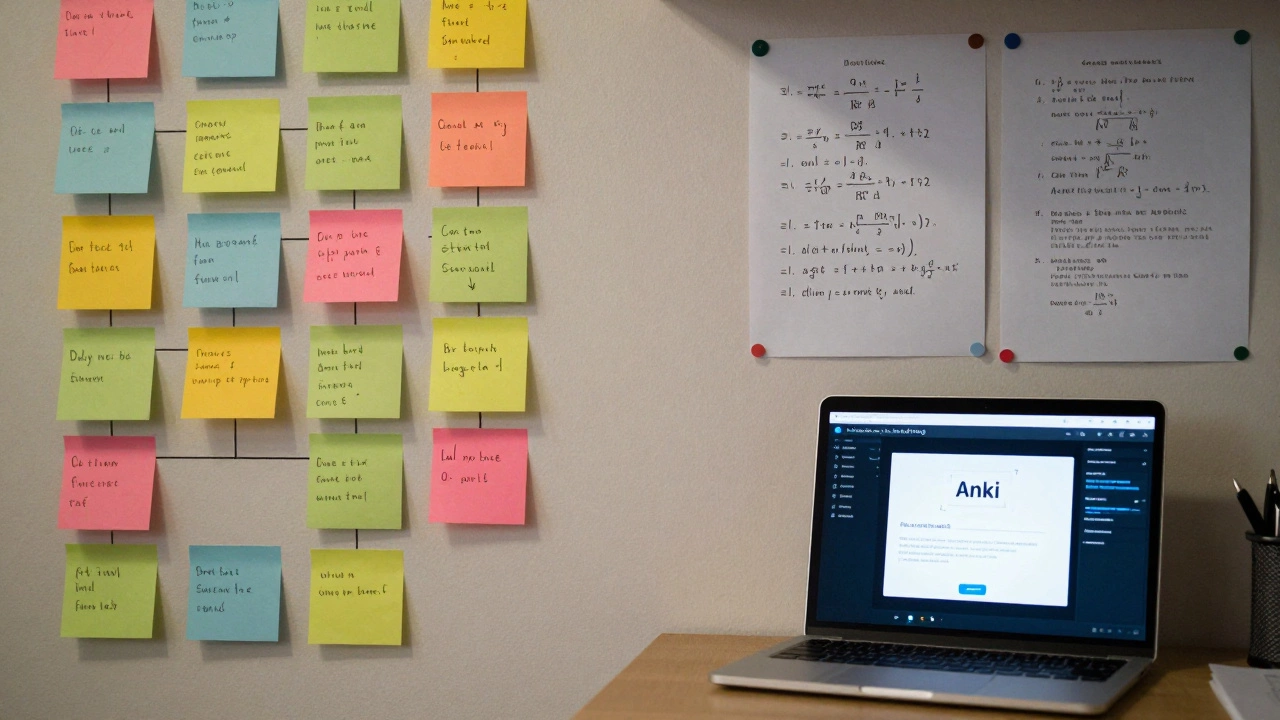
- Make flashcards. Write a question on one side, the answer on the other. Use apps like Anki or a digital flashcard tool that uses spaced repetition to help you remember facts over time, or physical cards. Test yourself daily.
- Teach someone else. Explain a topic to a friend, a sibling, or even your pet. If you can’t explain it simply, you don’t understand it well enough. Teaching forces your brain to organize information clearly.
- Use mind maps. For subjects like Geography or Religious Studies, draw diagrams that link ideas. Start with a central topic and branch out. This helps you see how concepts connect - which is exactly what examiners look for.
- Test yourself regularly. Don’t wait for mocks. Set weekly goals: "This week, I’ll recall all the parts of the human heart without looking." Then do it. Track your progress.
What Tools Do Top Students Use?
You don’t need expensive tutors or fancy apps. But you do need the right tools:
- Official exam board specifications - These are free PDFs from websites like AQA, Edexcel, and OCR. They list every topic you need to know. Use them as your checklist.
- Revision guides - Books like CGP or Pearson are written to match the exam format. They break down hard topics into bite-sized chunks.
- YouTube channels - Channels like Physics & Maths Tutor and a free resource hub offering video tutorials, exam papers, and revision notes for GCSE subjects have short, clear videos for every topic.
- Timetable apps - Use Google Calendar or Notion to block out revision time. Treat it like a job. 45 minutes on, 15 minutes off.
Revision Isn’t Just About Studying - It’s About Your Mindset
Many students think revision is about hours spent. It’s not. It’s about focus. If you’re scrolling through TikTok while your notes are open, you’re not revising. You’re wasting time.
Top performers take breaks. They sleep well. They eat properly. They know that your brain needs rest to consolidate what you’ve learned. Pulling all-nighters doesn’t help. In fact, it hurts. Sleep is when your brain moves memories from short-term to long-term storage.
Also, don’t compare yourself to others. One student might revise for 3 hours a day. Another might do 45 minutes but do it perfectly. The quality matters more than the quantity.
When Should You Start?
Start early. Seriously. If your exams are in May or June, you should be doing at least 30 minutes a day of active revision by January. That gives you 4-5 months to build habits, fix gaps, and test yourself.
By February, you should have finished your first pass through all subjects. By March, you should be doing past papers. By April, you should be identifying weak spots and drilling them. May? Just keep practicing and stay calm.
What If You’re Behind?
You’re not too late. Even if you’ve only started in March, you can still make big improvements. Focus on the topics that carry the most marks. Use your exam board’s specification to find the high-weight areas. Prioritize those. Do one past paper per subject. Mark it. Learn from your mistakes. That’s more valuable than five hours of rereading.
And if you’re stressed? That’s normal. Everyone feels it. The key is to keep going. One small step every day adds up. You don’t need to be perfect. You just need to be consistent.
Is GCSE revision the same as studying?
No. Studying is when you first learn something in class. Revision is what you do after that - actively testing yourself, recalling information without help, and fixing gaps. Studying builds knowledge. Revision locks it in.
How many hours should I revise each day?
There’s no magic number. But most successful students revise between 1 and 3 hours per day during term time, with longer sessions on weekends. The key is consistency, not marathon sessions. One focused hour is better than three distracted ones.
Should I revise all subjects every day?
No. It’s better to rotate subjects. For example, revise Maths on Monday, English on Tuesday, Science on Wednesday. This gives your brain time to rest and process each topic. Trying to do everything every day leads to burnout.
Can I revise using only YouTube videos?
Videos are helpful for understanding concepts, but they’re not enough. You need to practice answering exam-style questions. Watch a video, then immediately do a past paper question on that topic. That’s how you turn knowledge into exam skills.
What if I can’t remember anything during the exam?
If you’ve revised properly, your brain will have stored the information. If you blank out, take a breath. Look for keywords in the question. Write down anything you remember - even small facts. Often, one detail triggers the rest. Examiners give credit for partial answers.
Final Thought: Revision Is a Skill - Not a Chore
GCSE revision isn’t about how much you can memorize. It’s about learning how to learn. The skills you build now - self-discipline, time management, memory techniques - will help you in college, at work, and in life. Treat revision like a project. Set goals. Track progress. Celebrate small wins. You’ve got this.