






GCSE Grade 9 Probability Calculator
How Hard Is Your Subject?
Grade 9 Probability
How many students achieve grade 9 in your subject
What this means: Only 0% of students in this subject get a grade 9—less than average.
This makes your subject one of the more challenging for achieving grade 9s
How to Improve Your Chances
Key Strategy for this Subject: Use active recall to master complex concepts
Top Tips
- 1. Analyze past papers like a detective to identify examiner patterns
- 2. Target your weak spots early with spaced repetition
- 3. Practice writing full, structured responses under timed conditions
Getting a grade 9 in GCSE isn’t just about working hard-it’s about working smart, consistently, and with real strategy. The grade 9 was introduced in 2017 when the UK switched from A* to a 9-1 grading system, and it’s meant to be the highest possible mark. Only the top 4-5% of students in each subject get it. That’s not a lot. But it’s not impossible either. If you’re aiming for a 9, you’re not chasing perfection-you’re chasing precision.
What Does a Grade 9 Actually Mean?
A grade 9 isn’t just an A*. It’s above it. Think of it this way: if an A* used to mean you knew the material really well, a grade 9 means you knew it inside out, backwards, and could apply it in ways the examiners didn’t expect. The exam boards design papers so that the hardest questions are meant to separate the top 5%. These aren’t just harder versions of regular questions-they’re new combinations, multi-step problems, or open-ended analysis tasks that test real understanding, not memorization.
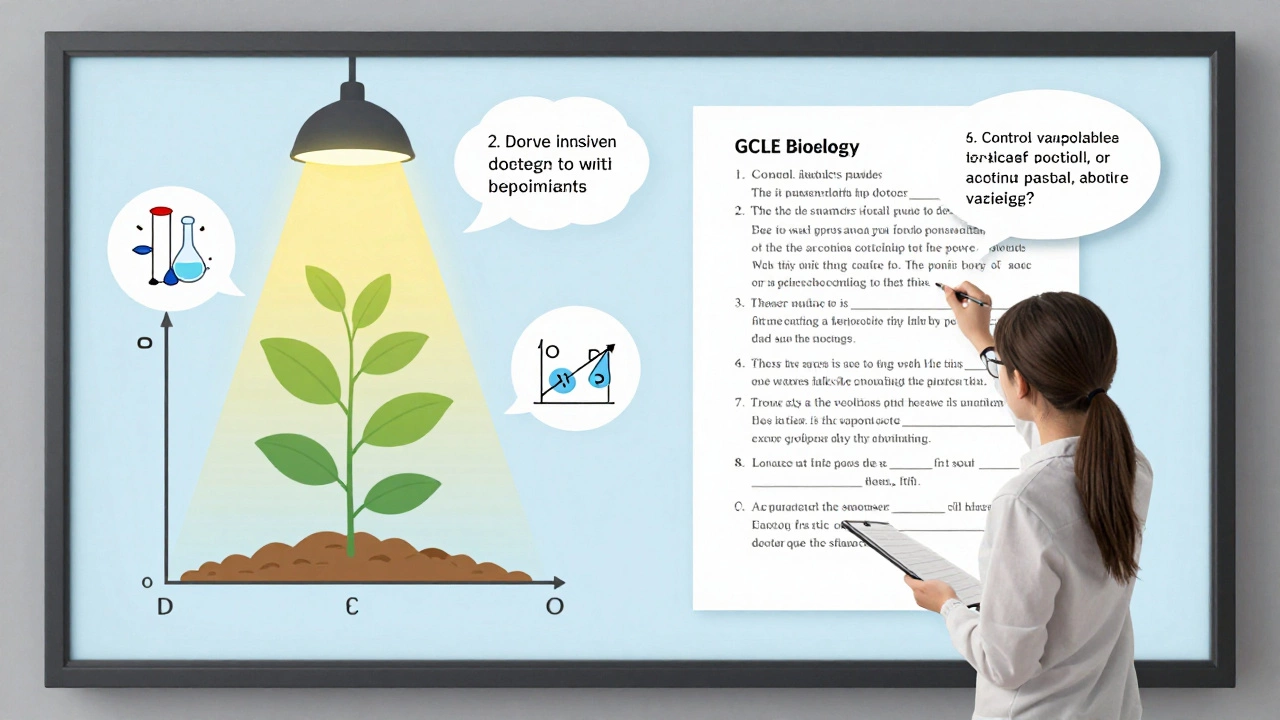
For example, in GCSE Biology, a grade 9 question might ask you to design an experiment to test how light intensity affects photosynthesis, then explain why your control variables matter, and predict what would happen if you used a different plant species. It’s not enough to recite the equation. You need to think like a scientist.
In Maths, it’s the same. You won’t just solve a quadratic equation-you’ll have to interpret a real-world scenario, build the equation yourself, solve it, then explain what the solution means in context. That’s the difference between a 7 and a 9.
How Many People Actually Get a 9?
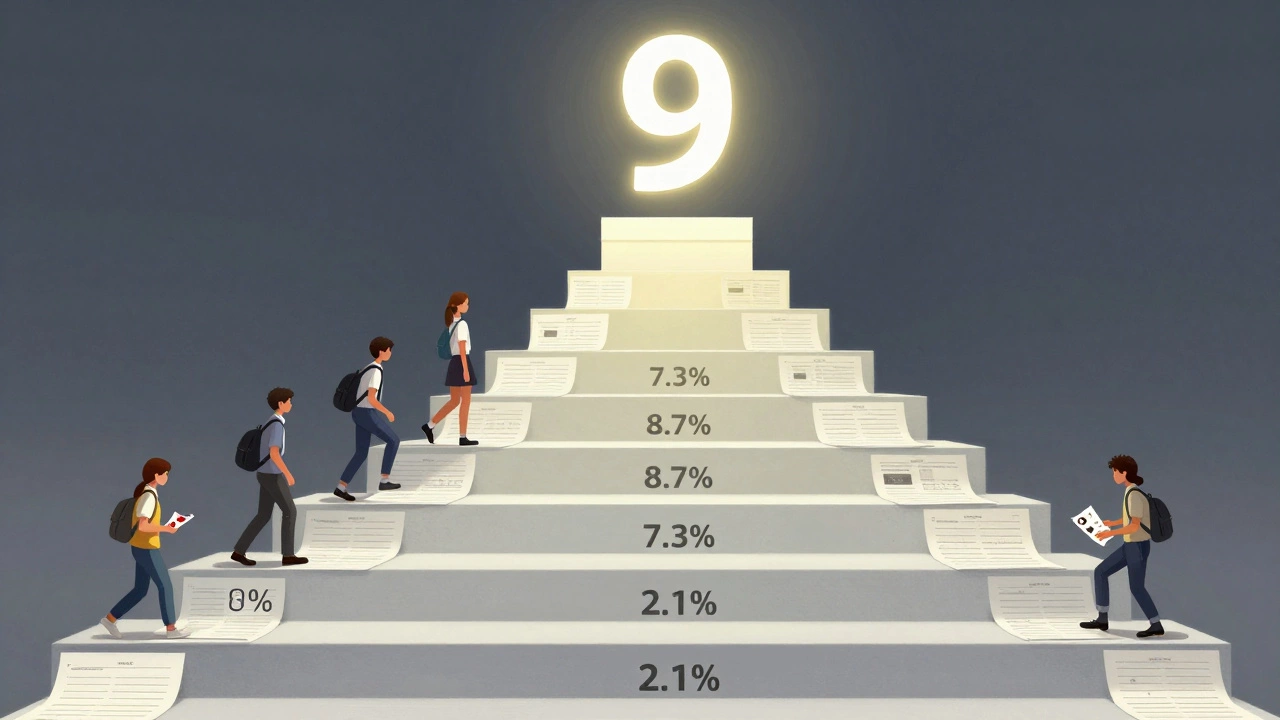
Official data from Ofqual shows that in 2023, the average percentage of students getting a grade 9 across all GCSE subjects was 4.8%. That’s less than one in twenty. But it varies wildly by subject.
Here’s a quick look at the top and bottom:
| Subject | Percentage Getting Grade 9 |
|---|---|
| Mathematics | 8.7% |
| Further Mathematics | 12.1% |
| Physics | 7.3% |
| English Literature | 5.9% |
| History | 4.2% |
| Art & Design | 2.1% |
| Design & Technology | 1.8% |
So if you’re aiming for a 9 in Maths, you’re competing with the top 9%-still tough, but more common than in Art, where only 1 in 50 students hit it. The harder the subject is perceived to be, the higher the percentage of top grades tends to be. That’s because the students who choose those subjects are usually the ones already strong in them.
What Do Top Students Do Differently?
Most students who get a 9 don’t study more hours-they study better. Here’s what sets them apart:
- They don’t just revise-they test themselves. Flashcards and rewriting notes feel productive, but they’re not. The best students use active recall: covering their notes and trying to write everything they remember. Then they check. Repeat. This builds memory stronger than passive reading ever could.
- They analyze past papers like detectives. Instead of doing one past paper and moving on, they look for patterns. What topics come up every year? What wording do examiners use? What’s the most common mistake students make? They don’t just answer-they reverse-engineer the mark scheme.
- They know their weak spots and attack them early. Most students avoid what they’re bad at. Top students go straight to it. If you struggle with trigonometry in Maths, you don’t wait until March to fix it. You tackle it in October, with spaced repetition and targeted practice.
- They write full answers under timed conditions. Writing a quick bullet point isn’t enough. You need to practice writing full, structured responses with proper terminology, clear explanations, and correct formatting. Examiners reward clarity and completeness, not just correct facts.
One student I spoke to, who got nine 9s, said she spent 20 minutes a day on each subject-not reviewing, but quizzing herself on one topic she’d struggled with the week before. She didn’t cram. She didn’t burn out. She just showed up every day.
Common Mistakes That Keep Students From a 9
Here’s what most students do wrong:
- Waiting until the last minute. GCSEs aren’t a sprint. They’re a marathon with checkpoints every month. If you start revising in January, you’re already behind. The best students start in Year 9 or early Year 10.
- Using only one resource. Your textbook is a starting point, not the whole map. Top students use revision guides (like CGP), YouTube channels (like Freesciencelessons), past papers, and teacher feedback together. Each gives a different angle.
- Ignoring feedback. If your teacher writes “explain further” or “use terminology,” don’t just read it and move on. Go back and fix it. That feedback is your roadmap to a 9.
- Thinking more hours = better results. Studying 6 hours a day with no focus is worse than 90 minutes of deep, deliberate practice. Quality beats quantity every time.
Is a 9 Worth the Stress?
Let’s be real: chasing a 9 is intense. You’ll miss out on some social events. You’ll feel pressure. You’ll doubt yourself. But here’s the truth-it’s not just about university applications. A grade 9 shows you can handle complexity, manage your time, and persist through difficulty. Those are skills that matter far beyond school.
Colleges and employers notice it. But more importantly, you’ll notice it in yourself. You’ll walk into an exam feeling calm because you’ve seen every type of question before. You’ll know how to think under pressure. That confidence? That’s the real reward.
What If You Don’t Get a 9?
Here’s something most people don’t say: you can still get into top sixth forms, universities, and careers without a single 9. Many students with mostly 8s and 7s go on to Oxford, Cambridge, and medical school. The grade 9 is a bonus, not a requirement.
What matters more is consistency. A string of 8s shows you’re reliable, hardworking, and capable. A single 9 won’t save you if your other grades are low. Focus on building a strong overall profile, not just one perfect grade.
If you’re aiming for a 9, give it your best shot-but don’t let it define your worth. You’re not just studying for a grade. You’re building a way of thinking that will serve you for life.
Is it possible to get a 9 in every GCSE subject?
Yes, it’s possible, but extremely rare. In 2023, fewer than 0.5% of students achieved nine or more grade 9s across all subjects. It requires exceptional ability, perfect time management, and consistent effort over two years. Most students who get multiple 9s focus on subjects they’re naturally strong in and already enjoy.
Do you need a tutor to get a 9?
No, you don’t. Many students who get 9s are self-taught using free resources like BBC Bitesize, Corbettmaths, and past papers. But a good tutor can help if you’re stuck on a concept, need feedback on your exam technique, or want someone to hold you accountable. A tutor isn’t magic-they’re a guide. The work still has to be yours.
How many past papers should I do before the exam?
At least 5 full past papers per subject under timed conditions. But don’t just do them-review them. For each paper, write down every mistake you made, why you made it, and how to fix it. Then redo similar questions from other papers. Quality of review matters more than quantity of papers done.
When should I start revising for GCSEs?
Start building good habits in Year 9. By the start of Year 10, you should be doing weekly topic reviews. By Christmas of Year 11, you should be doing full past papers. Waiting until March or April is too late if you’re aiming for a 9. The top students treat revision like brushing their teeth-daily, non-negotiable.
Can you still get into a top university without a 9?
Absolutely. Universities look at your overall profile: grades, personal statement, references, extracurriculars, and sometimes interviews. Many successful applicants have a mix of 8s and 9s. What stands out is depth of understanding, not perfection. A student with five 8s and a strong science project will often beat someone with six 9s but no real curiosity or initiative.
Next Steps: Your 30-Day Plan to Push Toward a 9
If you’re serious about getting closer to a 9, here’s a simple 30-day plan:
- Week 1: Pick your hardest subject. List the 3 topics you struggle with most. Find one free video or revision guide for each and watch it.
- Week 2: Do one full past paper under timed conditions. Mark it strictly using the official mark scheme. Write down every point you lost.
- Week 3: For each mistake, find 3 similar questions from other papers and do them. Focus on understanding why you got it wrong, not just the right answer.
- Week 4: Teach one topic to someone else-even if it’s just explaining it out loud to your wall. If you can teach it clearly, you’ve mastered it.
That’s it. No extra hours. No magic tricks. Just focused, deliberate practice. That’s how grade 9s are made.