




Cram Session Strategy Planner
Add your topics and mark your current understanding to see where to focus your energy.
- Active Recall: Close book, recall everything.
- Blurting: Dump all knowledge $\rightarrow$ Fill gaps.
- Past Papers: Solve under timed conditions.
- Triage: Focus on the "Maybe" bucket first.
You've just realized the exam is tomorrow, and your notes look like a foreign language. The panic is real, but staring at your textbook in a state of paralysis won't help. While spending months preparing is the goal, sometimes life happens, and you're left with a few hours to save your grade. The trick isn't trying to learn everything-it's about strategically deciding what not to learn so you can master the high-yield material.
- Focus on high-weightage topics first.
- Use active recall instead of re-reading.
- Prioritize sleep over a 4:00 AM all-nighter.
- Ditch the phone and use a focus timer.
- Review past papers to spot patterns.
Triage Your Syllabus
When you're short on time, you can't treat every page of your textbook with equal importance. You need to perform academic triage. Start by looking at the grade weightage. If Chapter 4 is worth 40% of the mark and Chapter 1 is only worth 5%, you know where to spend your energy.
Scan your syllabus and mark topics into three buckets: "I know this," "I sort of get this," and "This is complete gibberish." Your priority should be the middle bucket. Why? Because moving a "maybe" to a "yes" is much faster than trying to learn a complex concept from scratch. If you spend four hours fighting with one impossible math formula and ignore three easier concepts, you've just lost a massive chunk of potential points.
The Power of Active Recall
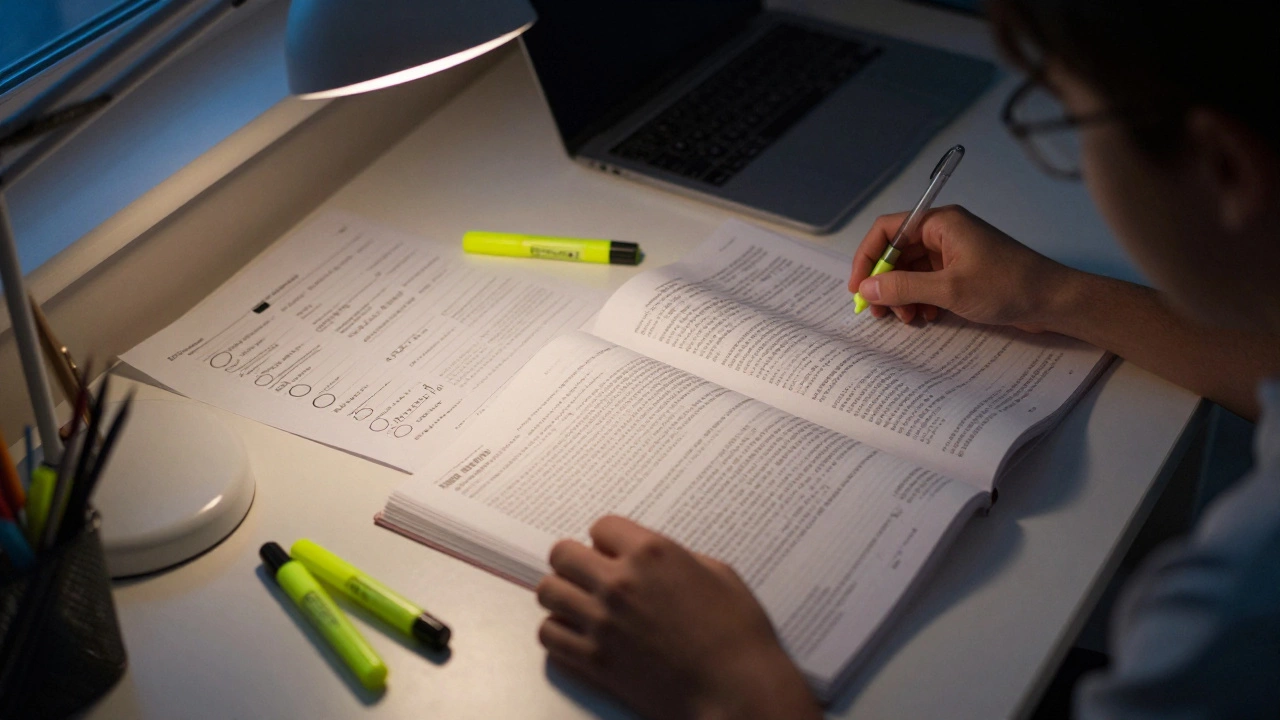
Most people cram by highlighting a textbook or reading their notes over and over. This is a trap called the "illusion of competence." You feel like you know the material because it looks familiar, but you can't actually reproduce it during the test. To actually memorize quickly, you need Active Recall is a study method where you challenge your brain to retrieve information from memory rather than passively reviewing it .
Instead of reading a page, close the book and try to write down everything you remember about that topic. Or, explain the concept out loud to an imaginary student. If you can't explain it simply, you don't understand it yet. This process forces your brain to build stronger neural paths, making the information stick even when you're stressed. If you have flashcards, use them; if you don't, write quick questions on one side of a piece of paper and answers on the other.
Using the Pomodoro Technique for Focus
Your brain has a limit on how much it can absorb before it shuts down. If you try to study for six hours straight, your concentration will plummet by hour three. This is where Pomodoro Technique is a time management method that uses a timer to break work into intervals, typically 25 minutes in length, separated by short breaks comes in.
Set a timer for 25 minutes of absolute focus-no phone, no music with lyrics, no distractions. When the timer goes off, take a 5-minute break to stretch or drink water. After four cycles, take a longer 20-minute break. This prevents burnout and keeps your mind fresh. A study conducted by the University of Illinois suggests that brief diversions actually help the brain maintain focus on a task for longer periods, which is exactly what you need when the clock is ticking.
| Method | Effort Level | Retention Speed | Best For... |
|---|---|---|---|
| Passive Reading | Low | Very Slow | Quickly skimming a topic |
| Active Recall | High | Fast | Core concepts and definitions |
| Blurting | Medium | Medium | Identifying knowledge gaps |
| Past Papers | High | Very Fast | Exam format and common questions |
The Strategy of "Blurting"
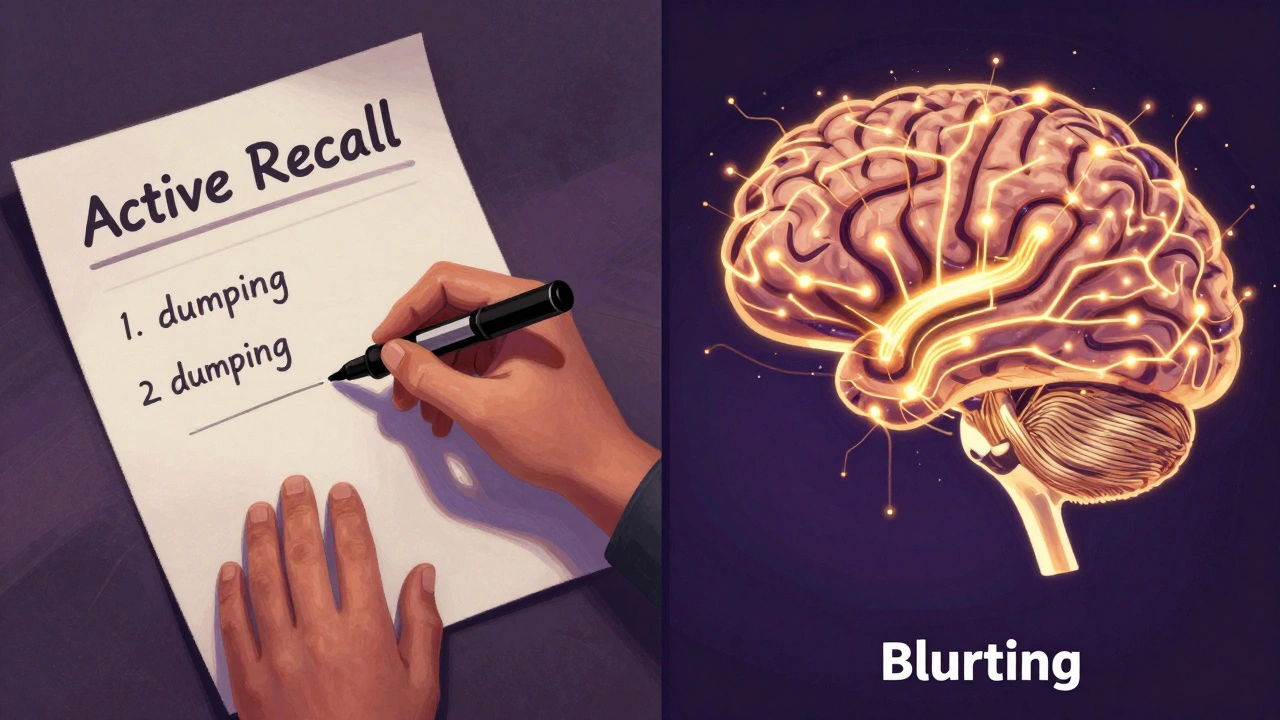
If you're feeling overwhelmed, try "blurting." It's a more aggressive version of active recall. Take a blank piece of paper and write down everything you know about a specific topic as fast as you can. Don't worry about grammar or organization-just dump the information.
Once you're done, open your textbook and use a different colored pen to add in everything you missed. Those missing pieces are your "danger zones." Instead of reviewing the whole chapter again, you now have a surgical list of exactly what you need to memorize. This saves hours of wasted time because you're only studying what you don't know.
Mining Past Exam Papers
Exam boards are creatures of habit. They often reuse the same types of questions, just with different numbers or scenarios. If you have access to Past Papers is previous versions of an examination used to practice and understand the structure and expectations of a test , stop reading the textbook and start solving them.
Don't just look at the answers. Try to answer the question under timed conditions. This trains your brain to retrieve information under pressure and helps you recognize "keyword triggers." For instance, if a question asks to "evaluate," it's looking for a pro/con list, not just a description. Understanding the how to cram for an exam logic means knowing what the examiner wants, not just knowing the facts.

Fueling Your Brain Without Crashing
It's tempting to survive on energy drinks and candy, but a sugar crash in the middle of your study session is a disaster. Your brain runs on glucose, but spikes and drops in blood sugar cause "brain fog." Opt for slow-release energy: nuts, berries, or whole-grain toast.
Water is your best friend here. Even mild dehydration can impair cognitive function and memory recall. If you feel a mental block, drink a glass of water and walk away from your desk for two minutes. The physical movement resets your focus and can often trigger the memory you were struggling to find.
The Sleep Paradox
Here is the most controversial part of cramming: you must sleep. Pulling an all-nighter might feel productive because you're putting in the hours, but it's actually counterproductive. Sleep is when Memory Consolidation is the process where the brain converts short-term memories into long-term ones during sleep happens.
If you don't sleep, the information you spent ten hours studying stays in your short-term memory, where it's easily overwritten or lost due to stress. Aim for at least 4-6 hours. If you're truly desperate, a 90-minute nap is better than nothing, as it allows you to complete at least one full sleep cycle. You'll perform significantly better with a slightly less-covered syllabus and a rested brain than with a fully-covered syllabus and a fried brain.
Can I actually learn a whole semester's worth of work in one night?
Realistically, no. You cannot achieve deep mastery of a subject in a few hours. However, you can learn enough "recognition-level" information to pass or even do decently. The goal of cramming is survival and efficiency, not academic perfection. Focus on the most important 20% of the material that usually accounts for 80% of the marks.
Should I read the summary at the end of the chapter first?
Yes. When cramming, the chapter summaries and bolded key terms are your best friends. They provide the skeletal structure of the topic. Once you understand the main points, filling in the details is much easier. It's better to have a broad understanding of everything than a perfect understanding of only one page.
What do I do if I completely blank during the exam?
Don't panic. Take a deep breath and move to a different question. Often, answering a simpler question will trigger a memory related to the harder one. If you're still stuck, write down any related keywords or formulas you remember-sometimes the act of writing helps the brain retrieve the full answer.
Are energy drinks helpful for cramming?
In small doses, caffeine can increase alertness. However, too much can lead to jitters and anxiety, which actually blocks your ability to recall information. Switch to water or green tea if you start feeling shaky. The "crash" after a high-sugar energy drink can leave you unable to focus during the actual exam.
Is it better to study in a group or alone when cramming?
Generally, study alone. Group study is great for deep learning, but when you're cramming, it often turns into a social event or a shared panic session. The only exception is if you have a friend who truly understands the material and can explain a complex concept to you in five minutes, saving you an hour of reading.
Next Steps for Different Scenarios
If you have 12 hours: Spend 2 hours on triage, 6 hours on active recall and blurting for high-weight topics, 2 hours on past papers, and 2 hours for a meal and a short nap.
If you have 4 hours: Skip the textbook entirely. Go straight to past papers and the marking scheme. Learn the answers to the most common questions and use the textbook only to clarify things you completely don't understand.
If you have 1 hour: Read the chapter summaries and the bolded terms. Focus on the formulas or dates you're most likely to forget and write them down as soon as the exam starts (a "brain dump") so you don't have to hold them in your head.