





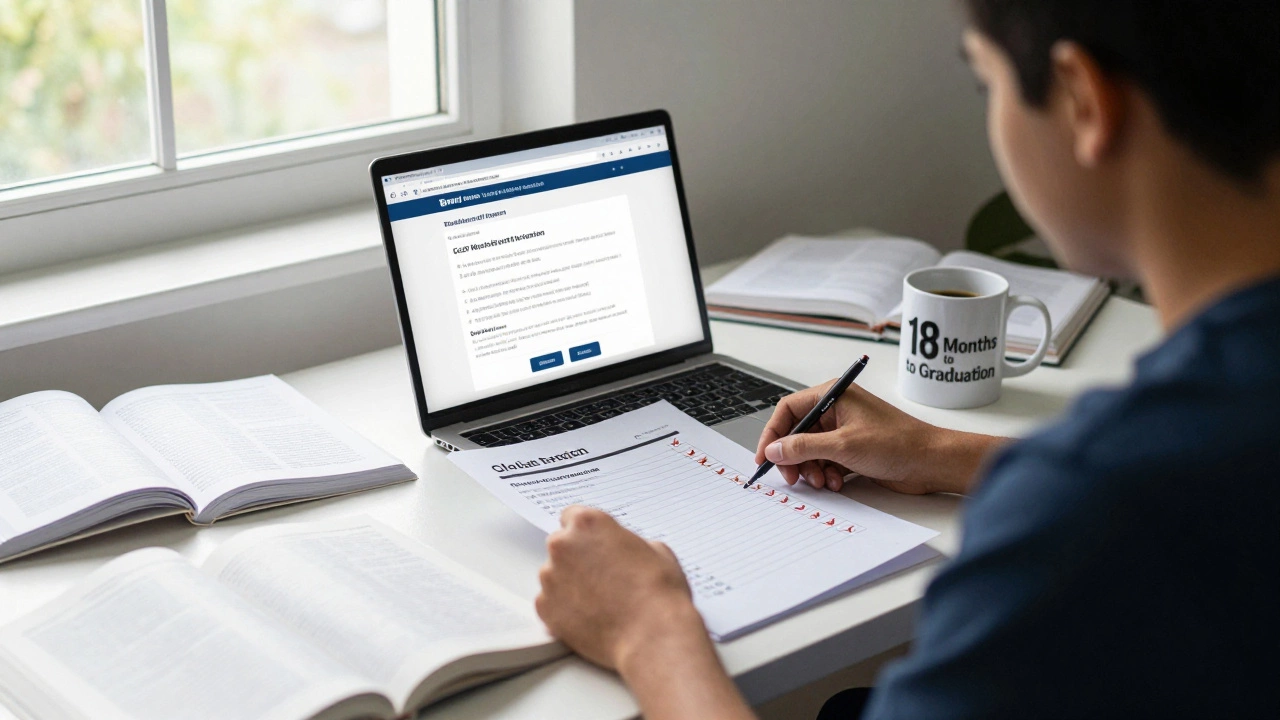
Degree Acceleration Calculator
Estimate Your Time Savings
Your Acceleration Estimate
Key Strategies for You
Want to finish your degree in half the time? You’re not alone. More people than ever are cutting through the noise and getting degrees faster-without sacrificing quality. The trick isn’t working harder. It’s working smarter. And the tools to do it are already out there, built into the online education system.
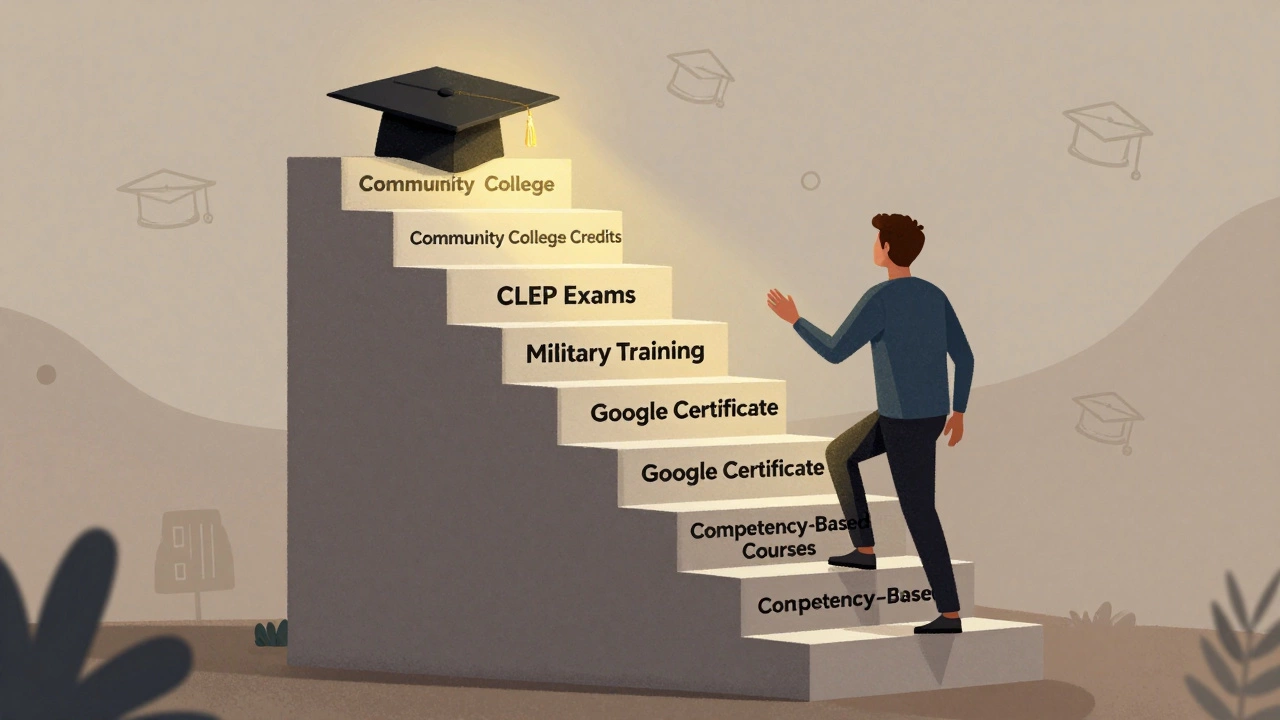
Start with credits you already earned
Most people don’t realize they might already have college credits sitting unused. Did you take a few classes at a community college before switching schools? Did you pass AP exams in high school? Did you earn certifications through military service or workplace training? These can all count.Many online universities accept up to 90 transfer credits toward a bachelor’s degree. That’s three full years of coursework. If you’ve got 60 credits already, you’re halfway there before you even enroll. Schools like Southern New Hampshire University and Western Governors University let you submit transcripts from any accredited institution and get a free credit evaluation. No guesswork. Just a clear map of what’s accepted.
Don’t assume your credits won’t transfer. Call the admissions office. Ask for their transfer policy in writing. Some schools even have online tools where you can upload your syllabi and get instant feedback on what credits will count.
Test out courses instead of taking them
You don’t need to sit through a 15-week class if you already know the material. CLEP (College Level Examination Program) and DSST exams let you prove mastery of subjects like Psychology, Calculus, or Business Law by passing a single 90-minute test. Each exam costs around $90. A full semester course? $1,500 or more.Over 2,900 colleges accept CLEP credits-including online ones like Excelsior University and Thomas Edison State College. You can earn up to 30 credits this way. That’s roughly one full year of college, shaved off your timeline.
Here’s how it works: Pick a subject you’re confident in. Study for a week using free CLEP prep materials from the College Board. Take the test. Pass. Credit awarded. Done. No essays. No group projects. Just a test and a transcript update.
Choose a competency-based program
Traditional schools measure progress by time. Competency-based programs measure it by what you can do. That’s the game-changer.Western Governors University (WGU) is the biggest name here. You pay a flat rate-around $3,500 every six months-and you can finish as many courses as you can master in that time. Some students finish a bachelor’s in 12 months. Others take two years. It depends on how fast you learn.
Each course ends with a performance assessment. You might write a report, record a presentation, or pass a proctored exam. If you’re already familiar with the material, you can skip the lessons and go straight to the test. No waiting for semesters to start. No waiting for your classmates to catch up.
It’s not for everyone. If you need structure, deadlines, and weekly lectures, this might feel too loose. But if you’re self-motivated, it’s the fastest path to a degree.
Take more credits per term
Most students take 12-15 credits per semester. That’s the norm. But if your schedule allows, take 18 or even 21. Many schools let you overload without extra cost-especially online ones.At Arizona State University Online, you pay the same whether you take 12 or 18 credits. So if you can handle four classes instead of three, go for it. The workload is heavier, sure. But you’re not paying more. And you’re finishing faster.
Plan ahead. Don’t overload your first term. Start with 15. If you’re keeping up with A’s and B’s, bump it up next term. Use tools like Google Calendar to block study time. Treat it like a job. 30-40 hours a week on coursework is doable. Many full-time workers do it.
Use summer and winter terms
The biggest time-waster? Waiting for the next semester to start. Most schools have short terms in summer and winter. These are often 6-8 weeks long and cover one course.Take a class in May. Finish by July. Start the next one in January. You’re adding two extra semesters every year. That’s 50% more progress.
Some schools, like the University of Florida Online, offer summer sessions with the same professors and same syllabi as fall. No watered-down content. Just condensed pacing. You’ll move faster, but you won’t learn less.
Stack certificates into degrees
Many online degrees are built on stackable credentials. You earn a certificate. Then, you apply those credits toward an associate’s. Then a bachelor’s.For example: Start with a Google Career Certificate in IT Support (takes 6 months). Many universities, including the University of North Carolina, accept those credits toward a bachelor’s in Information Technology. You’ve cut a year off your degree before you even enroll in college.
Look for programs labeled “pathway degrees” or “stackable credentials.” These are designed to let you build up, not start from scratch. Check with your target school: Do they accept industry certs? If yes, start there.
Don’t waste time on general education
You don’t need to take 10 different gen-ed courses if you can get them out of the way fast. Use online platforms like Coursera or edX to complete requirements like English Composition, Statistics, or Introduction to Psychology.Many schools accept credits from these platforms. Just make sure the course is accredited and matches your degree’s requirements. Always get pre-approval. Email the registrar with the course syllabus and ask: “Will this fulfill my General Education requirement?”
One student in Ohio finished all her gen-ed credits in 4 months using Coursera and then transferred them to her online bachelor’s program. She graduated a full year early.

Work with an academic advisor from day one
This is the secret most people skip. Don’t wait until your second year to meet your advisor. Book a call on your first day.Ask: “What’s the fastest path to graduation?” “Which electives count toward my major?” “Can I test out of any courses?” “What credits from other schools do you accept?”
Advisors know the loopholes. They know which classes are easy to transfer. They know which exams are most accepted. They’ve helped dozens of students finish early. Use them.
Set up a 30-minute check-in every term. Keep a spreadsheet of your progress. Track credits earned, credits needed, exams scheduled. Make it visual. Progress is motivating.
Combine work and study
If you’re working, don’t see it as a distraction. See it as a resource. Many employers offer tuition reimbursement. Some even pay for online degrees if the course relates to your job.Companies like Amazon, Starbucks, and Walmart have programs that cover 100% of tuition. You just need to maintain a C average. That’s it. You’re getting paid to go to school.
Even if your employer doesn’t offer reimbursement, you can still use your work experience for credit. Some schools give you credit for professional experience through Prior Learning Assessment (PLA). You write a portfolio showing how your job taught you college-level skills. It’s not easy-but it’s possible.
What doesn’t work
Don’t enroll in too many schools at once. It sounds smart-get credits from everywhere. But it backfires. Transferring credits between schools is messy. Some won’t accept them. Others cap how many they’ll take.Don’t rush into a degree without knowing the requirements. A degree in Business Administration at one school might need 120 credits. At another, it’s 128. Know the target before you start.
Don’t ignore accreditation. A degree from a non-accredited school won’t help you get a job or transfer credits later. Stick to regionally accredited institutions. Check the U.S. Department of Education’s database if you’re unsure.
Real example: How one person finished in 18 months
Maria, 32, worked full-time as a medical assistant in Atlanta. She wanted a bachelor’s in Health Sciences. She had:- 30 credits from a community college (from 10 years ago)
- Passed 3 CLEP exams (Biology, Psychology, Sociology)
- Completed a 6-month medical coding certificate from AAPC
She enrolled in WGU. Her advisor confirmed: 51 credits already counted. She took 6 courses in her first term-finished them all in 5 months. Took another 6 in the next term. Finished her capstone project in December. Graduated in 18 months. No loans. No burnout. Just smart planning.
She didn’t study harder. She studied smarter.
Can I really finish a bachelor’s degree in one year?
Yes-but only under specific conditions. You need a lot of prior credits, access to competency-based programs like WGU, and the ability to handle heavy course loads. Most students who finish in 12 months have already earned 60+ credits through transfer, CLEP, or prior learning. It’s not common, but it’s possible.
Do employers care if I got my degree faster?
No, not if the school is accredited. Employers care about the degree itself, not how long it took. They don’t see your transcript’s timeline. They see the name of the university and the major. A degree from SNHU or WGU is just as valid as one from a traditional school.
Are online degrees taken seriously?
Yes-if they’re from accredited institutions. According to a 2024 survey by the National Center for Education Statistics, 83% of employers say online degrees are as credible as on-campus ones. The key is accreditation. Avoid for-profit schools with no regional accreditation.
Can I use military training for college credit?
Absolutely. The American Council on Education (ACE) evaluates military training and recommends college credits for most service members. If you were in the Army, Navy, Air Force, Marines, or Coast Guard, request your Joint Services Transcript. Many online schools accept it for up to 45 credits.
What’s the cheapest way to get a degree fast?
Start with community college courses (under $100 per credit), then use CLEP exams ($90 each), and finish at a low-cost competency-based school like WGU ($3,500 per term). Most students who use this combo pay under $10,000 total for a full bachelor’s degree.
If you’re serious about finishing faster, start today. Gather your transcripts. Check your old AP scores. Look up CLEP subjects you know. Call one online school and ask for a credit evaluation. That one call could save you a year.