






Distance Learning Format Selector
Recommended Format
Select your preferences above to see which distance learning model fits your life.
When you hear the phrase distance learning is an educational approach where students and instructors are separated by physical distance rather than sharing a traditional classroom, your mind probably jumps to Zoom calls, LMS dashboards, and pixelated video lectures. It’s easy to assume that if you aren’t sitting in a lecture hall, you must be glued to a screen. But that assumption is dangerously incomplete. The reality of how we learn from afar is far more diverse than just high-speed internet connections.
In fact, before Wi-Fi was even a concept, people were earning degrees and mastering skills without ever stepping foot on a campus. So, is distance learning only online? The short answer is no. While digital platforms dominate the modern landscape, the ecosystem includes television broadcasts, postal mail, radio, and increasingly, sophisticated hybrid models that blend physical materials with virtual interaction. Understanding this spectrum matters because the "right" format depends entirely on your lifestyle, learning style, and access to technology.
The Historical Backbone: Correspondence Courses
To understand why distance learning isn't synonymous with "online," we have to look back at the 19th century. Before computers, there was the mail. Correspondence courses were educational programs delivered through postal mail, where students received printed study materials and submitted assignments for grading via post. This model powered education for over a century. Institutions like the University of London began awarding external degrees in the 1850s, allowing workers, farmers, and parents to study while maintaining their daily lives.
How did it work? You received a packet of textbooks or mimeographed lessons in the mail. You studied them at your own pace. When you finished an assignment, you mailed it back to an instructor who graded it and sent it back with feedback. It was slow, yes. A single lesson cycle could take weeks. But it democratized education for millions who couldn’t afford to move to a city or quit their jobs. Today, this model still exists, though it has largely been absorbed into broader "blended" offerings. Some vocational certifications and specialized professional development courses still use print-heavy methods for learners in areas with poor connectivity.
Broadcast Media: Radio and Television
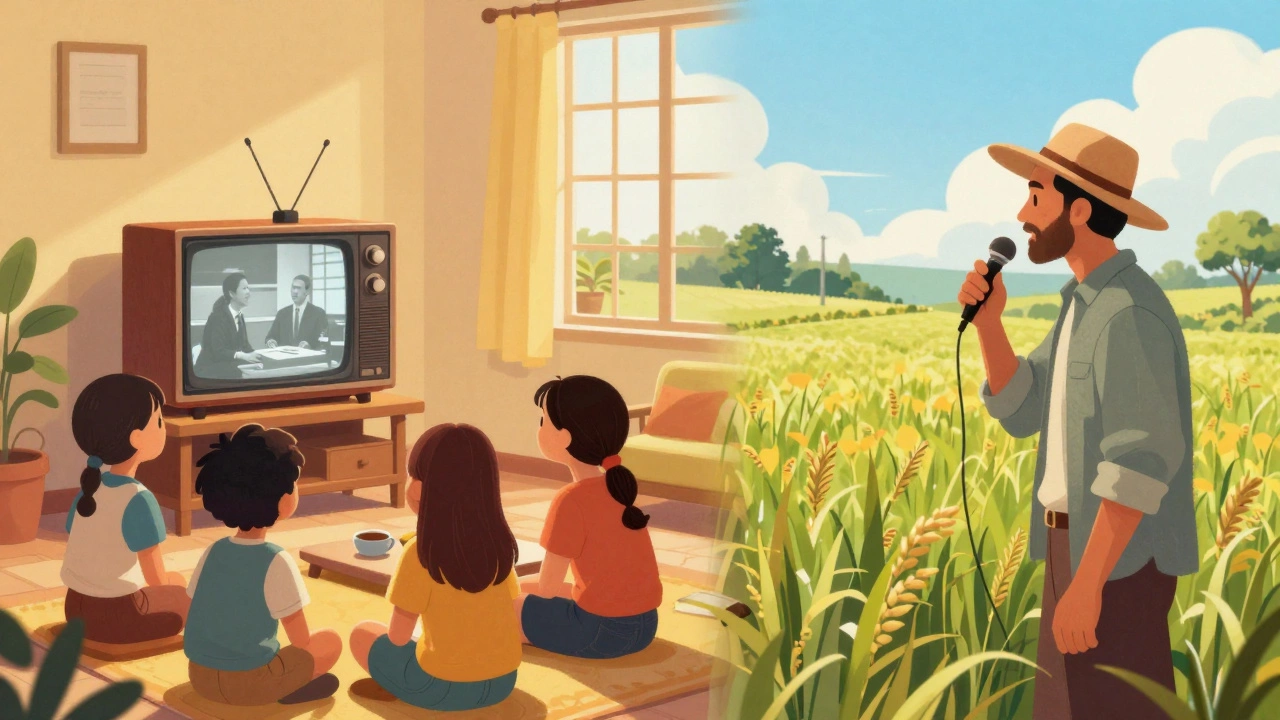
If mail felt too slow, broadcast media offered a faster alternative. In the mid-20th century, educational television became a medium for delivering structured academic content to remote audiences via scheduled TV broadcasts. Countries like India launched the IGNOU (Indira Gandhi National Open University) system, which used satellite TV to reach rural populations. In the US, public broadcasting stations aired science and history lectures specifically designed for college credit.
Radio played a similar role, especially in developing regions. radio-based instruction is a method of distance education that uses audio broadcasts to deliver lessons, often accompanied by printed study guides. Even today, in parts of Africa and Asia, radio remains a critical tool for adult literacy and agricultural training. These formats prove that distance learning doesn’t require two-way digital interaction. One-way transmission combined with self-study materials can be highly effective, particularly for foundational knowledge.
The Digital Shift: Synchronous vs. Asynchronous
Now, let’s talk about the online portion, since it’s what most people encounter today. Not all online learning is created equal. There are two main types: synchronous and asynchronous.
Synchronous online learning is real-time instruction where students and teachers interact simultaneously via video conferencing tools like Zoom or Microsoft Teams. This mimics a traditional classroom schedule. You log in at 9 AM, listen to the lecture, ask questions, and participate in breakout rooms. It requires discipline and reliable internet, but it offers immediate feedback and social connection.
On the other hand, asynchronous online learning is self-paced education where students access pre-recorded lectures, readings, and forums at any time, without needing to be online simultaneously with peers. This is the backbone of massive open online courses (MOOCs) and many university degree programs. You watch a recorded lecture on Tuesday night, complete a quiz on Thursday morning, and post a discussion reply on Saturday. This flexibility is why online education exploded in popularity-it fits around work, childcare, and travel.
Hybrid and Blended Models: The Best of Both Worlds
Perhaps the most common form of modern distance learning isn’t purely online or purely offline. It’s blended. Blended learning is an educational approach that combines face-to-face instruction with online activities, creating a flexible and integrated learning experience. Think of it as a sandwich: the bread is the online component (discussions, quizzes, resource libraries), and the filling is occasional in-person workshops, labs, or intensives.
Many graduate programs use this model. Students might do all their reading and discussions online throughout the semester, but gather once a month for a weekend retreat on campus to network and tackle complex projects. Similarly, medical schools often use virtual simulations for anatomy practice, followed by brief lab sessions. This approach reduces the need for constant commuting while preserving the human element of mentorship and peer collaboration. It acknowledges that some skills-like surgery, engineering prototyping, or performance arts-require physical presence, even within a distance learning framework.

Who Benefits From Non-Online Distance Learning?
You might wonder why anyone would choose mail, radio, or TV when high-speed internet is available. The answer lies in accessibility and preference. For learners in rural areas with spotty broadband, downloading a 2-hour HD lecture can be impossible. Printed materials or radio broadcasts bypass this bottleneck. Additionally, some learners suffer from screen fatigue. Staring at a monitor for eight hours a day, then logging into another eight hours of online classes, leads to burnout. Physical books and handwritten notes offer a tactile break that can improve retention and reduce eye strain.
Furthermore, older adults returning to education may find traditional print materials more intuitive than navigating complex Learning Management Systems (LMS). For them, a well-organized textbook feels familiar and less intimidating than a password-protected portal. Distance learning, in its truest sense, is about removing barriers-not adding new ones through technological demands.
| Format | Interaction Level | Technology Required | Best For |
|---|---|---|---|
| Correspondence (Print) | Low (delayed feedback) | None (postal service) | Self-motivated learners, low-connectivity areas |
| Broadcast (TV/Radio) | Very Low (one-way) | Receiver device | Mass audience, foundational knowledge |
| Synchronous Online | High (real-time) | High-speed internet, webcam | Collaborative projects, social learners |
| Asynchronous Online | Medium (forum-based) | Internet access | Working professionals, flexible schedules |
| Blended/Hybrid | Variable | Mixed | Skill-based training, networking needs |
Choosing the Right Format for You
So, how do you decide which type of distance learning fits your life? Start by assessing your constraints. Do you have reliable internet? If not, lean toward print or broadcast options, or seek out institutions that offer downloadable content for offline use. Are you a night owl or an early bird? Asynchronous online learning lets you study whenever you’re alert, while synchronous courses demand fixed attendance.
Consider your learning style. Do you retain information better by writing notes by hand, or do you prefer interactive videos and quizzes? If you thrive on debate and immediate clarification, synchronous or blended models will keep you engaged. If you prefer deep, uninterrupted focus, asynchronous or correspondence courses allow you to control the pace.
Finally, think about your goals. If you’re pursuing a career change that requires networking, look for programs with in-person components or active online communities. If you simply need a certification to advance in your current job, a self-paced online course might be the most efficient route. Distance learning is not a monolith; it’s a toolkit. Use the right tool for the job.
Can I get a degree without using the internet?
Yes, though it is rare. Some universities still offer correspondence degrees primarily through mail, and others use radio or television broadcasts for core content. However, most accredited programs now require at least minimal internet access for registration, exams, or communication with advisors. Check with specific institutions for fully offline options.
Is asynchronous learning better than synchronous?
It depends on your schedule and personality. Asynchronous learning offers maximum flexibility, making it ideal for working parents or shift workers. Synchronous learning provides structure and real-time interaction, which helps prevent isolation and keeps you accountable. Many students find a mix of both works best.
What is the difference between distance learning and online learning?
Online learning is a subset of distance learning. All online learning is distance learning, but not all distance learning is online. Distance learning includes any method where teacher and student are separated, including mail, TV, radio, and hybrid models. Online learning specifically refers to digital delivery via the internet.
Do employers value non-online distance learning credentials?
Employers care about accreditation and competency, not the delivery method. A degree from an accredited university, whether earned via Zoom, mail, or TV, holds the same weight. What matters is the rigor of the program and the skills you demonstrate during interviews.
How do I stay motivated in a self-paced distance learning program?
Create a consistent study schedule and treat it like a job. Set weekly goals, join online study groups for accountability, and reward yourself for milestones. Breaking large tasks into small, manageable chunks also prevents overwhelm and keeps momentum going.