






GCSE vs. AP Difficulty Estimator
Answer these questions honestly to see which system's structure aligns better with your strengths, and where you might face the most friction.
Your Assessment Profile
GCSE Suitability
Analysis pending...
AP Suitability
Analysis pending...
Strategic Recommendation
Select options above and click analyze to receive your personalized advice.
Imagine standing at a crossroads. On one path lies the General Certificate of Secondary Education, commonly known as GCSE, which is the standard academic qualification taken by students in England, Wales, and Northern Ireland at age 16. On the other path sits the Advanced Placement, or AP, which is a United States-based program offering college-level curricula and examinations to high school students. You’re trying to figure out which one will hurt less, stress you out more, or actually look better on your future university application.
I’ve spent years watching students navigate both systems, often moving between them due to family relocations or international schooling. The short answer? They are different beasts entirely. Comparing their difficulty is like asking if lifting weights is harder than running a marathon. One tests endurance and breadth; the other tests intensity and depth. But if you have to pick a winner in terms of pure academic pressure, the scales tip differently depending on where you stand.
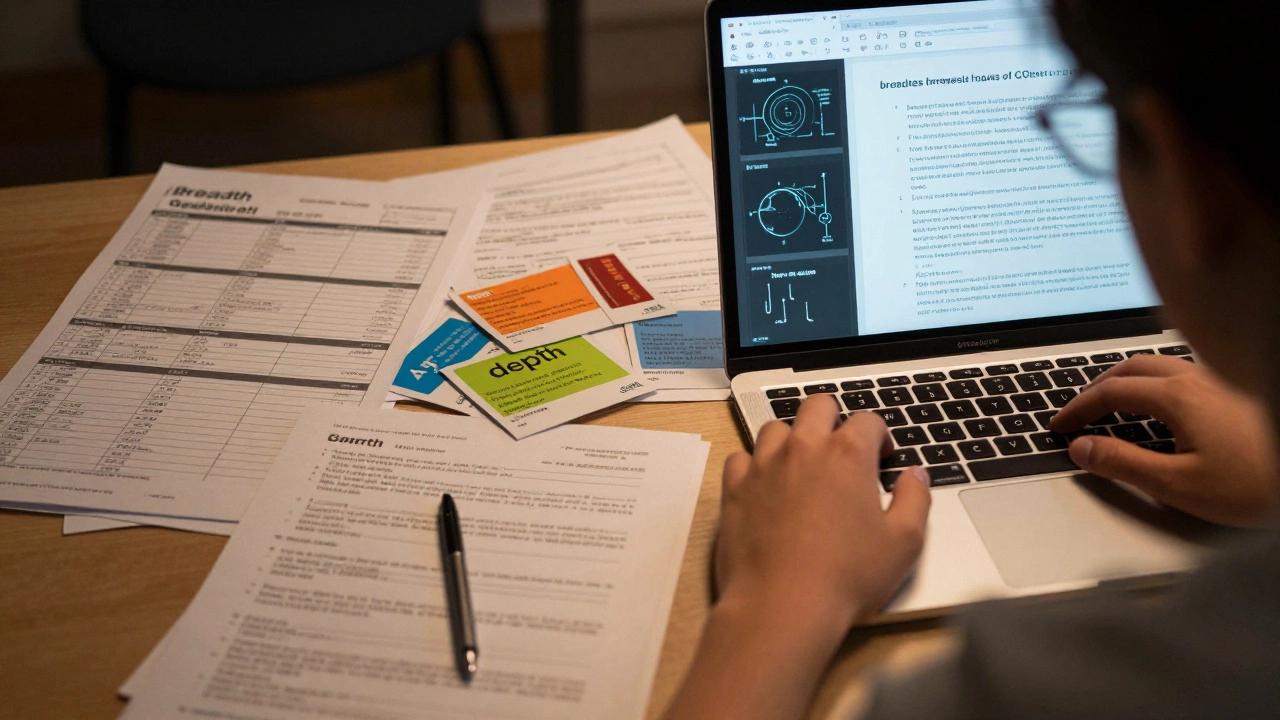
The Breadth vs. Depth Dilemma
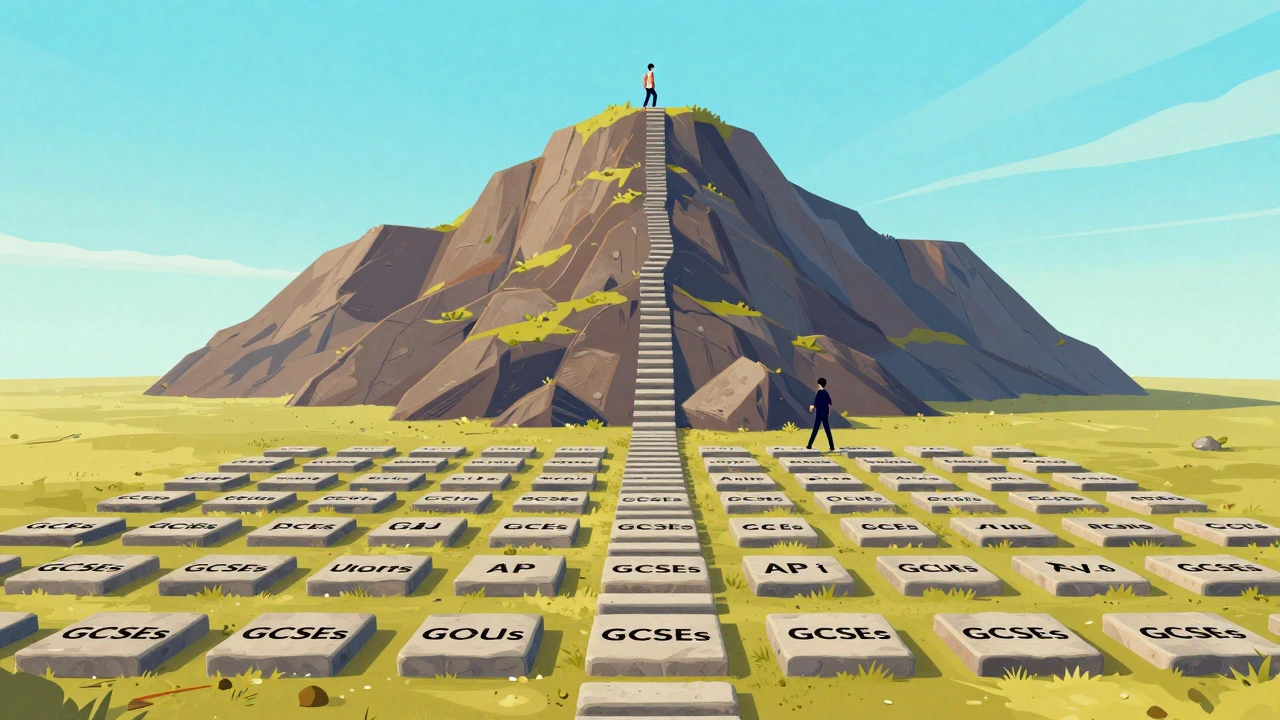
The first thing that hits you with GCSEs is the sheer volume. In the UK system, most students take between eight and ten subjects. You aren’t just studying math and English. You’re likely juggling science triple awards (biology, chemistry, physics), a modern foreign language, history, geography, art, and perhaps music or drama. The expectation is that you maintain a baseline competence across all these areas simultaneously.
APs work on an opt-in model. You choose your battles. If you love calculus but hate literature, you might take AP Calculus BC and skip AP English Literature. This allows for specialization early on. However, this freedom comes with a catch. The depth required for an AP course is significantly higher. An AP History class isn’t just about memorizing dates; it’s about constructing nuanced arguments using primary sources, mirroring the expectations of a freshman year college seminar in the US.
| Feature | GCSE (UK) | AP (US) |
|---|---|---|
| Typical Number of Subjects | 8-10 subjects | 3-5 courses (chosen by student) |
| Assessment Style | Final exams dominate (80-100%) | Final exam + classroom performance (varies) |
| Grade Scale | 9 (highest) to 1 (lowest) | 5 (highest) to 1 (lowest) |
| Curriculum Control | National syllabus (rigid) | College Board guidelines (flexible implementation) |
| Primary Goal | Broad foundational knowledge | College credit & advanced placement |
This structural difference changes how you study. With GCSEs, you need a rotation system. You can’t ignore biology because you’re struggling with algebra; both matter equally for your overall profile. With APs, you can pour everything into your strengths, but if you fail to meet the rigorous standards of that single subject, there’s no safety net of other easy grades to balance it out.
The Pressure Cooker: Exam Formats
Let’s talk about the actual sitting of the exams. This is where many students feel the true weight of the GCSE. The UK system has moved heavily toward linear assessment. This means almost everything counts in the final two weeks of Year 11. There is little to no coursework left in major subjects like English Language, Math, and Sciences. It is a sprint to the finish line where one bad day can drop your grade from a 7 to a 5.
AP exams are also high-stakes, but they happen once a year in May, regardless of when your school year ends. The format varies wildly by subject. AP Physics requires problem-solving under time pressure. AP Art Portfolio involves months of curated work submitted digitally. The unpredictability of AP formats can be stressful, but the stakes feel slightly different because you usually take fewer of them at once.
In my experience living here in Dublin, I see students who have done GCSEs struggle with the open-ended nature of AP essays. They are used to mark schemes that reward specific keywords and structured points. AP graders look for voice, synthesis, and critical thinking. Conversely, US students taking APs often find the rote memorization required for GCSE Humanities overwhelming. They expect to debate; GCSE expects you to recite and apply.
Grading Curves and University Expectations
Understanding what constitutes a "good" grade is crucial for gauging difficulty. In the current GCSE system, a grade 9 is the highest possible achievement, reserved for exceptional performance. A grade 4 is considered a "standard pass," while a 5 is a "strong pass." To get into top-tier UK universities via A-Levels, you typically need strong GCSE results as a prerequisite, but the GCSE itself doesn’t grant entry. It’s a gatekeeper.
AP scores range from 1 to 5. A 3 is generally considered "qualified," meaning you’ve demonstrated college-level mastery. Many top US universities require a 4 or 5 to grant college credit. Here’s the kicker: the curve is steep. Only about 10-15% of students achieve a 5 in most AP subjects. For GCSEs, the distribution is more bell-curve-like, though getting a 9 is statistically rare (often under 5% of candidates).
If you are aiming for Oxford or Cambridge, the pressure to get 8s and 9s in GCSEs is immense. These institutions use GCSE results as a filter before you even sit for interviews. In the US, a perfect score of 5s on five AP exams can boost your application significantly, potentially earning you tuition-free credits. The financial incentive adds a layer of pragmatic stress to APs that GCSEs lack.
Which One Is Actually Harder?
So, who wins the difficulty crown? It depends on your learning style.
- GCSE is harder if: You struggle with multitasking. Managing nine different subjects, each with its own vocabulary, formula sheet, and historical timeline, requires incredible organizational skills. If you are disorganized, GCSE will crush you. The breadth is the enemy.
- AP is harder if: You dislike deep analysis. If you prefer clear right-and-wrong answers, AP English or AP Government will frustrate you. The ambiguity of college-level writing and complex scientific modeling demands a maturity that not all 16-year-olds possess. The depth is the enemy.
From a global perspective, international schools often offer both. Students who take the International Baccalaureate (IB) diploma often say it combines the worst of both worlds: the breadth of GCSEs with the depth of APs. If you are choosing between just GCSE and AP, most educators agree that the cognitive load of AP is higher per subject, but the cumulative fatigue of GCSE is higher across the board.
Strategic Advice for Students
If you are currently navigating this choice, here is some practical advice based on real-world outcomes.
- Know Your Destination: If you plan to study in the UK, stick to GCSEs followed by A-Levels. The transition is smoother. UK universities understand the GCSE grading nuance better than they understand AP equivalencies.
- Leverage AP for Flexibility: If you are in the US or an international school with flexibility, use APs to showcase passion. Taking AP Computer Science and AP Physics signals a clear interest in STEM, which can be more powerful than a mediocre spread of GCSE grades.
- Don’t Underestimate the Basics: Regardless of the path, English and Math are non-negotiable. Strong foundations in literacy and numeracy make every other subject easier. Weaknesses here compound quickly in both systems.
- Practice Past Papers: For GCSEs, past papers are your bible. The questions repeat patterns. For APs, practice essays and free-response questions are key. The College Board releases previous exams; use them to understand the grader’s mindset.
Remember, difficulty is subjective. A creative writer might find AP Literature liberating and GCSE English restrictive. A logical thinker might thrive in the structured proofs of GCSE Math but struggle with the interpretive nature of AP Psychology. Choose the path that aligns with your strengths, not just the one that sounds impressive.
Can I take AP exams if I am doing GCSEs?
Yes, many students in international schools or private UK academies do both. However, it is highly demanding. Ensure you have the time to prepare for the specific AP curriculum, as it may not overlap perfectly with your GCSE syllabus. Check with your school administration for support resources.
Do US universities accept GCSE results?
Yes, most US universities accept GCSE results as part of your high school transcript. However, they often still require SAT or ACT scores and may recommend AP or IB courses to demonstrate readiness for college-level work. Top-tier Ivy League schools look favorably upon high GCSE grades (8s and 9s).
Is it easier to get a 9 in GCSE or a 5 in AP?
Statistically, getting a 5 in AP is often considered slightly more achievable for a dedicated student in a single subject, whereas getting a 9 in GCSE requires consistent excellence across a broad range of topics. However, in competitive subjects like AP Calculus BC or GCSE Further Mathematics, the percentage of top grades is similarly low.
Which system is better for medical school applications?
For UK medical schools, strong GCSE sciences (grades 8/9) are essential prerequisites. For US med schools, AP Biology and AP Chemistry scores can help strengthen your undergraduate application, but your GPA and MCAT score later on will matter far more. Both systems value science rigor highly.
How does the workload compare daily?
GCSE students typically have homework across multiple subjects every day, leading to a steady, moderate workload. AP students might have lighter days in some classes but intense, project-heavy weeks in others. The AP workload feels more sporadic but deeper, while GCSE is a constant grind.