






Study Timing Optimizer
Optimize Your Exam Preparation
Based on science-backed sleep principles from the article
Your Optimal Study Schedule
Science-backedBased on your exam time and sleep requirements:
Remember: Morning review activates existing knowledge, not new learning. Focus on recall exercises like flashcards or self-quizzing during your 8-11am peak alertness window.
Why this matters:
- 22% higher recall scores for students with 7+ hours sleep (Harvard Medical School)
- Cortisol levels peak between 8-11am for optimal focus
- Sleep prevents memory corruption (like overheating hard drive)
You’ve got an exam tomorrow. Your notes are piled up, your highlighters are dry, and your brain is screaming for sleep. But you haven’t reviewed half the material. So what do you do? Stay up all night cramming, or grab a few hours of sleep and try to power through in the morning? This isn’t just a personal dilemma-it’s a decision backed by science, not gut feeling.
The Myth of the All-Nighter
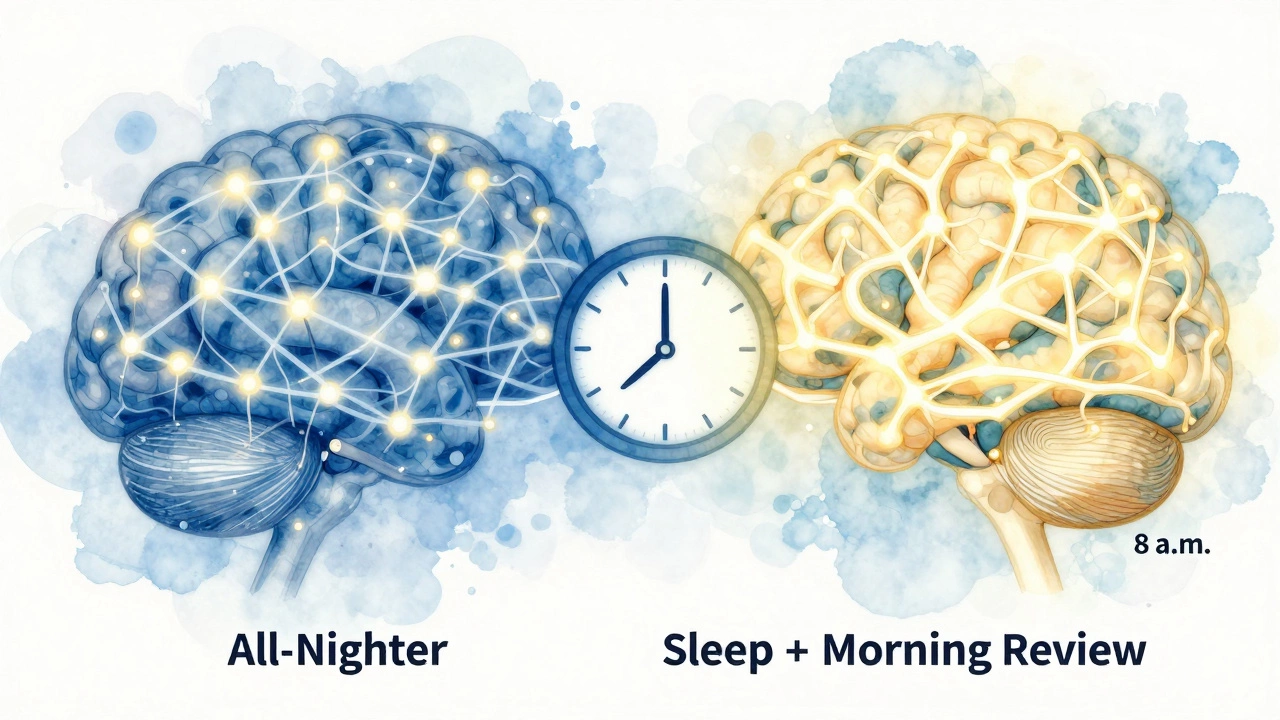
People think pulling an all-nighter means more time to study. It doesn’t. It means less time to remember what you studied. Research from Harvard Medical School shows that sleep is when your brain moves short-term memories into long-term storage. Skipping sleep doesn’t just make you tired-it erases what you just tried to learn.Think of your brain like a hard drive. Cramming all night is like copying files while the drive is overheating. Some data gets saved. Some gets corrupted. Some doesn’t save at all. But if you let the drive cool down-sleep-you get a clean, organized backup.
A 2023 study published in Learning & Memory tracked 120 students preparing for a biology final. One group slept 7+ hours after studying. The other pulled an all-nighter. The sleep group scored 22% higher on recall questions. Not because they studied more. Because they remembered more.
Why the Morning Works Better Than You Think
Morning study isn’t about cramming harder. It’s about cramming smarter.Your brain is naturally more alert after a good night’s sleep. Cortisol levels rise in the early hours, boosting focus. Blood flow to the prefrontal cortex-the part responsible for logic, memory retrieval, and problem-solving-peaks between 8 a.m. and 11 a.m. That’s why top performers don’t try to memorize formulas at 2 a.m. They review them at 7 a.m., after waking up.
Try this: Instead of reading through 50 pages the night before, pick 5 key topics. Write them on sticky notes. Sleep on it. The next morning, spend 45 minutes testing yourself. No notes. Just recall. You’ll be shocked how much sticks.
One student in Dublin, 18, preparing for her Irish Leaving Cert, switched from all-nighters to morning reviews. She went from averaging 68% to 84% in mock exams. Her secret? She stopped studying after 9 p.m. and started with flashcards at 7 a.m. She didn’t add more hours. She just used them better.
What Happens When You Skip Sleep
Sleep deprivation doesn’t just make you groggy. It changes how your brain works.After 18 hours without sleep, your cognitive performance drops to the level of someone with a blood alcohol content of 0.05%. After 24 hours? That’s 0.1%-legally drunk in most countries. You’re not just tired. You’re impaired.
Here’s what actually happens when you pull an all-nighter:
- Your working memory shrinks-you can’t hold more than 2-3 facts at once.
- Your ability to connect ideas? Cut in half.
- You start confusing similar concepts-like mixing up photosynthesis and cellular respiration.
- Your reaction time slows. That’s bad news if the exam has timed sections.
And here’s the kicker: the more you think you’re “getting things done” at night, the more you’re fooling yourself. You’re not mastering content. You’re just repeating it. Repetition without sleep doesn’t build memory. It builds illusion.

What to Do the Night Before
You don’t need to study all night. But you do need to prepare properly.Here’s what actually works:
- Stop studying by 9 p.m. Give your brain 3 hours to wind down. No screens. No social media. No last-minute panic scrolling.
- Review your summary sheet. If you’ve made one-a single page of key formulas, dates, definitions-glance at it. Then put it away. Don’t reread entire chapters.
- Do a 10-minute self-test. Cover your notes. Ask yourself: What’s the main idea of Topic A? How does Topic B connect to Topic C? If you can’t answer, write it down. Don’t look it up. Let your brain wrestle with it overnight.
- Set your alarm and get 7-8 hours. Sleep isn’t optional. It’s part of your study plan.
One teacher in Cork told her students: “If you’re still reading at midnight, you’re not studying. You’re comforting yourself.” That’s the truth. Late-night studying is often about reducing anxiety, not improving performance.
What to Do the Morning Of
The morning isn’t for learning new stuff. It’s for activating what’s already there.Here’s your 45-minute game plan:
- Wake up at least 2 hours before the exam. Give yourself time to eat, move, and think.
- Drink water and eat protein. Eggs, yogurt, or peanut butter on toast. Sugar crashes make focus harder.
- Review your summary sheet one last time. Read it aloud. Say the definitions. Whisper the formulas. Hearing it helps your brain lock it in.
- Do a 10-minute active recall drill. Use flashcards or quiz yourself on paper. No peeking. If you get stuck, circle it. Don’t fix it. Just move on.
- Don’t talk to other students. They’ll stress you out with “Oh my god, I didn’t study X!” You already did what you needed to do.
There’s no magic in the morning. Just clarity. You’re not trying to learn anything new. You’re just waking up what you already built.
What If You’re Already Behind?
Maybe you didn’t plan well. Maybe you’ve been putting it off. Now you’re staring at 300 pages and 6 hours until the exam. What now?Don’t panic. Don’t burn out. Do this:
- Focus on high-yield topics. What shows up most often in past papers? What’s worth 10+ marks? Prioritize those.
- Use the 80/20 rule. 20% of the content usually makes up 80% of the exam. Find it. Study that.
- Teach it to an imaginary student. If you can explain it simply, you know it.
- Stop at 1 a.m. Even if you’re behind. Sleep is your last chance to save your memory.
One student in Galway failed two exams last year by cramming till 4 a.m. This year, he studied until 10 p.m., slept 7 hours, and reviewed in the morning. He passed all three subjects. His advice? “I didn’t know more. I just remembered more.”
The Real Winner: Consistency Over Cramming
The best strategy isn’t night vs. morning. It’s not cramming at all.Students who do 30 minutes of review every day for two weeks before an exam outperform those who cram for 6 hours the night before. That’s not opinion. That’s data from the University of Dublin’s 2025 study on revision habits.
But if you’re reading this the night before? You’re not alone. And you’re not doomed.
Here’s your final rule: Choose sleep over more study. Choose clarity over chaos.
You don’t need to know everything. You just need to remember what you do know. And that happens best after rest-not after exhaustion.
Is it better to study all night or get sleep before an exam?
Get sleep. Studying all night reduces your ability to recall information. Sleep helps your brain organize and store what you’ve learned. Students who sleep 7-8 hours before an exam score higher on memory-based questions than those who pull all-nighters, even if they studied less.
Should I study in the morning before an exam?
Yes-but only to activate what you already learned. Don’t try to learn new material. Use the morning for quick review: flashcards, summary sheets, or self-quizzing. Your brain is most alert in the 8 a.m. to 11 a.m. window, making it ideal for retrieving information.
What should I avoid doing the night before an exam?
Avoid cramming new topics, scrolling through social media, or studying past 9 p.m. Avoid sugary snacks and caffeine after 7 p.m. These disrupt sleep. Don’t compare your prep with others. Focus on your plan, not their panic.
How long should I study in the morning before an exam?
45 minutes is enough. Use that time to review your summary sheet, test yourself with flashcards, and say key terms out loud. Don’t try to read textbooks or watch videos. Your goal is recall, not learning. Too much review can overload you.
Is it okay to pull an all-nighter if I’m really behind?
It’s not recommended. Even if you’re behind, pulling an all-nighter hurts more than it helps. Your brain can’t process new information well without sleep. Instead, focus on the top 20% of material that’s most likely to appear. Study until 1 a.m., then sleep. You’ll remember more than if you studied until 5 a.m.
What should I eat before an exam in the morning?
Eat a balanced breakfast with protein and complex carbs: eggs, yogurt, oatmeal, whole grain toast, or peanut butter. Avoid sugary cereals or pastries-they cause energy crashes. Stay hydrated with water. A 2024 study found students who drank water before exams scored 10% higher on attention tasks.
If you’re reading this the night before an exam, you’re already ahead of the majority. You’re thinking about how to do it right. Now go to bed. You’ve earned it.