




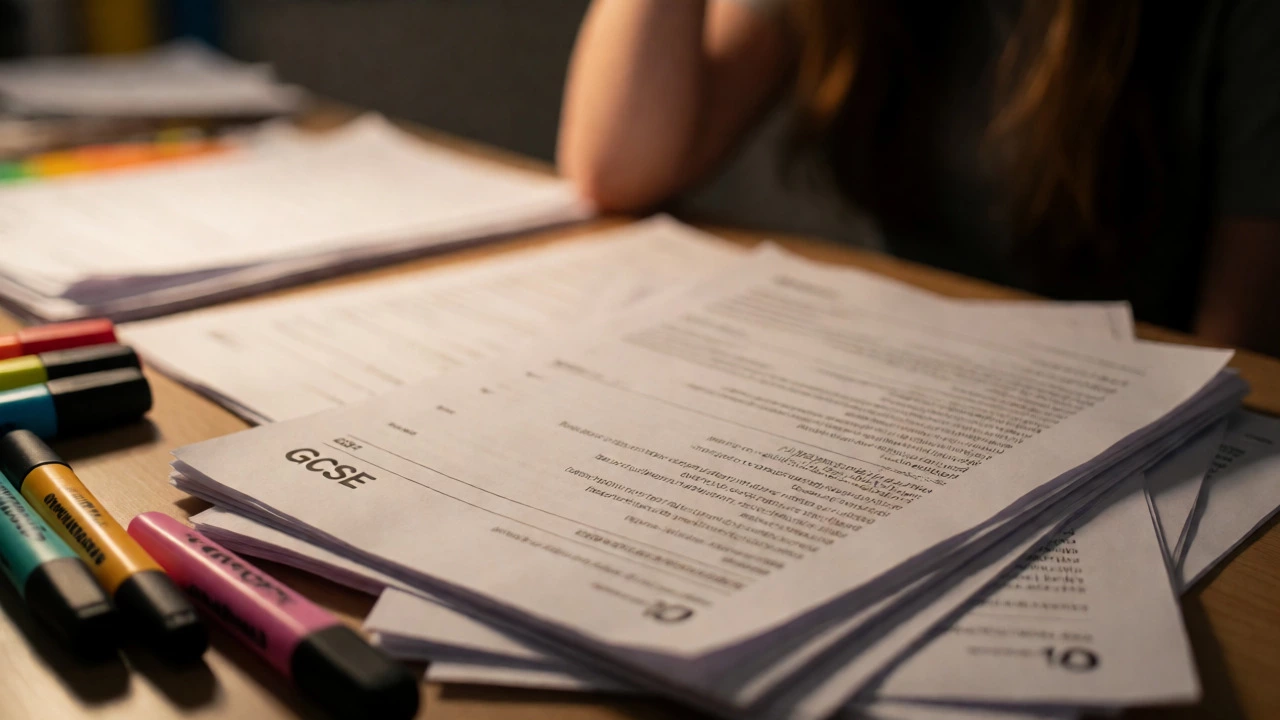
GCSE Revision Strategy Simulator
Welcome! This interactive quiz tests your understanding of scientifically backed revision methods discussed in the article. Choose the best strategy for each scenario to maximize your retention and exam performance.
Ready to Test Your Study Skills?
This simulator presents common revision scenarios. Select the most effective approach based on cognitive science principles like Active Recall and Spaced Repetition.
Quiz Complete!
Key Takeaways from this Quiz:
- Active Recall: Testing yourself is far more effective than re-reading notes.
- Spaced Repetition: Reviewing at intervals (Day 1, 2, 4, 7) combats the Forgetting Curve.
- Pomodoro: Short, focused bursts with breaks maintain concentration better than marathon sessions.
- Traffic Light System: Prioritize 'Red' (difficult) topics over 'Green' (easy) ones.
You’ve got the syllabus. You’ve got the past papers stacked on your desk like a Jenga tower waiting to topple. But staring at them doesn’t magically transfer knowledge into your brain. If you’re asking how is the best way to revise for GCSE, you’re probably tired of reading notes until they blur and still feeling unprepared when the clock starts ticking. The truth? Most students revise wrong. They re-read. They highlight. They feel productive while achieving almost nothing.
Here’s the good news: there is a scientifically backed, highly effective method that cuts study time in half while boosting retention. It’s not about being smarter; it’s about working with how your brain actually stores information. This guide breaks down exactly how to structure your revision so you walk into the exam hall confident, calm, and ready to crush it.
Why Passive Reading Fails (And What Works Instead)
Think about the last time you revised history or biology. Did you read the textbook chapter twice? Maybe use a rainbow of highlighters? That feels nice, but it’s passive. Your brain recognizes the text, thinks “I know this,” and moves on. Recognition isn’t recall. In an exam, you can’t see the answer choices; you have to pull them from memory.
The most powerful tool in your arsenal is Active Recall. This technique forces your brain to retrieve information without looking at your notes. When you struggle to remember something, that mental effort strengthens the neural pathways associated with that fact. It’s like lifting weights for your memory-the harder the lift, the stronger the muscle.
How do you do it? Close your book. Ask yourself a question based on what you just learned. Can you explain photosynthesis out loud? Can you write down the key dates of the Cold War from memory? If you get stuck, peek, then close the book again and try once more. This simple switch transforms vague familiarity into concrete knowledge.
Spaced Repetition: Beating the Forgetting Curve
Even if you master a topic today, you’ll forget 50% of it within 24 hours unless you review it. This is known as the Forgetting Curve, first mapped by psychologist Hermann Ebbinghaus in the 1880s. He discovered that memory decay happens rapidly right after learning, then slows down over time.
To beat this curve, you need Spaced Repetition. This means reviewing material at increasing intervals: one day later, three days later, a week later, and two weeks later. Each successful retrieval resets the forgetting curve, making the memory last longer.
You don’t need complex software to start. Here’s a simple manual system:
- Day 1: Learn a new topic (e.g., Algebraic Fractions).
- Day 2: Review Day 1’s topic briefly.
- Day 4: Review Day 1’s topic again.
- Day 7: Review Day 1’s topic one last time before moving on.
Apps like Anki automate this process using algorithms, but a physical flashcard box with compartments works just as well. The key is consistency, not complexity.
Structuring Your Revision Plan
Randomly opening a textbook is a recipe for panic. You need a plan that balances all subjects and prioritizes weak areas. Start by creating a Revision Timetable that spans from now until your exams. Don’t schedule every minute; instead, block out subject-specific sessions.
Use the "Traffic Light" system to prioritize topics:
- Red: Topics you find difficult or haven’t started. Schedule these during your peak energy hours (usually mornings).
- Amber: Topics you understand but make mistakes on. Review these regularly.
- Green: Topics you are confident in. Review these less frequently to maintain fluency.
A common mistake is spending too much time on Green topics because it feels good to be right. Resist the urge. Spend 70% of your time on Red and Amber topics. That’s where the marks are hiding.
| Technique | Effectiveness | Time Cost | Best For |
|---|---|---|---|
| Rereading Notes | Low | Medium | Familiarizing with new material |
| Highlighting | Very Low | High | Visual learners needing structure |
| Active Recall | High | Medium | All subjects, especially factual content |
| Practice Questions | Very High | High | Applying knowledge, timing practice |
| Mind Mapping | Medium | Medium | Connecting concepts, essay planning |

Mastering Past Papers
If you only do one thing besides Active Recall, make it Past Papers. These are the single most accurate predictor of your final grade. They show you exactly how questions are phrased, which topics appear repeatedly, and what the mark scheme expects.
Don’t just do a paper and check the score. Analyze your mistakes. Did you lose marks because you didn’t know the fact? Or did you misread the question? Or did you run out of time? Each error type requires a different fix.
Try this workflow for a mock exam session:
- Set a timer for the exact duration of the real exam.
- Work in silence, no phones, no music with lyrics.
- Mark your own work strictly against the official mark scheme.
- Identify the weakest topic area revealed by the errors.
- Add that specific topic to your next revision slot.
This feedback loop turns failure into data. Every mistake is a clue telling you what to study next.
Managing Stress and Lifestyle Factors
Your brain is a biological machine. It needs fuel, rest, and maintenance. You cannot hack sleep or nutrition with caffeine alone. During GCSE season, many students sacrifice sleep for extra study hours, but this backfires. Sleep is when your brain consolidates short-term memories into long-term storage. Pulling an all-nighter often results in remembering less than if you had slept six hours and studied four.
Keep these non-negotiables in mind:
- Sleep: Aim for 8-9 hours. Consistency matters more than total hours.
- Hydration: Even mild dehydration reduces concentration levels.
- Breaks: Use the Pomodoro Technique-25 minutes of focused study, 5 minutes of break. After four cycles, take a longer 15-30 minute break.
Also, watch your environment. Study in a place dedicated to work. If you study in bed, your brain associates that space with sleep, making it harder to focus. Create a clear distinction between "rest zones" and "work zones."

Subject-Specific Tips
Different subjects require slightly different approaches. One size does not fit all.
Maths and Sciences: Focus heavily on problem-solving. Reading formulas isn’t enough; you must apply them. Do hundreds of small problems rather than a few large ones. For sciences, combine Active Recall for definitions with diagram labeling for processes.
English and Humanities: These subjects rely on argument construction and evidence. Practice writing thesis statements and linking quotes to analysis. Use mind maps to connect themes across texts. For English Literature, memorize key quotes but ensure you understand their context and significance.
Languages: Immersion is key. Listen to podcasts or radio stations in the target language daily. Practice speaking aloud, even if it’s just describing your dinner. Grammar rules are best learned through usage, not just rote memorization.
Final Weeks: Tapering Like an Athlete
In the final two weeks before exams, shift your strategy. Stop trying to learn entirely new, complex topics. Instead, focus on consolidation and confidence building. Review your summary sheets, redo past papers under timed conditions, and refine your exam technique.
Create a "Cheat Sheet" for each subject-a single A4 page containing the most critical facts, formulas, or dates you keep forgetting. Review this sheet every morning. By exam day, this condensed resource will be burned into your memory.
Remember, revision is a marathon, not a sprint. Burnout is real. If you feel overwhelmed, step back. Take a walk, call a friend, or watch an episode of your favorite show. A refreshed mind absorbs information far better than a exhausted one.
How many hours should I revise per day?
This varies by individual, but quality beats quantity. For most GCSE students, 2-4 hours of highly focused, active revision per day is sustainable and effective. During holiday periods, you might extend this to 5-6 hours, but always include regular breaks. Avoid studying for 8+ hours straight, as diminishing returns set in quickly after 4 hours of intense cognitive load.
Is it better to revise alone or in a group?
Both have benefits. Studying alone allows for deep focus and personalized pacing, ideal for mastering difficult concepts via Active Recall. Group study is excellent for testing each other, discussing complex ideas, and staying motivated. A hybrid approach often works best: study solo for core learning, then meet friends for quick quizzing sessions or to clarify doubts.
What is the Pomodoro Technique?
The Pomodoro Technique is a time management method that uses a timer to break work into intervals, traditionally 25 minutes in length, separated by short breaks. Each interval is known as a pomodoro. After four pomodoros, you take a longer break of 15-30 minutes. This helps maintain high levels of concentration and prevents mental fatigue.
Should I listen to music while revising?
It depends on the task and the person. For tasks involving verbal processing (like writing essays or learning languages), lyrical music can be distracting. Instrumental music, lo-fi beats, or white noise are generally safer options as they mask background distractions without competing for linguistic processing resources. Silence is often best for complex problem-solving.
How do I handle exam anxiety?
Preparation is the best cure for anxiety. Knowing you have done the work builds confidence. Additionally, practice mindfulness or deep breathing exercises. Visualize the exam day going smoothly. On the day itself, arrive early, bring spare pens, and remember that one bad question does not define your entire future. Talk to teachers or counselors if anxiety becomes overwhelming.