





Adult Learning Readiness Checker
Evaluate a course, training session, or your own study plan against the four pillars of adult learning. Answer honestly to see how well it supports adult learners.
Do learners have control over their pace and path?
Is prior knowledge leveraged as a resource?
Is the timing aligned with life needs?
Is learning practical rather than subject-based?
You’ve probably heard that adults learn differently than kids. But have you ever stopped to ask how? It’s not just about being older or having less time. There is a specific framework, often called the 4 pillars of adult learning, that explains why traditional school methods often fail grown-ups. If you’re trying to upskill, teach a team, or go back to school, ignoring these pillars is like trying to build a house on sand.
The concept comes from Andragogy, which is the method and practice of teaching adult learners. Developed by educator Malcolm Knowles in the 1970s, it contrasts with pedagogy (child-focused teaching). While children often learn because they are told to, adults learn because they need to. This shift in motivation changes everything. Let’s break down the four core principles that make adult learning stick.
Pillar 1: Self-Concept and Autonomy
The first major shift happens in how we view ourselves. As we mature, our self-concept moves from dependency to independence. Children rely heavily on teachers for direction. Adults, however, see themselves as self-directing beings. When you force an adult into a rigid, lecture-heavy environment where they have no say, they resist. It feels patronizing.
Think about your last work training session. Did you feel engaged if the instructor talked at you for two hours without asking for input? Probably not. You likely felt a subtle urge to check your phone or zone out. That’s your autonomy kicking in. For effective adult learning, you need control over the pace, the path, and sometimes even the content.
- For Learners: Ask yourself, "How can I steer this course?" Can you skip sections you already know? Can you choose which case study to analyze?
- For Educators: Stop being the "sage on the stage." Become a facilitator. Offer choices. Let learners set their own goals within the curriculum.
This doesn’t mean chaos. It means structure that respects independence. If you’re designing a program, include self-assessment tools. Let learners diagnose their own gaps before starting. This simple step transforms passive listeners into active participants.
Pillar 2: The Role of Experience
Adults bring a massive, rich reservoir of experience to the table. Unlike children, who are mostly blank slates, adults have decades of life and work history. This is both a resource and a barrier. Why? Because new information must connect to what they already know. If it doesn’t, it gets rejected as irrelevant.
Imagine teaching Excel to a junior accountant versus a senior manager. The junior might learn formulas abstractly. The senior manager needs to see how those formulas solve the specific budget crisis they faced last month. Their experience dictates what matters. Ignoring this leads to disengagement. They’ll think, "This isn’t useful," and tune out.
| Approach | Child-Centric (Pedagogy) | Adult-Centric (Andragogy) |
|---|---|---|
| Source of Knowledge | Textbooks and Teacher | Learner's Prior Experience |
| Method | Memorization and Repetition | Problem-Solving and Reflection |
| Feedback | Grades and Corrections | Peer Discussion and Real-World Application |
To use this pillar effectively, tap into stories. Ask learners, "Have you seen this problem before? How did you handle it?" Use simulations that mirror real-life scenarios. When adults realize their past mistakes are valuable data points, confidence skyrockets. They aren't starting from zero; they're building on a foundation.

Pillar 3: Readiness to Learn
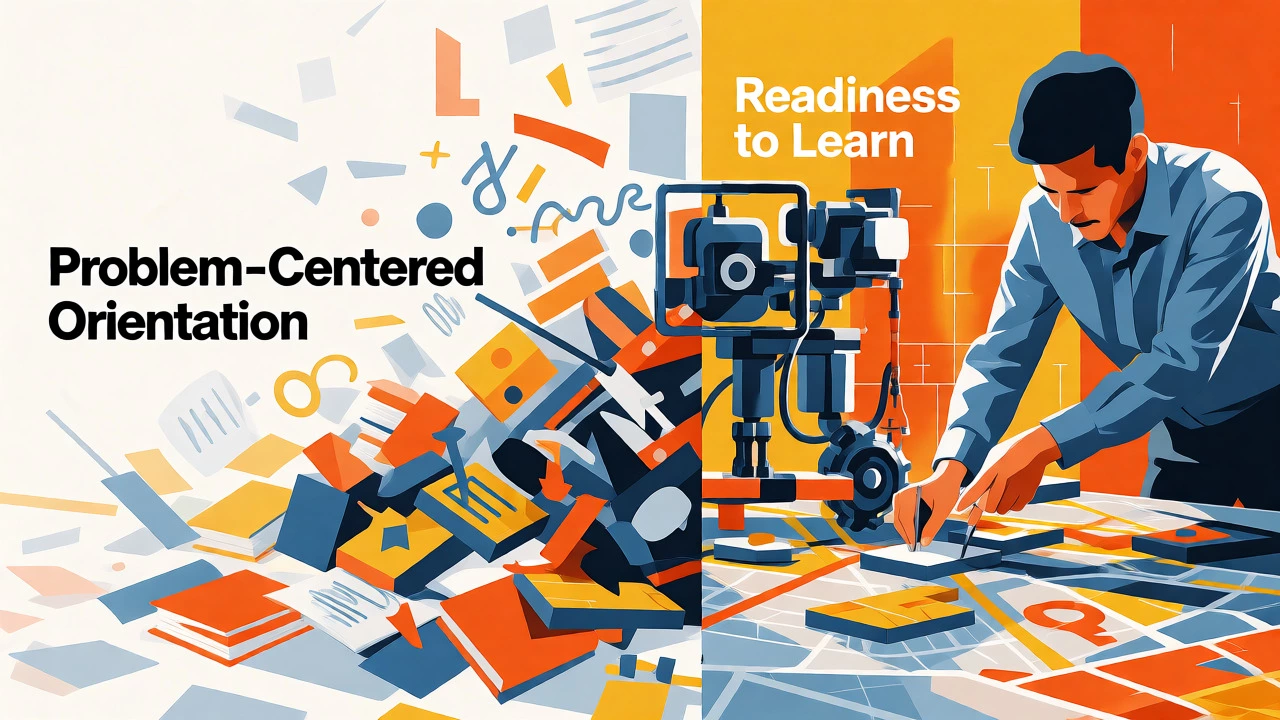
Children follow a fixed schedule. They learn algebra in Year 9 whether they want to or not. Adults develop readiness based on social roles and developmental tasks. You don’t learn project management because it’s Tuesday; you learn it because you were just promoted and now have three people reporting to you.
This is known as Readiness to Learn. It is tied directly to social role transitions and immediate life needs. If the timing is wrong, learning fails. Trying to teach financial planning to someone who hasn’t yet taken responsibility for their own bills is usually a waste of time. They aren’t ready.
Identify the trigger. What life event makes this knowledge urgent right now? Is it a career change? A health diagnosis? Becoming a parent? Align your learning objectives with these triggers. If you’re teaching a group, survey them first. Find out what problems keep them up at night. Address those first. Relevance creates urgency, and urgency drives retention.
Pillar 4: Orientation to Learning
Finally, look at the orientation. Children learn subject-centered. They study biology, then history, then math. These are separate boxes. Adults are problem-centered. They don’t care about the box labeled "Communication Theory." They care about solving the conflict with their difficult client.
Adults want to apply knowledge immediately. They prefer practical application over theoretical abstraction. If you teach a language, don’t start with grammar rules. Start with ordering coffee. If you teach coding, don’t start with syntax theory. Build a tiny app that does one useful thing.
This pillar demands that you reframe content. Instead of "Chapter 5: Negotiation Tactics," try "How to Get a Raise." Same material, different packaging. The brain processes the second option as actionable intelligence, not just academic trivia. Keep sessions short and focused on immediate utility. The goal isn’t to know everything; it’s to do something better tomorrow.
Putting It All Together
These four pillars-Autonomy, Experience, Readiness, and Problem-Centered Orientation-are interconnected. You can’t really have one without the others. Autonomy allows you to choose relevant problems. Experience provides the context for those problems. Readiness ensures you tackle them when it matters most.
If you’re struggling to learn a new skill, check these pillars. Are you feeling controlled? Do you see how this connects to your past? Is it urgent? Is it practical? Fixing one of these leaks can dramatically improve your results. And if you’re teaching, remember: respect the adult. They aren’t empty vessels to be filled. They are experienced professionals looking for tools to get the job done.
Who developed the concept of the 4 pillars of adult learning?
Malcolm Knowles, an American educator, is widely credited with popularizing the term "andragogy" and outlining the key assumptions about adult learners in the 1970s. His work laid the foundation for modern adult education practices.
Why do adults struggle with traditional classroom settings?
Traditional classrooms often ignore the first pillar: self-concept. Adults value autonomy and may feel infantilized by rigid structures. Additionally, traditional settings often focus on subject-centered content rather than the problem-centered approach adults prefer, leading to lower engagement.
How can online courses apply the principle of experience?
Online courses can leverage experience by including discussion forums where learners share real-world examples, using case studies that reflect common professional challenges, and allowing learners to choose projects that align with their current jobs or interests.
Is the 4 pillars model still relevant today?
Yes, absolutely. While technology has changed how we deliver content, the psychological drivers of adult motivation remain the same. Modern micro-learning platforms and corporate training programs still rely heavily on these principles to ensure high completion rates and knowledge retention.
What is the difference between pedagogy and andragogy?
Pedagogy refers to the method of teaching children, characterized by teacher-led instruction and subject-centered curricula. Andragogy is the method of teaching adults, characterized by learner autonomy, experience-based learning, and problem-centered approaches.