






A-Level to US GPA & Admission Estimator
How are your A-Levels viewed in the US?
Enter your predicted or final A-Level grades below to see your estimated weighted GPA, college credit potential, and strategic advice for your application.
Your Grades
Estimated Weighted GPA
Based on typical US admissions translations for A-Levels.
College Credit Potential
- Skip Intro Courses? Likely
- Graduate Early? Possible
Strategic Advice:
Select your grades and click "Estimate US Profile" to see how your A-Levels translate to the American system.
You’ve just finished your A-Levels are advanced academic qualifications taken by students in England, Wales, and Northern Ireland, typically at ages 16 to 18, serving as the standard entry requirement for universities. You have three solid grades, maybe an A* here and there, and you’re looking at top-tier universities across the Atlantic. But then you hit a wall: the application forms ask for "GPA," "SAT scores," or "AP credits." What on earth does that mean? Is your hard work recognized? Do you need to retake exams?
The short answer is: there isn’t one single American equivalent. The US education system is decentralized, meaning high schools operate under local district rules rather than a national board like the Cambridge Assessment or Edexcel. However, if you are trying to map your British experience to the American landscape, you are usually looking at three main pathways: the Advanced Placement (AP) program, which offers college-level coursework; the International Baccalaureate (IB) Diploma, a global alternative; and the standard US High School Diploma, which is the baseline graduation credential.
The Closest Match: Advanced Placement (AP) Courses
If you want the closest structural match to A-Levels, look at AP courses are college-level classes offered in US high schools, culminating in standardized exams administered by the College Board in May each year. Just like A-Levels, APs allow you to specialize. While a typical US student takes a broad range of subjects, you can choose to take four or five APs in depth-say, AP Calculus BC, AP Physics C, and AP English Literature.
Here is how the comparison works in practice:
- Depth vs. Breadth: A-Levels are deep but narrow (3-4 subjects). APs are modular. You can do them alongside other general classes, but taking multiple APs mimics the intensity of Sixth Form.
- Exams: Both systems rely heavily on final external exams. Your A-Level results come from papers sat at the end of two years. AP exams are also sat in May, covering material taught over the preceding year.
- University Credit: This is the big win. In the UK, A-Levels get you *into* university. In the US, high AP scores (usually 4 or 5 out of 5) can earn you actual college credit, allowing you to skip introductory courses or graduate early.
For example, if you got an A in A-Level Mathematics, a US university will likely view that as equivalent to having passed AP Calculus AB and possibly BC with a score of 5. It signals that you can handle rigorous, specialized content.
The Global Standard: International Baccalaureate (IB)
Another common pathway in the US, especially in private and international schools, is the IB Diploma is a rigorous pre-university qualification developed by the International Baccalaureate Organization, requiring students to study six subject groups plus a core component including the Extended Essay and Theory of Knowledge. Unlike A-Levels, the IB forces breadth. You must take sciences, humanities, arts, and languages.
US universities love the IB because it proves a student is well-rounded. If you are comparing the two:
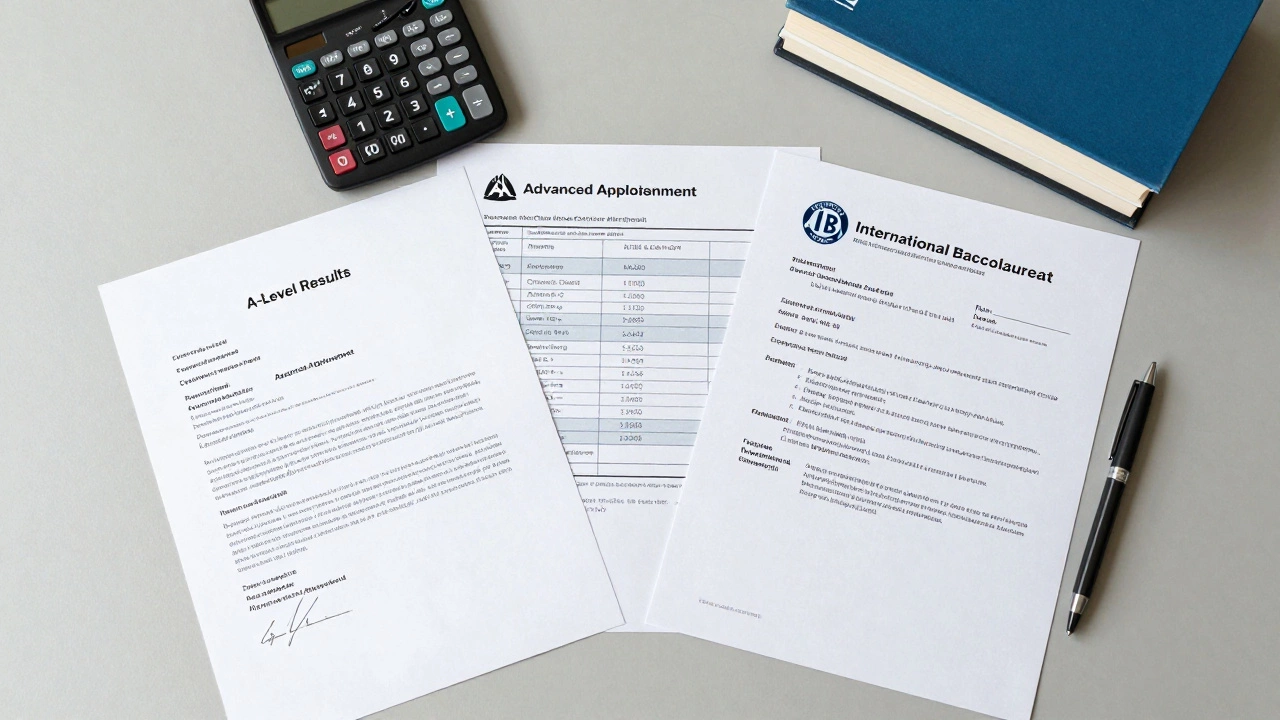
| Feature | A-Levels | AP Program | IB Diploma |
|---|---|---|---|
| Subjects Taken | 3-4 (Specialized) | Variable (Modular) | 6 + Core (Broad) |
| Assessment Style | Final Exams (mostly) | Final Exam (May) | Exams + Internal Assessments + Essays |
| US Recognition | High (Top Tier Universities) | Very High (Standard) | Very High (Prestigious) |
| College Credit | Indirect (Placement) | Direct (Score dependent) | Direct (Score dependent) |
If you hold an IB Diploma with a high score (36+), you are often seen as even more prepared for the liberal arts style of US education than an A-Level student, simply because you’ve been forced to write essays in history, analyze literature, and do science labs simultaneously.
The Baseline: US High School Diploma & GPA
It is crucial to understand that in the US, everyone gets a High School Diploma is the official certificate awarded upon completion of secondary education in the United States, signifying that a student has met state and local graduation requirements. This is not equivalent to A-Levels. It is equivalent to passing your GCSEs. To get into a good university, simply having the diploma isn't enough; you need to show academic excellence through your GPA (Grade Point Average).
Your GPA is a cumulative average of all your grades from 9th to 12th grade, calculated on a 4.0 scale. An A is 4.0, a B is 3.0, and so on. Because A-Levels are only two years, US admissions officers have to translate your A-Level predictions and final results into this context. Generally:
- AAA at A-Level translates roughly to a weighted GPA of 3.8-4.0.
- AAB might sit around 3.7-3.8.
- ABB could be viewed as a 3.5-3.6.
This conversion is not exact. Admissions officers look at the context. Did you take difficult subjects? Did you improve over time? Since A-Levels are external exams, they are trusted highly. They remove the ambiguity of teacher-graded GPAs, which can vary wildly between different US high schools.
Do You Need SAT or ACT Scores?
Historically, yes. The SAT and ACT are standardized tests used for college admissions in the United States, measuring reasoning skills in math, reading, and writing. were mandatory for almost every university. However, the landscape shifted dramatically post-2020. As of 2024-2026, many top universities (including Harvard, Yale, and UC Berkeley) are "test-optional" or have permanently dropped these requirements.
But here is the catch: if you are an international applicant with A-Levels, submitting a strong SAT score can still help. Why? Because it provides a standardized benchmark. An A-Level in Math is respected, but an SAT Math score of 750+ gives the admissions officer a quick, familiar data point to compare you against domestic students. If your A-Levels are stellar (A*A*A*), you likely don’t need the SAT. If they are good but not perfect (ABB), a high SAT can boost your profile significantly.
Navigating University Applications: Common App vs. UCAS
In the UK, you use UCAS. In the US, most students use the Common Application is a centralized online platform that allows high school students to apply to multiple US colleges and universities using a single set of materials. The process feels very different. UCAS is straightforward: grades, personal statement, reference. The Common App is holistic.
They want to know who you are outside the classroom. You will need to list extracurricular activities, community service, and leadership roles. For A-Level students, this can be a shock. We are trained to focus solely on academics. But in the US, a student with ABB and a vibrant resume (captain of the debate team, founder of a charity) might be preferred over a student with AAAA and no hobbies.
Also, pay attention to deadlines. Early Decision (ED) and Early Action (EA) deadlines in the US are usually November 1st or 15th. This is right in the middle of your A-Level exam preparation period. Plan ahead. You will need to submit predicted grades, and your final A-Level results must meet the conditions set by the university later in the summer.

Financial Considerations: Cost and Aid
Let’s talk money. US universities are expensive. Tuition at private institutions can exceed $50,000 per year. However, US universities offer substantial financial aid to international students, though it varies by school. Some, like MIT and Harvard, are "need-blind" for internationals, meaning they meet 100% of demonstrated financial need regardless of citizenship. Most others are "need-aware," meaning your ability to pay might influence your admission chances.
When applying, you will fill out the CSS Profile or the ISFAA form to demonstrate your financial situation. Scholarships based on merit (academic achievement) are also available, but they are competitive. Don’t assume you’ll get a full ride just because you have A-Levels. Research each university’s financial aid policy for international students thoroughly before applying.
Key Takeaways for A-Level Students
If you are standing at the crossroads between staying in the UK or heading to the US, keep these points in mind:
- A-Levels are respected: Top US universities know exactly what an A-Level is. They do not consider it inferior to APs or IB.
- Context matters: Highlight the difficulty of your subjects. Taking Further Mathematics or Physics at A-Level is a huge plus.
- Build a holistic profile: Start thinking about extracurriculars now. Document your hours, impact, and leadership.
- Consider the SAT: Even if optional, check if your target schools recommend it for international applicants.
- Deadlines are tight: US applications are due months before UK ones. Start drafting essays in Year 12 (Sixth Form Year 1).
The transition from the focused, exam-driven world of A-Levels to the holistic, activity-rich culture of US admissions is a shift in mindset, not just paperwork. Your academic rigor is your foundation, but your personality and experiences are the house you build on top of it.
Is A-Level harder than AP?
It depends on how you define "hard." A-Levels require deeper specialization in fewer subjects over two years, while APs cover college-level material in one year but often with less depth than A-Levels. Many educators argue that A-Levels are more rigorous in terms of subject mastery, whereas APs test breadth and speed. However, both are challenging and respected by universities.
Do US universities accept predicted A-Level grades?
Yes. When you apply via the Common App, you will submit your predicted grades from your Sixth Form teachers. These predictions are crucial for initial acceptance. However, your final offer is conditional. You must achieve the specific grades you were promised when your actual A-Level results are released in August.
Can I transfer AP credits if I already took them?
If you are currently in the US system and taking APs, yes. If you are an international student with only A-Levels, you cannot "transfer" AP credits because you haven't taken them. However, some universities may grant placement exams based on your A-Level performance, allowing you to skip introductory courses without having sat the AP exam.
Which is better for US colleges: A-Levels or IB?
Neither is objectively "better." Both are highly regarded. A-Levels demonstrate depth and specialization, which appeals to students who know their major. The IB demonstrates breadth and balance, which aligns well with the US liberal arts philosophy. Choose the curriculum that suits your learning style and strengths.
Do I need to take the IELTS or TOEFL if I did A-Levels in English?
Often, no. Many US universities waive English language proficiency tests for students who have completed A-Levels (or IB) with English as a medium of instruction, provided they achieved a certain grade (e.g., a B or above in A-Level English Language/Literature). Always check the specific language requirements of each university you apply to.