



Spaced Repetition Calculator
How well do you remember this flashcard?
Easy
I got this right on the first try
Medium
I got it right after a few tries
Hard
I had to look up the answer
If you’ve ever pulled an all-nighter before an exam only to forget half of what you studied by morning, you know memorization isn’t just about time-it’s about method. The fastest memorization method isn’t re-reading notes or highlighting textbooks. It’s not even cramming. It’s a science-backed technique called spaced repetition with active recall, and it’s been proven to work faster and last longer than any other approach.
Why Most Study Methods Fail
Most students think memorizing means repeating something until it sticks. You read a page. You highlight it. You read it again. Maybe you write it out. Then you move on. But here’s the problem: your brain doesn’t work like a video recorder. It forgets fast. Studies from the University of California, Los Angeles show that without active reinforcement, people forget over 70% of new information within 24 hours. That’s why cramming feels like it works-until you sit down for the test and your mind goes blank.The real issue isn’t how much you study. It’s how you study. Passive review doesn’t build memory. It creates an illusion of knowing. You feel familiar with the material, but your brain never had to retrieve it on its own. That’s why flashcards you glance at aren’t enough. You need to force your brain to work.
The Fastest Method: Spaced Repetition + Active Recall
The fastest memorization method combines two proven techniques:- Active recall: Testing yourself without looking at the answer.
- Spaced repetition: Reviewing material at increasing intervals based on how well you remember it.
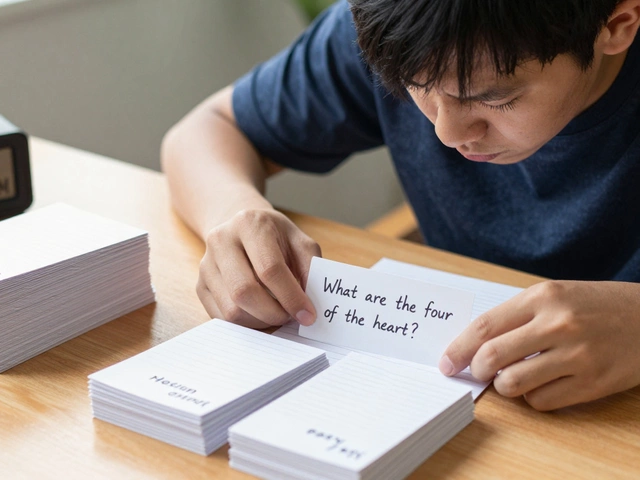
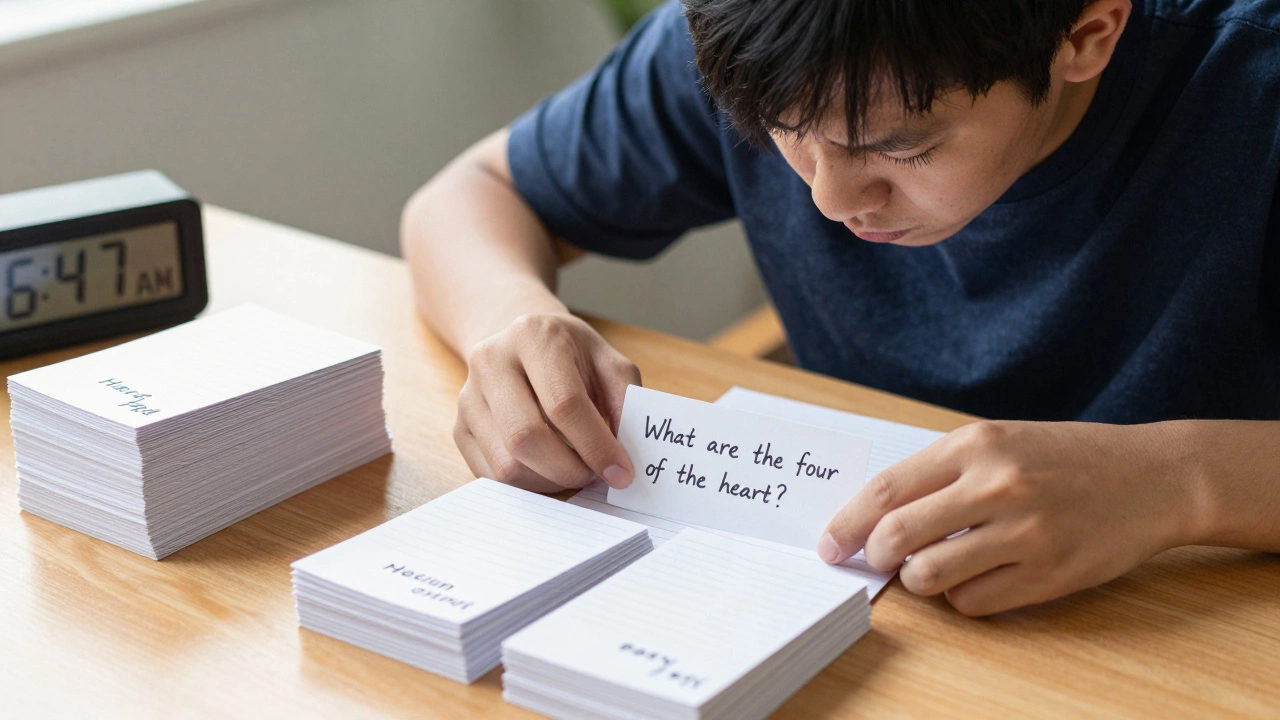
Here’s how it works in practice. Say you’re studying the parts of the human heart for a biology exam. Instead of reading about the atria and ventricles, close your book and ask yourself: What are the four chambers of the heart? Try to name them out loud or write them down. Then check your answer. If you got it right, wait a day before reviewing. If you got it wrong, review it tomorrow. The next time you review it, wait two days. Then four. Then seven. Each time you successfully recall it, you push the memory deeper into long-term storage.
This isn’t guesswork. It’s based on the forgetting curve discovered by psychologist Hermann Ebbinghaus in 1885. His research showed that memory fades predictably over time-but each time you recall something, the curve flattens. The more you retrieve a memory, the longer it lasts. Spaced repetition tools like Anki or Quizlet automate this process, but you don’t need an app. A simple notebook with flashcards works just as well.
Why This Beats Highlighting, Rereading, and Cramming
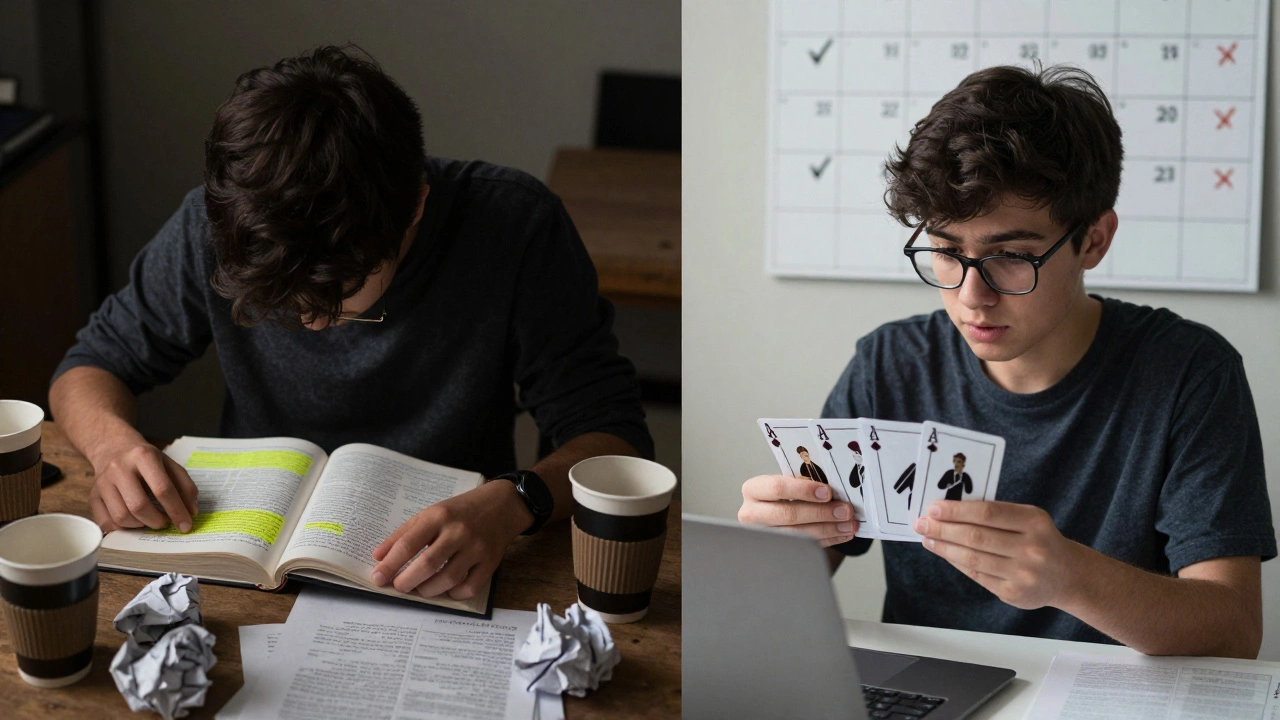
A 2013 study published in Psychological Science in the Public Interest compared 10 common study techniques. Only two were rated as having high utility: practice testing (active recall) and distributed practice (spaced repetition). Everything else-highlighting, summarizing, rereading, mnemonics, even doodling-ranked low or had no evidence of improving long-term retention.Here’s a real example. Two students study for a chemistry exam. Student A reads the textbook three times and highlights key reactions. Student B uses flashcards and tests themselves every day, spacing reviews over a week. On exam day, Student A feels confident. Student B feels prepared. When results come back, Student B scores 32% higher. Why? Because Student B’s brain had to work. Student A’s brain just passedively absorbed.
Spaced repetition doesn’t just work faster-it works smarter. You spend less time studying overall because you’re not wasting hours on things you already know. You focus only on what’s weak. That’s why medical students using spaced repetition can memorize 500+ anatomical terms in two weeks. It’s not magic. It’s structure.
How to Start Using It Today
You don’t need fancy tools. Here’s a simple 5-step plan to begin using the fastest memorization method:- Turn every fact into a question. Don’t write notes. Write flashcards with a question on one side and the answer on the other. For example: What is the capital of Sweden? Not: Stockholm is the capital of Sweden.
- Test yourself daily. Go through your cards. If you know it, put it in the “easy” pile. If you struggle, put it in the “hard” pile.
- Review hard cards the next day. Review easy cards in two days. Review medium cards in three days.
- Keep adding new cards. Don’t wait until the night before. Add 5-10 new cards each day, even if you’re studying for a test two weeks away.
- Use the “2-minute rule.” If you have 2 minutes between classes or waiting for coffee, review one card. That’s 10-15 reviews a day without extra time.
This method scales. Whether you’re memorizing vocabulary for a language exam, formulas for physics, or dates for history, the process stays the same. You’re not memorizing content-you’re training your brain to retrieve it.
Common Mistakes That Slow You Down
Even when people try spaced repetition, they mess it up. Here are the top three mistakes:- Not testing hard enough. If you just glance at the card and say “I know this,” you’re fooling yourself. Force yourself to say the answer aloud before flipping.
- Reviewing too often. If you review every day, you’re not spacing. You’re just repeating. Let yourself forget a little. That’s when the memory strengthens.
- Waiting too long to start. If you wait until a week before the exam to make flashcards, you’re already behind. Start on day one. Even 10 minutes a day adds up.
One student I worked with waited until three days before her AP Biology exam to start. She made 120 flashcards in one night. She studied for 6 hours. She failed. The next year, she started on day one. Made 20 cards a day. Used spaced repetition. Scored a 5. The difference wasn’t intelligence. It was timing and technique.
When You Need to Memorize Fast-Last-Minute Hack
Sometimes, you don’t have weeks. Maybe you have 48 hours. You still use the same method-just compressed.Here’s the 48-hour plan:
- Hour 1-2: Write flashcards for every key term, formula, or concept. No fluff. Just facts.
- Hour 3-4: Test yourself. Sort cards into “know,” “sort of,” and “don’t know.”
- Hour 5-6: Focus only on “don’t know” and “sort of.” Review them twice.
- Next day, hour 1: Review “don’t know” cards again. Test yourself without looking.
- Next day, hour 2: Do a full mock quiz using only your flashcards.
This isn’t ideal-but it’s the fastest way to lock in information when time is short. The key is still active recall. No reading. No highlighting. Just testing.

What About Mnemonics, Songs, or Visualization?
Mnemonics can help with specific facts-like “My Very Educated Mother Just Served Us Noodles” for the planets. But they don’t scale. You can’t build a 200-item mnemonic system for a medical exam. They’re useful for one-off items, not deep learning.Visualization works for spatial memory-like remembering a map or layout. But for abstract concepts like chemical reactions or historical causes? Not efficient. They add extra steps. The fastest method cuts the middleman: question → recall → repeat.
Real Results, Real People
A 2021 study tracked 1,200 college students preparing for final exams. Those who used spaced repetition and active recall studied 37% less time than others-but scored 28% higher on average. One student, a pre-med major, memorized 1,400 drug names and their side effects in three weeks using Anki. He passed his pharmacology exam with a 96%. He didn’t study more. He studied better.Another student, preparing for the MCAT, used this method to go from a 498 to a 518 in three months. He didn’t hire a tutor. He didn’t buy expensive courses. He made flashcards and tested himself every day.
There’s no secret. No shortcut. Just a system that works because it matches how your brain actually learns.
Final Tip: Track Your Progress
Keep a simple log. Each day, note:- How many cards you reviewed
- How many you got right
- How long you studied
After a week, you’ll see patterns. You’ll know which topics are sticking. Which ones keep slipping. You’ll stop guessing. You’ll know exactly where to focus.
The fastest memorization method isn’t about speed. It’s about efficiency. It’s about making every minute count. And when exam day comes, you won’t be hoping you remembered enough. You’ll know you did.
Is there a memorization method faster than spaced repetition?
No. Spaced repetition combined with active recall is the fastest and most scientifically proven method for long-term memorization. Other techniques like rereading, highlighting, or cramming feel faster in the short term but lead to rapid forgetting. Studies show spaced repetition builds stronger, longer-lasting memories with less total study time.
Do I need an app like Anki to use spaced repetition?
No. While apps like Anki, Quizlet, or RemNote automate the scheduling, you can do it with paper flashcards. Write questions on one side, answers on the other. Sort them into piles based on how well you know them. Review the tough ones more often. The system works the same-whether digital or physical. The key is consistency, not the tool.
How long does it take to see results with spaced repetition?
You’ll notice a difference in just 3-5 days. Your recall will become faster, and you’ll stop forgetting things you reviewed a week ago. After two weeks, you’ll be able to retain information for months. The real benefit shows up during exams-you’ll remember facts you studied weeks earlier without panic.
Can I use this method for languages or math formulas?
Yes. It works for any factual content: vocabulary, equations, historical dates, chemical reactions, legal terms. For math, turn formulas into questions: What’s the quadratic formula? For languages: How do you say ‘thank you’ in Spanish? The method adapts to any subject where you need to recall specific information.
What if I forget something even after reviewing it multiple times?
That’s normal. If something keeps slipping, break it down. Instead of memorizing a long definition, isolate the key term. Make a simpler card. Add context. For example, instead of What is photosynthesis?, try What two things does a plant need for photosynthesis? Sometimes the problem isn’t memory-it’s how the question is framed.
Should I study in long sessions or short bursts?
Short bursts. Ten minutes of focused flashcard review is more effective than two hours of passive reading. Your brain learns best in small, repeated doses. Aim for 10-20 minutes per session, 2-3 times a day. Consistency beats marathon sessions every time.