





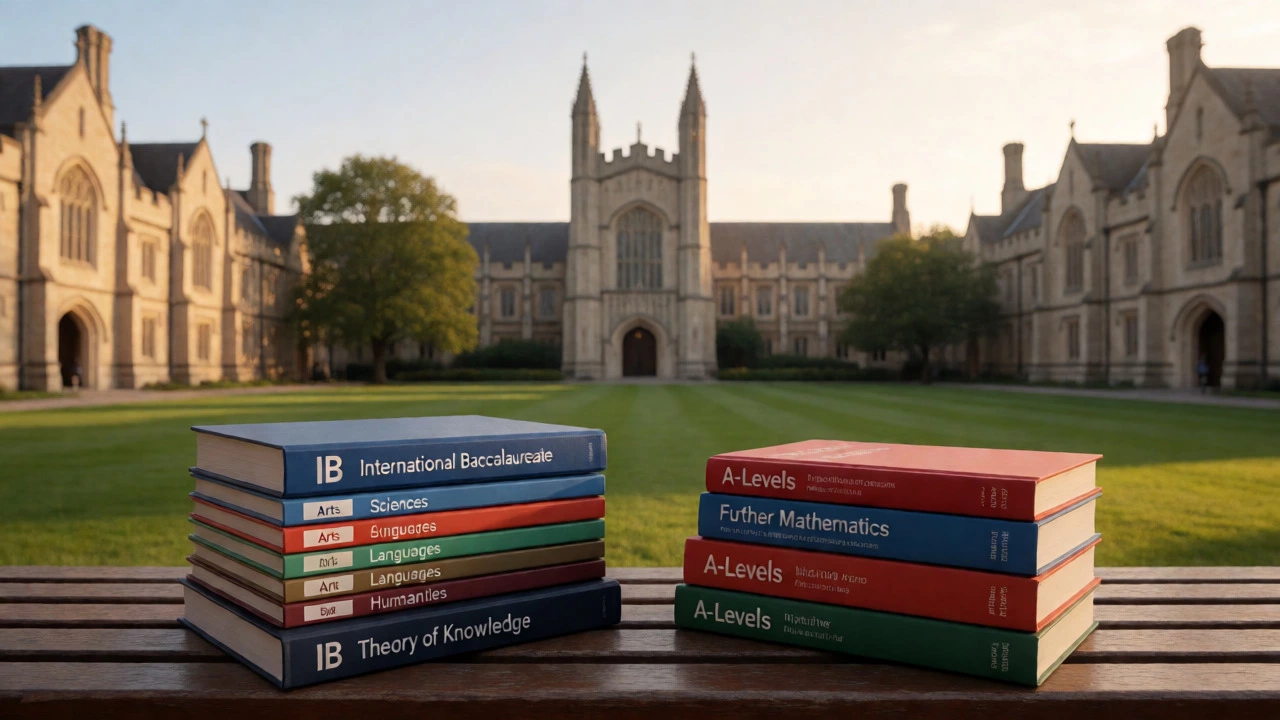
Yale Admissions Fit Quiz: IB vs. A-Levels
Not sure which path suits you best? Answer these 5 questions to see which curriculum might highlight your strengths more effectively for a Yale application.
1. How do you feel about studying subjects outside your primary interests?
2. What is your approach to assessment?
3. How much time can you dedicate to extracurriculars during exam years?
4. Which narrative sounds more like you?
5. How do you handle writing long-form independent research?
Why this fits?
Yale Tip
You’re staring at two different paths to the same door. On one side, the International Baccalaureate (IB) with its core components like Theory of Knowledge and CAS projects. On the other, the A-Levels, offering deep specialization in three or four subjects. You want into Yale. Does the Ivy League school care which badge you wear? The short answer is no, Yale doesn’t have a hidden preference for one over the other. But the longer answer is where the real strategy lives. It’s not about what Yale prefers; it’s about how each qualification highlights your strengths differently.
Quick Summary / Key Takeaways
- Yale treats IB and A-Levels as equivalent academic standards when evaluating international applicants.
- The decision should hinge on your personal learning style: breadth (IB) versus depth (A-Levels).
- High scores matter most: aim for 40+ in IB or AAA/A*AA in A-Levels to be competitive.
- Subject choice flexibility is higher with A-Levels, while IB forces a balanced six-subject load.
- Extracurriculars and essays often outweigh minor differences in curriculum prestige.
The Myth of the Preferred Curriculum
Let’s kill the rumor right now. Yale’s admissions office does not sit around debating whether an IB student is "smarter" than an A-Level student. They are looking for academic rigor and intellectual curiosity. Both qualifications are globally recognized as gold-standard pre-university credentials. When an admissions officer from New Haven looks at a transcript from a British school system and another from an IB World School, they see comparable levels of difficulty. They know that getting an A* in Further Mathematics is just as tough as scoring a 7 in Higher Level Math Analysis and Approaches. The difference isn't in the value of the certificate; it's in the narrative you build around it.
If you’re worried that choosing A-Levels makes you look less "well-rounded," stop. If you think IB automatically gives you a leg up because of the extended essay, pause. Yale evaluates the whole person. They want to see that you can handle college-level work. Whether you prove that through the structured, broad approach of the IB Diploma Programme or the specialized, intense focus of A-Levels is secondary to the grades you achieve and the story you tell in your application.
How Yale Interprets Your Grades
Understanding how these systems translate to Yale’s expectations is crucial. For A-Level students, Yale typically expects predicted grades of AAA or higher, often including specific subjects relevant to your intended major. For example, if you’re applying for Engineering, they’ll expect A*s in Maths and Physics. The grading scale is straightforward: A*, A, B, C, D, E. There’s little ambiguity here.
For IB students, the expectation is similarly high but structured differently. You need a total score of 40 or above out of 60 to be considered a strong candidate. This usually means securing 6s and 7s in your Higher Level subjects. The IB also includes the Core (Theory of Knowledge, Extended Essay, Creativity, Activity, Service), which adds points but also complexity. Admissions officers understand the conversion scales used by universities worldwide, so they don’t penalize you for the format. They look for consistency. Did you maintain high performance across all six subjects in IB? Or did you excel in your three chosen A-Level subjects? Both show discipline, just in different ways.
| Feature | International Baccalaureate (IB) | A-Levels |
|---|---|---|
| Academic Breadth | Mandatory study of six subjects across arts, sciences, languages, and humanities. | Focus on 3-4 subjects chosen based on career goals or interests. |
| Core Components | Theory of Knowledge (TOK), Extended Essay (EE), and CAS project required. | No mandatory core; focus is entirely on subject-specific exams. |
| Assessment Style | Mix of internal assessments, external exams, and coursework. | Predominantly final external examinations (though some coursework remains). |
| Competitive Score | 40+ points out of 60, with 6s/7s in HL subjects. | AAA to A*A*A, depending on course competitiveness. |
| Flexibility | Low; strict rules on subject combinations. | High; freedom to drop unrelated subjects early. |
Breadth vs. Depth: Choosing Your Weapon
This is where your personality comes into play. The IB is designed to create well-rounded scholars. You cannot ignore math if you love literature, nor can you skip science if you’re an artist. This breadth appeals to Yale’s liberal arts philosophy. They want students who can connect disparate ideas. If you thrive on variety and enjoy juggling multiple disciplines simultaneously, the IB structure might actually help your application stand out by demonstrating versatility. It shows you can manage a heavy, diverse workload without dropping balls.
A-Levels, conversely, allow for laser-focused expertise. If you are deeply passionate about History and Politics, you can drop everything else and dive headfirst into those fields. This depth can be impressive if your extracurricular activities align perfectly with those subjects. Imagine applying to Yale’s political science program with top marks in History, Government, and Economics, backed by debate club leadership. That coherence is powerful. Yale appreciates students who know what they want to study. If you’re undecided, the IB’s forced diversity might feel like a burden, but it could also help you discover a new interest before you commit to a major.

The Role of Extracurriculars and Essays
Here’s the truth that many students miss: once you hit the threshold of good grades, academics take a back seat. Both IB and A-Level students with perfect scores get rejected every year. Why? Because Yale admits people, not transcripts. Your Common Application essay, your supplemental essays for Yale, and your activity list carry massive weight.
Does the IB give you more material for essays? Potentially. The Extended Essay requires independent research, which can spark a compelling narrative about your intellectual journey. The CAS requirement forces you to engage with your community, providing concrete examples of service and leadership. However, A-Level students often have more time to dedicate to sports, music, or volunteering because their academic schedule is narrower. An A-Level student who captains a national sports team and volunteers weekly might present a stronger profile than an IB student who barely scraped by on CAS hours. Don’t let the curriculum dictate your life outside school. Use whatever time you have to pursue passions that define you.
Strategic Considerations for International Applicants
If you are studying outside the US, context matters. Yale understands that educational systems vary. They use regional admissions officers who know the reputation of local schools. If you attend a prestigious IB school known for producing Yale admits, that context helps. Similarly, if you’re at a UK sixth form with a strong track record of sending students to Ivy Leagues, that history counts.
Consider the timing of your results. A-Level results come later in the summer than IB results. This can affect conditional offers. Yale usually makes decisions before final A-Level results are published, relying on predicted grades. IB results are also predicted initially. Ensure your teachers write accurate, strong predictions. Over-predicting can lead to awkward situations if you miss the offer, though Yale rarely rescinds offers for minor grade dips if the rest of the application was stellar.
Also, think about credit transfer. Many US colleges grant credit for high IB scores (usually 5, 6, or 7 in HL subjects). Some accept A-Levels too, but policies vary widely. Check Yale’s specific transfer credit policy. Getting ahead in college courses can save time and money, making the practical benefits of one curriculum over the other worth considering beyond just admission chances.

Common Pitfalls to Avoid
Don’t choose a curriculum solely because you think Yale likes it. Choose it because it fits your learning style. If you struggle with writing long essays under timed conditions, the IB’s heavy assessment load might overwhelm you, leading to lower grades. Lower grades hurt your application more than the curriculum type ever could. Conversely, if you lack self-discipline, the freedom of A-Levels might lead to procrastination and mediocre results.
Another mistake is neglecting English proficiency. Regardless of whether you do IB or A-Levels, if English isn’t your first language, you’ll likely need to submit TOEFL or IELTS scores. High scores here reinforce your ability to cope with Yale’s rigorous reading and writing demands. Don’t assume that doing an English-medium curriculum exempts you; check the waiver criteria carefully.
Final Verdict: What Should You Do?
So, does Yale prefer IB or A-Levels? They prefer excellence. They prefer authenticity. They prefer students who challenge themselves within their chosen framework. If you are a specialist who loves diving deep into two or three subjects, go for A-Levels and ace them. If you are a generalist who enjoys connecting dots across disciplines and has strong time management skills, the IB will showcase your abilities beautifully.
Your best move is to talk to your current teachers. Ask them honestly: "Which system would allow me to achieve my highest potential?" Their insight into your work habits is more valuable than any online forum debate. Then, focus on building a rich life outside the classroom. Write essays that sound like you, not like a template. Lead initiatives that matter to you. Show Yale that you’re ready to contribute to their community, regardless of the alphabet soup on your transcript.
Is IB harder than A-Levels?
It depends on the student. IB is often considered more demanding due to the breadth of six subjects plus the core requirements (TOK, EE, CAS). A-Levels are deeper but narrower. Students who struggle with time management may find IB harder, while those who dislike being forced to study unrelated subjects may find A-Levels easier.
Does Yale accept A-Levels instead of SATs?
Yes, Yale accepts A-Level results in place of SAT or ACT scores for international applicants. Strong A-Level grades (typically AAA or higher) demonstrate sufficient academic readiness. However, submitting SAT scores can sometimes strengthen an application if the scores are exceptional, even with good A-Levels.
What IB score do I need for Yale?
To be competitive for Yale, aim for a total score of 40 or higher out of 60. Ideally, you should have 6s or 7s in your Higher Level subjects. Scores below 38 make admission significantly more difficult unless you have extraordinary achievements in other areas.
Can I apply to Yale with only two A-Levels?
Generally, no. Most successful applicants have completed three or four A-Levels. Applying with only two subjects may signal a lack of academic breadth or rigor compared to peers. Unless there are exceptional circumstances, completing three A-Levels is the standard expectation for US university applications from the UK system.
Do IB and A-Level students compete against each other?
Not directly. Yale uses holistic review. While they compare academic metrics, they evaluate students within the context of their school and country. An IB student from India and an A-Level student from the UK are assessed based on their respective opportunities and challenges. The competition is global, but the evaluation is contextual.