






Acorn Profile Screening Tool
What is the Acorn Profile?
The Acorn profile describes autistic children who are quiet, observant, and deeply focused—often overlooked in classrooms because they don't show "classic" autism behaviors. This tool helps educators and parents recognize subtle signs that may indicate an Acorn profile.
Results
Your score: 0/7 points
There’s no such thing as "Acorn autism" as a medical diagnosis. But if you’ve heard the term, you’re likely referring to the Acorn profile-a way educators and therapists describe a specific pattern of autism traits seen in some children, especially those who are quiet, observant, and deeply focused. It’s not in the DSM-5 or ICD-11. It’s not a clinical label. But in schools across Ireland, the UK, and beyond, it’s become a useful shorthand for understanding how some autistic kids learn, behave, and interact.
Where Did the Acorn Profile Come From?
The Acorn profile emerged from classroom observations, not labs. Teachers in special needs education noticed a group of children who didn’t fit the stereotypical image of autism. These weren’t the kids who shouted in class or flapped their hands. They were the ones sitting quietly in the corner, drawing intricate patterns, memorizing train schedules, or correcting grammar in books no one else read. They often passed standard screening tools because they didn’t show "obvious" signs. But they struggled-deeply-with social cues, sensory overload, and transitions.
One early adopter of this framework was a special education coordinator in County Cork who started using the terms "Acorn" and "Oak" to describe two very different autism profiles. The Acorn kids were subtle. The Oak kids were more visible in their needs. The metaphor stuck: Acorns are small, hidden, and often overlooked-but they grow into something strong if given the right soil.
What Does an Acorn Profile Look Like in Real Life?
Here’s what you might see in a child with an Acorn profile:
- They speak little in group settings but write detailed answers on paper
- They notice small changes-a moved chair, a different teacher’s tie, a broken tile-and become visibly distressed
- They have intense, narrow interests: vintage clocks, cloud types, the history of Irish railways
- They avoid eye contact not out of rudeness, but because it feels physically overwhelming
- They excel in subjects like math or science but freeze during unstructured social time like lunch or PE
- They may be labeled "shy," "daydreamers," or "lazy"-until someone looks deeper
One student in a Dublin primary school was described by her teacher as "too quiet to be autistic." She never tantrumed. She never ran out of class. But she would spend entire recesses tracing the same leaf pattern in her notebook. When asked to join a game, she’d nod and stay still. Her anxiety spiked every time the bell rang unexpectedly. Once her school used the Acorn framework to understand her, they gave her a quiet space, a visual schedule, and allowed her to communicate via written notes. Her grades improved. So did her confidence.
Why the Acorn Profile Matters in Schools
Most autism support systems are built for the "Oak" profile-kids who need structured behavioral plans, sensory rooms, or one-on-one aides because their needs are loud and visible. The Acorn profile slips through. They don’t disrupt. They don’t cry out. So they’re often missed until they burn out.
A 2023 study by the Irish Autism Action network found that 42% of autistic children identified in primary schools had been previously labeled as "just introverted" or "gifted but awkward." Many of these children were later diagnosed with autism after a teacher noticed the Acorn pattern: high cognitive ability masked by extreme social anxiety and sensory sensitivity.
When schools don’t recognize the Acorn profile, kids internalize their struggles. They believe they’re "broken" because they can’t do what others do easily-like making friends, joining group work, or speaking up. By the time they hit secondary school, many are anxious, depressed, or refusing to attend.
How to Support an Acorn-Profile Child
Supporting an Acorn-profile child isn’t about fixing them. It’s about removing barriers. Here’s what works:
- Give them time and space. Don’t force social interaction. Let them observe first.
- Use written or visual communication. Many Acorn kids process language better on paper or through pictures.
- Stick to routines. Predictability reduces anxiety. A visual timetable helps more than verbal reminders.
- Allow stimming. Fidget toys, rocking, or doodling aren’t distractions-they’re regulation tools.
- Teach self-advocacy. Help them learn to say, "I need quiet," or "Can I write this instead?"
- Involve them in planning. Ask what helps them feel safe. They often know better than adults.
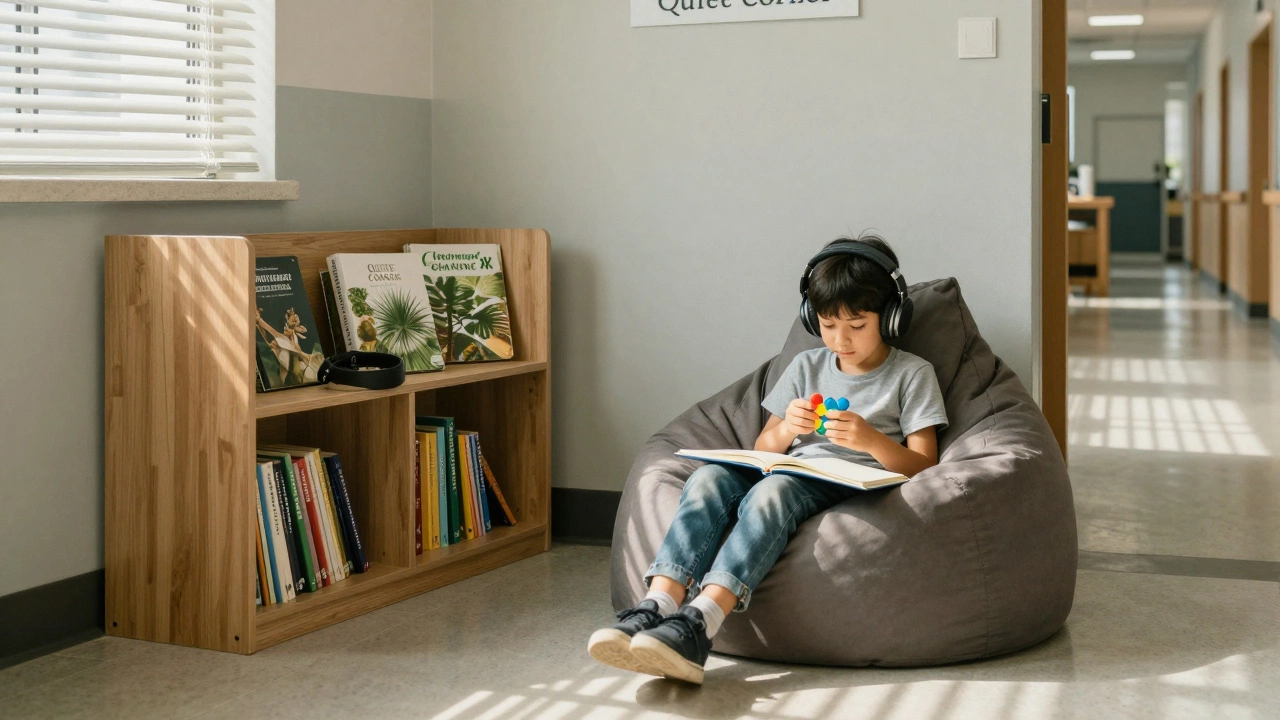
One school in Galway introduced "Quiet Corner Time"-15 minutes after lunch where kids could sit with books, puzzles, or noise-canceling headphones. The number of Acorn-profile students who left school early dropped by 68% in one term.
Acorn vs. Oak: Two Sides of the Same Coin
The Acorn profile isn’t "mild autism." It’s not less serious. It’s just different. The Oak profile might need help managing meltdowns. The Acorn profile might need help managing shutdowns. Both are equally valid. Both require support.
Think of it this way: Oak kids need space to explode. Acorn kids need space to breathe. One isn’t better than the other. But schools often only have systems for the Oaks.
Many Acorn children grow up to be engineers, writers, researchers, or artists. Their strength lies in deep focus, attention to detail, and honesty. But they need environments that don’t punish quietness or mistake stillness for disengagement.

What Parents and Teachers Should Avoid
There are common mistakes made with Acorn-profile children:
- Pushing them to "be more social"-this increases anxiety, not connection
- Interpreting silence as defiance or lack of effort
- Comparing them to neurotypical peers or even to "more obvious" autistic children
- Waiting until they have a breakdown before offering help
- Assuming they don’t care because they don’t talk
Instead, look for the signs: a child who writes beautifully but won’t read aloud, who remembers every detail of a story but can’t explain how they felt about it, who prefers to play alone but watches others with intense interest. These aren’t quirks. They’re clues.
Getting the Right Support
If you suspect your child or student has an Acorn profile, start with:
- Requesting a school-based assessment through the National Council for Special Education (NCSE)
- Asking for an Individual Education Plan (IEP) that includes sensory and communication accommodations
- Connecting with Autism Ireland or the Irish Autism Action network for parent workshops
- Using tools like the Autism Spectrum Quotient (AQ) for Children or the Social Communication Questionnaire (SCQ) as starting points
Remember: you don’t need a formal diagnosis to begin support. Many schools in Ireland now use the Acorn framework as a practical tool-even before diagnosis-to adjust teaching methods and reduce stress.
Final Thought: Quiet Doesn’t Mean Empty
The Acorn profile reminds us that autism isn’t one thing. It’s a spectrum of experiences-and some of the brightest minds hide in plain sight. They don’t need to be louder. They need to be seen. They need classrooms that value stillness as much as speech, depth as much as speed, and quiet focus as much as group participation.
If you’re a teacher, a parent, or someone who works with children-look beyond the noise. The quiet ones are still learning. They’re just doing it in their own way.
Is Acorn autism a real diagnosis?
No, "Acorn autism" is not a medical or clinical diagnosis. It’s a descriptive term used in special education to describe a quiet, observant profile of autism where children show strong focus and internal processing but struggle with social cues and sensory overload. It helps educators recognize autism in kids who don’t fit the stereotypical image.
How is the Acorn profile different from other types of autism?
The Acorn profile differs mainly in how autism presents. While some autistic children show outward behaviors like stimming, meltdowns, or verbal outbursts (often called the "Oak" profile), Acorn-profile children are quieter. They may avoid eye contact, speak little, and internalize stress. Their challenges are less visible, which often leads to them being overlooked or misunderstood as shy or disinterested.
Can a child with an Acorn profile succeed in mainstream school?
Yes, absolutely. Many Acorn-profile children thrive in mainstream schools when given the right supports: visual schedules, quiet spaces, written communication options, and time to process. They often excel in subjects that match their interests. The key is not changing the child, but adjusting the environment to reduce anxiety and allow their strengths to shine.
What should teachers do if they suspect a student has an Acorn profile?
Start by observing patterns: Does the child avoid group work? Do they notice small changes in the environment? Do they have intense interests? Document these observations and speak with the school’s special educational needs coordinator (SENCO). Request a classroom observation by an educational psychologist. Use tools like visual timetables and quiet breaks to test what helps. You don’t need a diagnosis to begin supporting them.
Are Acorn-profile children more likely to be misdiagnosed?
Yes. Because they don’t display disruptive behaviors, Acorn-profile children are often mislabeled as anxious, introverted, gifted but awkward, or even lazy. Some are diagnosed with ADHD or selective mutism before autism is considered. This delay can lead to years of unnecessary stress. Recognizing the Acorn profile helps avoid these misdiagnoses.