






GCSE to US University Requirements Calculator
US University Eligibility Assessment
Based on typical US university requirements, determine if your GCSE results meet minimum admission criteria.
Enter your GCSE details to see if you meet US university requirements.
Key Requirements
- Required Minimum 5 GCSEs at Grade 4+ including English and Mathematics
- Recommended Grade 5+ for stronger university consideration
- Note U.S. universities evaluate GCSEs as part of your academic record
If you're used to the UK education system and you're trying to understand how GCSEs fit into American schooling, you're not alone. Many students, parents, and even universities ask: What is the American GCSE equivalent? The short answer is there isn't a single direct match - but the closest comparison is the combination of completing high school and earning a high school diploma in the United States.
GCSEs Are Not a Single Test - They're a System
GCSEs (General Certificate of Secondary Education) aren't one exam you take at the end of school. They're a set of subject-based qualifications taken by students in England, Wales, and Northern Ireland around age 16, after completing Key Stage 4. Most students take between 8 and 10 GCSEs, covering core subjects like English, Maths, Science, and a few electives like History, French, or Art.
Each GCSE is graded from 9 to 1 (with 9 being the highest), replacing the old A*-G system. A grade 4 is considered a 'standard pass' and a grade 5 is a 'strong pass'. These grades matter because they determine whether you can move on to A Levels, vocational courses, or apprenticeships.
In the U.S., there's no single exam that mirrors this structure. Instead, students complete a series of courses over four years, and their final credential is a high school diploma - earned by meeting state-specific credit requirements, not by passing standardized subject exams.
The American High School Diploma: The Closest Match
The American high school diploma is the closest thing to the outcome of completing GCSEs. It’s awarded after successfully finishing required courses in English, Math, Science, Social Studies, and electives - usually over grades 9 through 12.
Unlike GCSEs, there’s no national exam system in the U.S. Each state sets its own graduation requirements. For example:
- In California, students need 13 years of coursework across core subjects.
- In Texas, students must pass end-of-course exams in five subjects: Algebra I, English I, English II, Biology, and U.S. History.
- In New York, students must pass five Regents exams to earn a standard diploma.
So while the U.S. doesn’t have a centralized GCSE-style exam, some states do use end-of-course tests that function similarly - especially New York’s Regents exams. Passing these tests is mandatory, just like earning passing grades in GCSEs.
What About Standardized Tests Like the SAT or ACT?
You might hear people say the SAT or ACT is the American equivalent of GCSEs. That’s misleading.
The SAT and ACT are college admissions tests. They’re taken by juniors or seniors - usually around age 17 or 18 - and they measure readiness for college, not completion of secondary education. A student can take the SAT without ever passing a single GCSE. Likewise, a U.S. student can graduate high school with a diploma and never take the SAT.
Think of it this way: GCSEs are like finishing high school. The SAT is like applying to college. They’re two different steps.
Some U.S. high schools offer Advanced Placement (AP) courses - which are more like A Levels in the UK. AP exams are taken after GCSE-equivalent coursework and are used for college credit. So if you’re comparing levels, GCSEs are before APs, not the same as them.
How Do Colleges View GCSEs vs. U.S. Diplomas?
When U.S. universities evaluate international applicants, they look at GCSE results as part of a student’s academic record. They don’t say, “You need an American diploma,” because they understand the UK system.
Most U.S. colleges will accept a student who has completed GCSEs with at least five passes at grade 4 or higher - including English and Maths - as equivalent to a U.S. high school diploma. Many also look at GCSE grades to judge a student’s academic strength before they take A Levels.
For example, if a student from the UK applies to a U.S. university with five GCSEs at grade 7 (A), they’re seen as having strong academic preparation - similar to a U.S. student with top grades in rigorous courses.
But if a student only has two GCSEs, they likely won’t be accepted without further education - just like a U.S. student who dropped out of high school wouldn’t be.
What About GED?
The GED (General Educational Development) is sometimes mentioned as the American equivalent of GCSEs. But it’s not.
The GED is a high school equivalency credential for people who didn’t finish high school. It’s a single test covering four subjects: Math, Science, Social Studies, and Reasoning Through Language Arts. Passing it earns you a credential equal to a high school diploma.
It’s more like the UK’s Functional Skills or an adult education route - not the standard path for 16-year-olds. Most U.S. students don’t take the GED. They graduate from high school normally.

Why the Confusion? It’s About Timing and Structure
The biggest source of confusion is timing. In the UK, students take GCSEs at 16. In the U.S., students are still in 10th grade at 16 - halfway through high school.
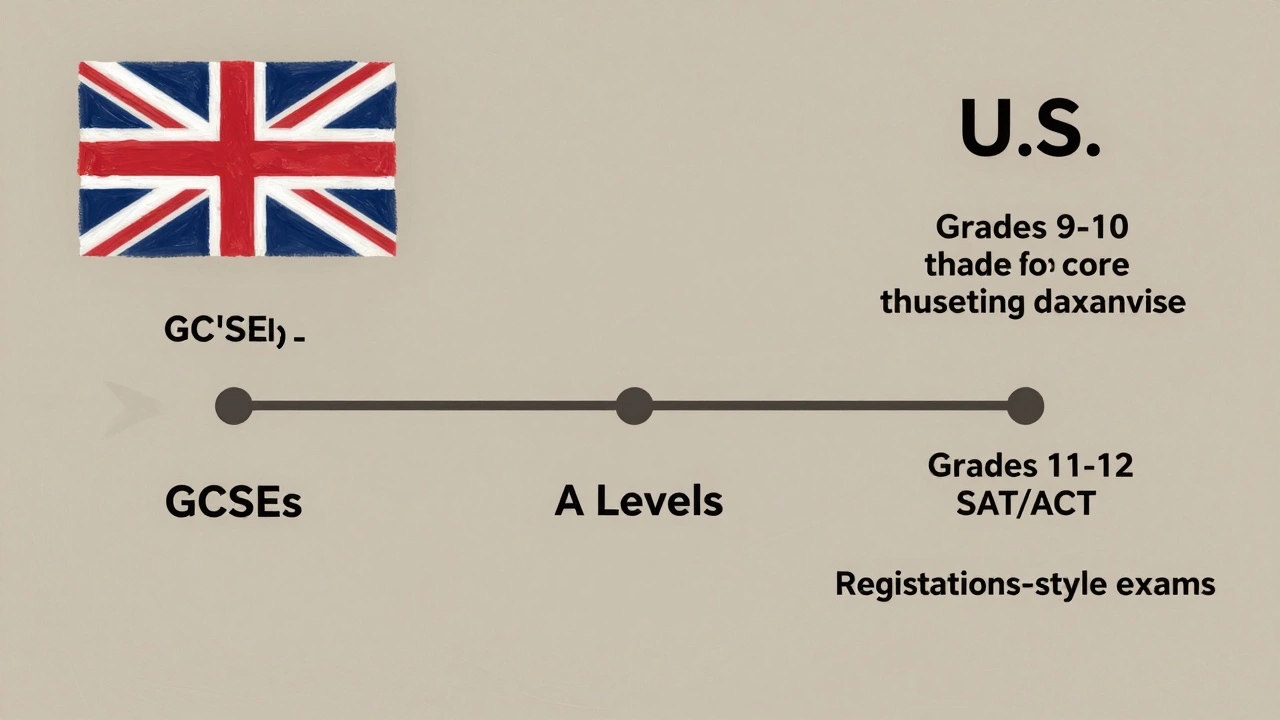
Think of it this way:
- UK: Year 10-11 (ages 15-16) → GCSEs
- US: Grade 9-10 (ages 14-16) → Completing core subjects
- UK: Year 12-13 (ages 16-18) → A Levels
- US: Grade 11-12 (ages 16-18) → Final high school years + SAT/ACT
So GCSEs roughly align with the end of 10th grade in the U.S. - not the end of high school. That’s why the American equivalent isn’t a single test or credential. It’s the entire process of completing 10th grade coursework with passing grades in core subjects.
Practical Takeaway: What Should You Do?
If you’re a UK student applying to U.S. colleges:
- Make sure you have at least five GCSEs at grade 4 or higher, including English and Maths.
- Keep your grades strong - U.S. admissions officers look at them as indicators of academic discipline.
- Don’t worry about matching your GCSEs to SAT scores. They serve different purposes.
- If you’re applying as an adult without GCSEs, a GED + college prep courses may be your path.
If you’re a U.S. student trying to understand UK qualifications:
- GCSEs = finishing the first half of high school.
- A Levels = the final two years of high school, with deeper subject focus.
- AP exams = similar to A Levels, but taken in the U.S. system.
There’s no perfect one-to-one translation. But if you understand that GCSEs mark the end of compulsory education in the UK - and that U.S. students are still in school at that age - the picture becomes much clearer.