






Andragogy vs. Pedagogy: Interactive Comparison
Explore the fundamental differences between how children learn versus how adults learn. Click on each principle below to see detailed comparisons.
| Principle | PedagogyChild-Centered | AndragogyAdult-Centered |
|---|
Real-World Scenario Challenge
You are designing a training program. Select the approach that best aligns with Andragogy for each situation.
Score: 0/3
Have you ever sat through a training session that felt like high school all over again? The instructor lectures from the front, you take notes passively, and by lunchtime, half the room is mentally checking out. If so, you’ve experienced the clash between traditional teaching methods and how adults actually learn.
The core answer to your question lies in a concept called andragogy. Unlike pedagogy, which focuses on children who are dependent learners, andragogy is the art and science of helping adults learn. It was popularized by educator Malcolm Knowles in the 1970s, but its roots go back further. The fundamental principle isn't just one rule; it's a shift in mindset. Adults don't learn best when they are told what to do. They learn best when they understand why they are doing it, when they can draw on their own experiences, and when they have control over their learning journey.
The Shift from Pedagogy to Andragogy
To understand adult learning, we first need to look at what it is not. Traditional education, or pedagogy, assumes the learner is dependent. A child goes to school because parents send them there. The teacher decides what is important, sets the goals, and controls the environment. The child’s experience is largely irrelevant to the curriculum.
Adults are different. When you are an adult, you are autonomous. You choose to learn a new software skill because your boss asked for it, or you want to learn Spanish because you’re moving to Madrid. This autonomy changes everything. According to Knowles’ theory, as people mature psychologically, their self-concept moves from being a dependent personality toward being a self-directed human being. Ignoring this fact is the number one reason corporate training fails.
If you treat an adult learner like a child, you risk triggering resistance. They might think, "Why am I wasting my time with this basic stuff?" or "Who are you to tell me how to do my job?" Effective adult education respects the learner’s capacity to make their own decisions.
Core Principles of Andragogy
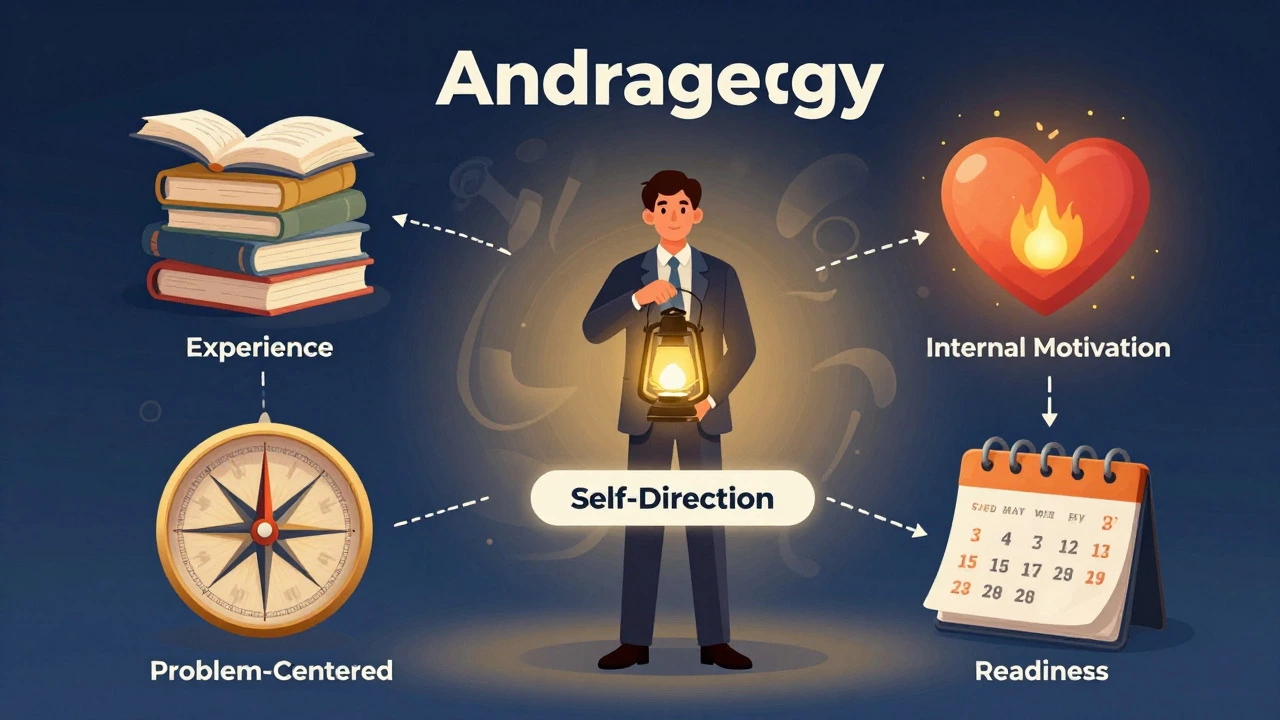
Malcolm Knowles identified six major assumptions about adult learners. While these aren't rigid laws-they vary by individual and culture-they provide a powerful framework for anyone designing workshops, courses, or mentoring programs.
| Assumption Area | Pedagogy (Child-Centered) | Andragogy (Adult-Centered) |
|---|---|---|
| Self-Concept | Dependent on the teacher | Self-directed and autonomous |
| Experience | Limited; little value in learning | Rich resource for learning; accumulates over time |
| Readiness to Learn | Determined by biological age/curriculum | Determined by social roles and life tasks |
| Orientation to Learning | Subject-centered (future application) | Problem-centered (immediate application) |
| Motivation | External (grades, praise, fear) | Internal (self-esteem, quality of life, career growth) |
1. The Need to Know Why
Before an adult will commit to learning something, they need to know why it matters. Children often accept authority: "Because I said so" works in a kindergarten classroom. In a boardroom or a community college class, it doesn’t work.
Adults are pragmatic. They want to know how the information applies to their lives right now. If you are teaching a safety protocol, don't just list the rules. Explain the specific accidents that happened last year because those rules were ignored. Connect the content to their immediate reality. Without this context, adults view learning as a waste of time.
2. Self-Concept and Autonomy
This is perhaps the most critical principle. Adults have a deep psychological need to be seen as capable of directing their own lives. When a trainer takes total control, stripping the learner of choice, it creates friction.
How do you apply this? Give learners choices. Let them pick case studies relevant to their industry. Allow them to set their own pace within certain boundaries. Encourage collaborative decision-making about the agenda. When adults feel ownership over the process, their engagement skyrockets.
3. The Role of Experience
An adult enters any learning situation with a bag full of experiences. Some are valuable; some are outdated. But ignoring this reservoir is a mistake. Experience is the raw material for adult learning.
Think about a team meeting where you ask, "Has anyone dealt with this problem before?" Suddenly, the room lights up. People share stories, mistakes, and solutions. This peer-to-peer exchange is often more valuable than the expert’s lecture. However, there is a catch: sometimes past experience can be a barrier. If an adult has done something a certain way for twenty years, they may resist new methods. Facilitators must help learners examine their old habits critically without shaming them.
4. Readiness to Learn
Children are ready to learn reading and math based on their age. Adults are ready to learn based on their developmental tasks and social roles. You become ready to learn tax law when you buy a house. You become ready to learn leadership skills when you get promoted.
Timing is everything. If you try to teach retirement planning to a recent graduate, they likely won’t care. But if you offer it to someone turning fifty, they will hang on your every word. Align your content with the life stages and professional challenges your audience is currently facing.
5. Orientation to Learning
Schools are subject-centered. You study history, then biology, then algebra. These subjects are often abstract and disconnected from daily life until much later. Adults are problem-centered. They want to solve a specific issue.
Instead of teaching "The Theory of Customer Service," teach "How to Handle an Angry Client." Instead of "Introduction to Excel Formulas," teach "How to Automate Your Weekly Report." Frame learning around real-world scenarios and tasks. This makes the knowledge immediately usable, which reinforces retention.
6. Motivation to Learn
While external motivators like grades or promotions play a role, internal motivators are far stronger for adults. Adults want to improve their quality of life, gain satisfaction, achieve higher self-esteem, or enhance their ability to cope with their environment.
Understanding this helps in designing incentives. Highlight how mastering a new skill will make their job easier, less stressful, or more prestigious. Appeal to their desire for competence and recognition.
Applying Andragogy in Real-World Settings
Knowing the theory is one thing; applying it is another. Whether you are a corporate trainer, a university professor, or a community leader, here is how you can put these principles into practice starting today.
- Conduct a Needs Assessment: Before designing a course, talk to the learners. Ask them what problems they are facing. Use their answers to shape the curriculum. This addresses the "Need to Know Why" and "Readiness to Learn" principles.
- Use Experiential Learning Methods: Move away from long lectures. Use simulations, role-playing, case studies, and group discussions. These methods allow adults to use their existing experience and test new ideas in a safe environment.
- Create a Respectful Climate: Establish ground rules together. Show respect for their time and intelligence. Avoid jargon unless you define it clearly. Create a space where making mistakes is part of the learning process, not a source of shame.
- Facilitate, Don’t Dictate: Change your role from "sage on the stage" to "guide on the side." Your job is to curate resources, ask probing questions, and help learners connect dots, not just dump information.
Common Pitfalls to Avoid
Even well-meaning educators stumble when working with adults. Here are three common mistakes that undermine the principles of andragogy.
The "One Size Fits All" Approach: Adults come from diverse backgrounds with varying levels of prior knowledge. Assuming everyone starts at zero frustrates advanced learners and overwhelms beginners. Differentiate your content where possible.
Ignoring Emotional Barriers: Learning can be vulnerable. An adult might fear looking stupid in front of peers. Or they might be anxious about changing established routines. Acknowledge these feelings. Normalize struggle as part of growth.
Overloading with Information: Adults have limited cognitive bandwidth due to work and family responsibilities. Respect their time. Focus on essential concepts and provide handouts or digital resources for deeper dives later. Quality beats quantity.

Beyond Knowles: Modern Perspectives
While Malcolm Knowles laid the groundwork, the field of adult learning has evolved. Scholars like Jack Mezirow introduced Transformative Learning, which focuses on how adults change their frames of reference through critical reflection. Others emphasize the role of technology and social learning in the digital age.
Today, we also recognize that andragogy is not universal. Cultural factors significantly influence how adults prefer to learn. In some cultures, respecting hierarchy means listening quietly to an expert, rather than challenging them. Effective educators adapt andragogical principles to fit the cultural context of their learners.
Furthermore, the rise of microlearning and mobile learning aligns perfectly with adult needs. Short, bite-sized lessons that can be consumed on demand respect the adult learner’s busy schedule and preference for immediate application.
Conclusion: Empowering the Learner
The key principle of adult learning suggests that adults are not empty vessels waiting to be filled. They are active participants, rich with experience, driven by internal motivations, and eager to solve real problems. By shifting from a teacher-centered approach to a learner-centered one, you unlock potential that traditional methods often leave dormant.
Whether you are leading a workshop, mentoring a colleague, or designing an online course, remember this: treat your adult learners as partners. Respect their autonomy, leverage their experience, and connect your content to their lives. When you do, you don’t just transfer information-you empower transformation.
What is the difference between pedagogy and andragogy?
Pedagogy is the method and practice of teaching children, assuming they are dependent learners who need direction. Andragogy is the method and practice of teaching adults, assuming they are self-directed individuals who bring experience and motivation to the learning process.
Who developed the theory of andragogy?
Malcolm Knowles is credited with popularizing andragogy in the 1970s. He synthesized earlier ideas from educators like Alexander Kapp and Eduard Lindeman into a coherent framework for adult education.
Why is experience important in adult learning?
Experience serves as a rich resource for learning. Adults relate new information to what they already know. It also helps in problem-solving and critical thinking. However, outdated experiences can sometimes hinder learning if not addressed.
How can I make my training more andragogical?
Start by explaining the "why" behind the training. Involve learners in setting goals. Use real-world case studies instead of abstract theories. Encourage discussion and peer sharing. Finally, focus on solving immediate problems rather than just covering content.
Are all adult learners self-directed?
Not necessarily. While self-direction is a general trend in adult development, individual preferences vary. Some adults may prefer more structure, especially if they are new to a topic or uncomfortable with ambiguity. Good facilitators adjust their level of guidance based on the learner's needs.