






UK Qualification Equivalence Calculator
Are you wondering if your vocational diploma or international qualification counts for university entry? This tool helps you compare different Level 3 qualifications based on UCAS tariff points and typical entry standards.
Select a qualification and grade to see how it compares to A Levels.
Your Profile:
Equivalent To:
Key Differences Explained
A Levels
Exam-based. Specialized (3 subjects). Preferred for theoretical degrees (Medicine, Physics, Law).
BTECs
Coursework-heavy. Practical application. Often preferred for Arts, Business, Nursing, and Engineering.
IB Diploma
Broad curriculum (6 subjects + Core). Globally recognized. Demands strong time management.
You’re staring at a university application form or a job listing that asks for "3 A levels," and you’re wondering if your BTEC Level 3 diploma, your International Baccalaureate diploma, or maybe even your work experience counts. It’s a confusing landscape. The UK education system has evolved, but the shorthand of "A levels" remains the gold standard for many admissions tutors and employers. So, what actually sits on the same rung of the ladder?
The short answer is that there isn’t one single replacement. There are several pathways that universities and employers view as comparable in rigor and knowledge depth. We need to break down the specific qualifications that hold this weight, how they map to UCAS points, and where the subtle differences lie. If you’re trying to figure out if you can get into Manchester with a Cambridge Technical extended certificate, or if an Access to Higher Education Diploma is enough for mature students, keep reading.
Understanding the Framework: RQF Levels
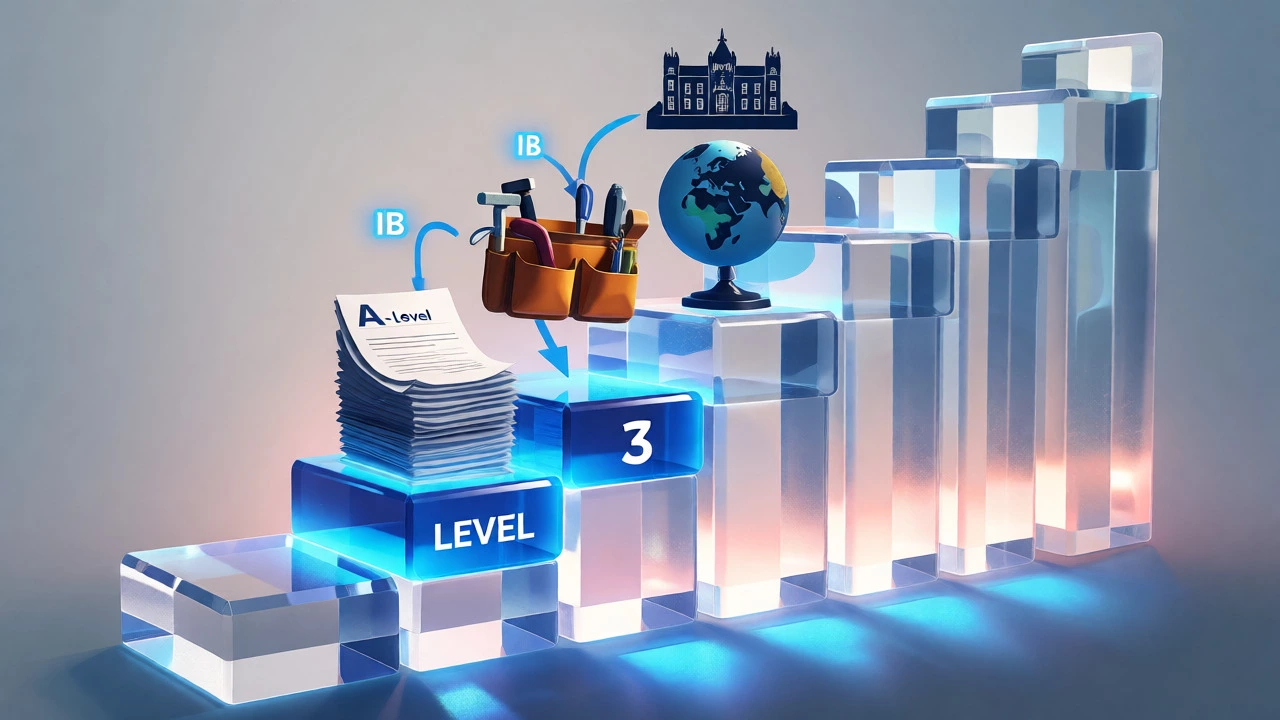
To compare apples with apples, we have to look at the Regulated Qualifications Framework (RQF). This is the national framework that ranks all qualifications in England, Wales, and Northern Ireland by difficulty. A levels sit at Level 3. That’s the key number. Any qualification at Level 3 is theoretically "equivalent" in terms of academic standing, though not necessarily in subject-specific preparation.
Think of Level 3 as the threshold for higher education entry. Below it, you’re in GCSE territory (Level 2). Above it, you’re looking at Foundation Degrees (Level 4-5) or Bachelor’s degrees (Level 6). When people ask "what’s equivalent to an A level," they are almost always asking about other Level 3 qualifications. But here’s the catch: not all Level 3 quals are created equal in the eyes of every institution. A Level 3 BTEC in Health and Social Care is treated very differently from a Level 3 A level in Chemistry when applying for medicine. Context matters more than just the level number.
The Vocational Heavyweights: BTECs and Cambridge Technicals
If you’ve opted for a vocational route, you’re likely holding a BTEC National Extended Diploma or a similar award from Pearson Edexcel, or perhaps a Cambridge Technical Level 3 qualification. These are the most common direct alternatives to traditional A levels.
A full BTEC National Extended Diploma is generally considered equivalent to three A levels. Why? Because it carries the same UCAS tariff points. An A* in an A level is worth 56 points. A Distinction* in a BTEC unit contributes similarly, and a full D*D*D* grade profile matches the points of AAA at A level. Universities use these points as a currency to compare different types of achievements.
However, don’t assume this equivalence is universal. Some highly theoretical courses, like Pure Mathematics or Physics, might prefer the linear assessment style of A levels over the coursework-heavy nature of BTECs. Conversely, for creative arts, business studies, or nursing, a BTEC is often preferred because it demonstrates practical application skills that A levels don’t test. Always check the specific course requirements. If the website says "BTEC accepted," it usually means they accept the full Extended Diploma as a substitute for three A levels.
| Qualification Grade | A Level Points | BTEC Extended Diploma Equivalent |
|---|---|---|
| Top Grade | A* = 56 points | D* = 112 points (for whole diploma) |
| High Grade | A = 48 points | D = 96 points (approx per third) |
| Mid Grade | B = 40 points | M = 80 points (approx per third) |
The Global Standard: International Baccalaureate (IB)
The International Baccalaureate Diploma Programme is arguably the closest peer to A levels in terms of global recognition and academic prestige. While A levels allow you to specialize early-dropping subjects after GCSE-the IB forces breadth. You must take six subjects across different disciplines, plus complete a Theory of Knowledge essay and a Creativity, Activity, Service (CAS) project.
Is it harder? Many students think so, simply because of the workload management required. But in terms of university entry, it’s a direct swap. Most UK universities publish clear conversion tables. For example, a score of 38 in the IB is often equated to AAA at A level. A score of 32 might align with BBC. The advantage of the IB is its international portability. If you’re applying to universities outside the UK, particularly in the US or Europe, the IB is often understood more easily than the UK-specific A level structure.
One major difference lies in assessment. A levels are largely exam-based at the end of two years. The IB mixes internal assessments (IA) with final exams. If you’re great at consistent, ongoing work but panic during high-stakes finals, the IB might suit you better. If you prefer focusing deeply on three subjects rather than juggling six, stick with A levels.
The Mature Student Route: Access to HE Diplomas
Not everyone takes A levels at age 16. Maybe you left school early, worked for ten years, and now want to study law or psychology. You don’t go back and do A levels. You take an Access to Higher Education Diploma in a relevant subject.
This is a Level 3 qualification designed specifically for adults returning to education. It’s intensive, usually completed in one year, and focuses heavily on study skills and subject-specific knowledge relevant to the degree you want. Universities love Access diplomas for mature students because they prove you can handle university-level workloads right now, not just remember facts from five years ago.
Crucially, an Access to HE Diploma is typically accepted as equivalent to three A levels for entry into related degree programs. If you have an Access Diploma in Science with Merit/Distinction grades, you can apply to science degrees that normally require AAA at A level. The caveat? It’s subject-specific. An Access in Humanities won’t help you get into Engineering. Check the "Progression Routes" section of your college’s Access course description before enrolling.
Vocational Alternatives: NVQs and Apprenticeships
What about NVQs (National Vocational Qualifications)? Here things get tricky. An NVQ Level 3 is technically at the same level as an A level, but it is competence-based, not knowledge-based. You prove you can do the job, not that you can write an essay about the theory.
Most universities will not accept a standalone NVQ Level 3 as a direct equivalent to A levels for academic entry. They lack the theoretical underpinning needed for degree-level study. However, if you combine an NVQ Level 3 with a technical certificate or a foundation degree, you can bridge the gap. Similarly, completing a Higher Apprenticeship (Level 4 or 5) puts you above A level standard, allowing you to enter directly into the second year of some degrees or skip the first year entirely depending on the university’s policy.
Employers, however, view them differently. In trades like plumbing, electrical engineering, or childcare, an NVQ Level 3 is often more valuable than three A levels. It shows immediate employability. So, "equivalence" depends entirely on who you’re asking. For a PhD program? No. For a site manager role? Yes, absolutely.

Scottish Highers and Advanced Highers
If you’re studying in Scotland, the terminology changes. Scottish Highers are taken at S5/S6. Are they equivalent to A levels? Not exactly. A single Higher is roughly equivalent to half an A level in terms of content depth. Therefore, universities typically require three Highers at Grade A/B to match the entry requirements of two or three A levels.
For competitive courses, Scottish students often take Advanced Highers which cover A level syllabus content. One Advanced Higher is broadly considered equivalent to one A level. If you’re applying from Scotland to English universities, expect to be asked for more Highers to compensate for the shorter teaching time per subject. Three As at Higher is often the baseline for good universities, whereas A levels might only need two Bs.
How to Decide Which Path Fits You
Choosing between these equivalents isn’t just about prestige; it’s about learning style and future goals. Ask yourself these questions:
- Do I know exactly what I want to study? If yes, A levels let you specialize. If no, the IB keeps doors open across sciences, humanities, and arts.
- Am I good at exams or continuous assessment? A levels are 90%+ final exams. BTECs are 50%+ coursework. Know your stress triggers.
- Do I want to work immediately after this stage? If you want to leave school at 18 with a job, a BTEC or apprenticeship provides better practical skills than A levels.
- Am I returning to education later in life? Don’t waste time on A levels. Take an Access to HE Diploma. It’s faster, cheaper, and tailored for adult learners.
Remember, the "best" qualification is the one that gets you into your desired destination while playing to your strengths. A brilliant student who hates essays might fail A levels but thrive with a Distinction in a BTEC Business Management course. The label doesn’t define your intelligence; the outcome does.
Frequently Asked Questions
Is a BTEC easier than an A level?
Not necessarily. BTECs are assessed through continuous coursework and projects, which requires strong organizational skills and consistency. A levels rely on high-pressure final exams. Students who struggle with exam anxiety may find BTECs less stressful, but achieving a Distinction* requires a very high standard of practical and theoretical understanding throughout the two-year course.
Can I get into Oxford or Cambridge with a BTEC?
Yes, but it depends on the course. Courses like Medicine, Law, or Natural Sciences traditionally favor A levels due to their theoretical depth. However, colleges are increasingly accepting BTECs for subjects like Engineering, Business, or Arts. You would typically need top grades (Distinction*) and excellent references. Always check the specific college’s admissions policy, as they have autonomy over entry requirements.
What is the IB equivalent of AAA at A level?
While conversions vary slightly by university, a total score of 38-40 in the International Baccalaureate is generally considered equivalent to AAA at A level. A score of 32-34 is often aligned with BBC. The IB also awards points for the core components (TOK and Extended Essay), which can boost your overall tariff points compared to standard A levels.
Does an Access to HE Diploma count as three A levels?
For university entry, yes. An Access to HE Diploma is designed to prepare mature students for degree-level study and is widely accepted as equivalent to three A levels in terms of UCAS points and academic readiness. However, it is subject-specific, so you must choose a diploma that aligns with your intended degree subject.
Are T Levels equivalent to A levels?
Yes, T Levels are new technical qualifications introduced in England. One T Level is equivalent to three A levels in terms of size and value. They include an industry placement of at least 45 days. Universities are beginning to recognize them, especially for technical and vocational degree courses, but traditional A levels remain the safer bet for purely academic subjects.